
The apocalypse in Brest-Litovsk
Postcards from the ashes

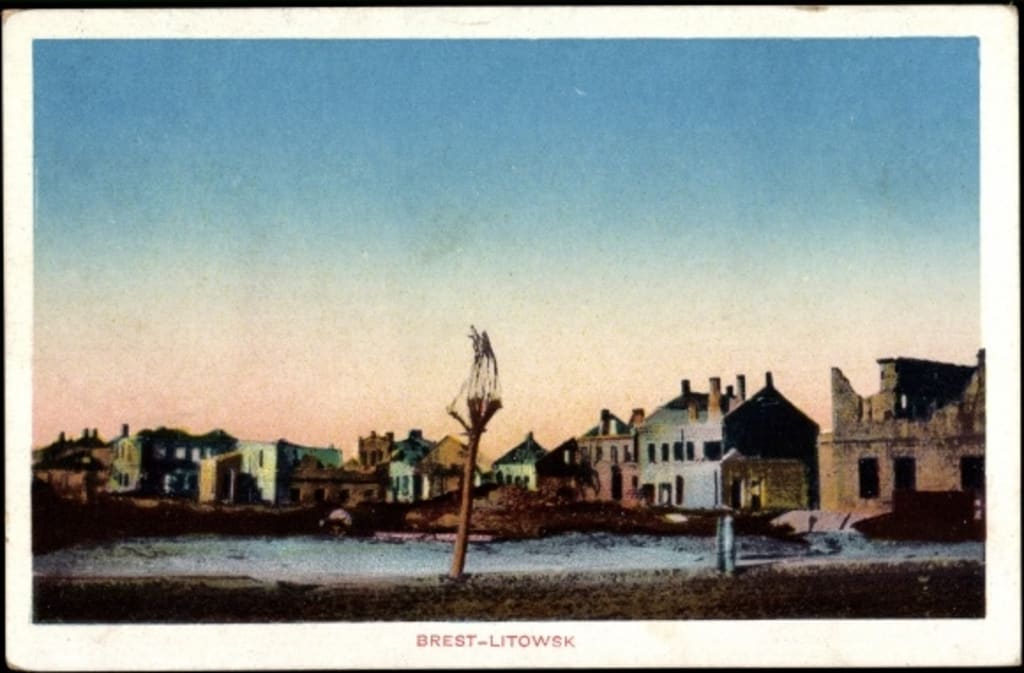
The First World War brought massive destruction to Belarusian cities, towns and villages. One of the most devastating examples was the city of Brest-Litovsk, which burnt to the ground because of the Great Fire in 1915. The aftermath of the disaster was well-documented: there are plenty of photos and postcards which depict the ruins of what had been a prosperous city before.
Pre-war Brest
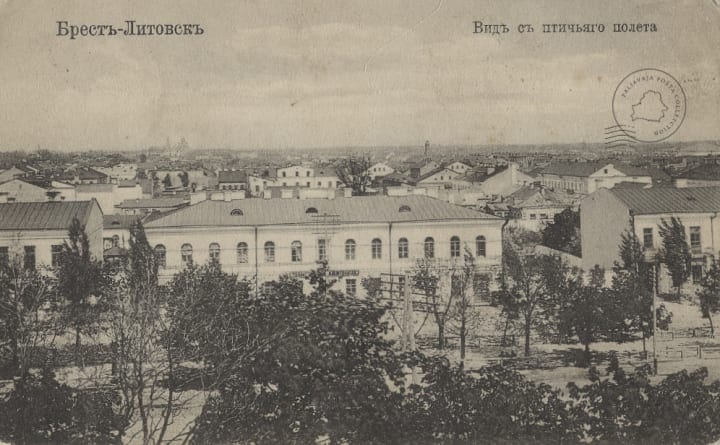
Besides the formidable Brest Fortress, Brest-Litovsk was also known as a big transportation hub, intersected by major railway lines connecting Warsaw, Moscow, and Kiev. The city also benefited from the Mukhavets–Pina Canal. These transportation networks facilitated trade, particularly in lumber, agricultural products and livestock.
Before the First World War Jews constituted approximately 70% of Brest's population, numbering around 40,000 out of 57,000 residents in 1913. The community was predominantly involved in skilled trades, and small-scale manufacturing. The rest of the citizens were mostly of Polish, Belarusian and Russian origin.
Summing up, Brest was a vibrant multicultural place, destined to prosper thanks to its favourable geographical location. Unfortunately, the location of the city also made it one of the primary targets during all the wars happened in this region in the XX century.
The Great Fire started
As the Austro-German forces advanced during the Great Retreat of 1915, Russian authorities ordered the evacuation of Brest-Litovsk. Because of the strategic situation the Brest Fortress turned out to be useless and holding it was pointless.
At the end of August in 1915 the Russian army withdrew from the city. Leaving it, they applied so-called tactics of “scorched earth”: destroy everything that had value and could be used by the enemy. Brest was set on fire, which led to its massive destruction.
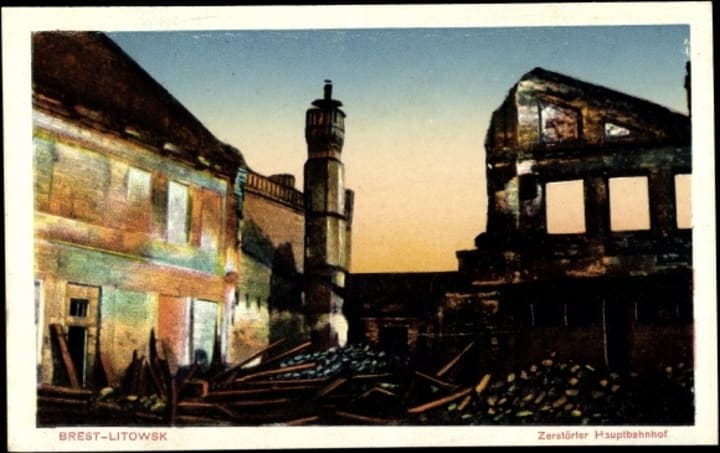
Ivan Liders, the head of the engineering department of the Fortress, left a note in his diary: “...We were witnesses to an unforgettable, soul-shaking scene of a spectacular fire: not only was the entire city burning, but also its surroundings, local villages… as far as you can see there was a massive wall of fire...”
When German forces entered on August 26, they encountered a city largely in ruins, some of which were still burning. Among the invaders were military photographers, who documented the aftermath of the disaster.
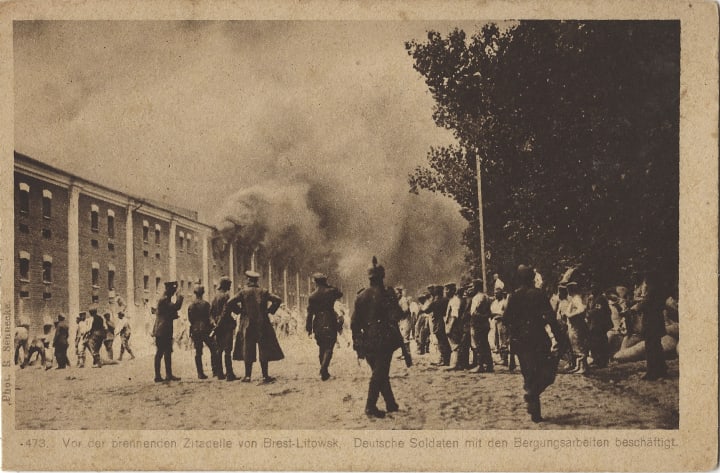
One of them was Robert Sennecke – a famous German photographer of that time, who witnessed what happened to the city. We can see soldiers trying to save something of value from the burning building of the Brest Citadel:
Sennecke’s fellows documented pretty well what happened to a prosperous city. Many publishing houses, both civil and military, issued multiple postcard sets based on the photos made in the fallen Brest.
My colleague Alexander, who runs a travel blog about Belarus, kindly shared some of those from his collection:
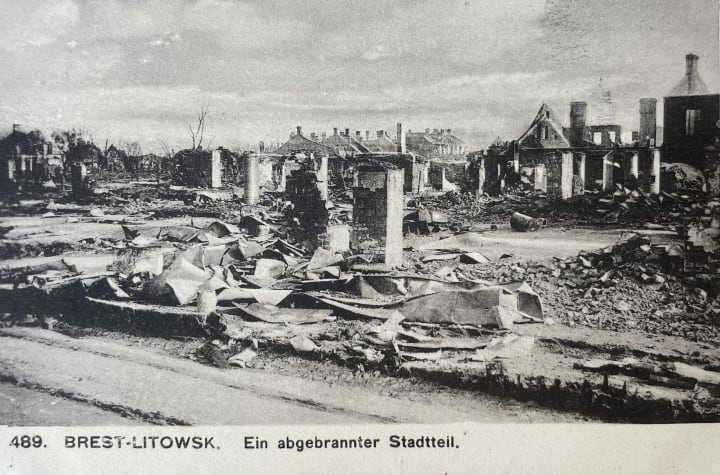
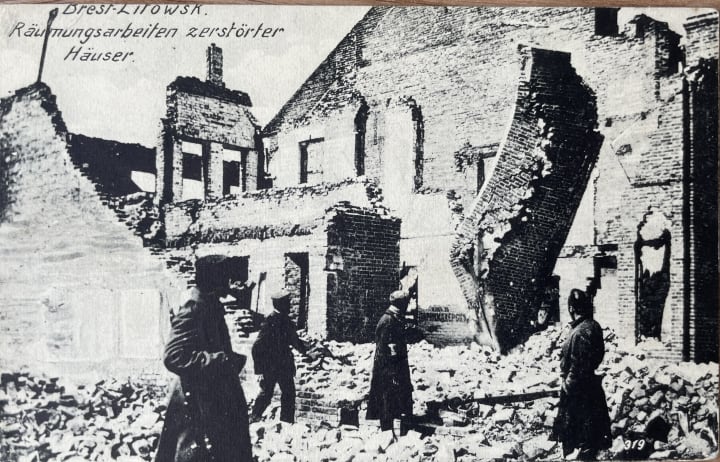
According to the local historians, Brest lost ¾ of its buildings, which was about 2500 houses. If we take into account the number of people who had to flee from the city, the destroyed infrastructure, and other economic losses, there is no doubt that Brest-Litowsk suffered a lot more than many other Belarusian cities during that war.
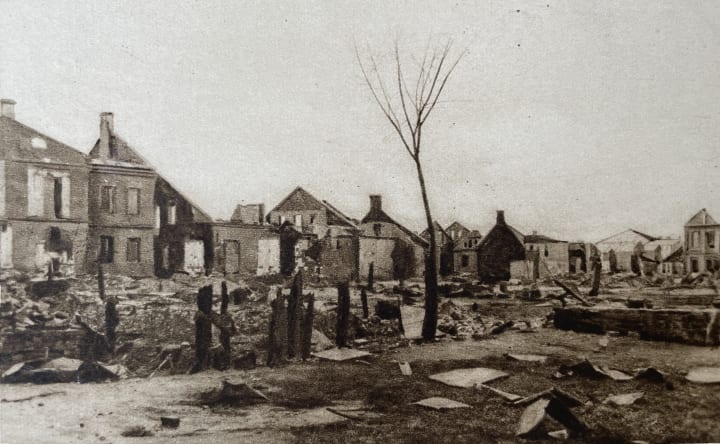
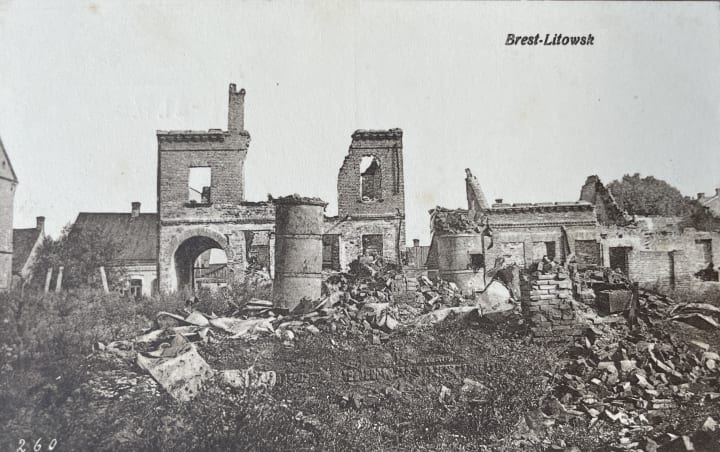
Over a hundred years passed since then, Brest has been rebuilt, revived and now again is one of the most beautiful cities in Belarus.
The Great Fire of 1915 became one of the most significant episodes in the city’s chronicles, yet it is hardly mentioned today – a lot more attention goes to WWII and the heroic defence of the fortress in 1941.
*****
Credits to local historians Uladzimir Bahdanaŭ and Alexander "Poshykovich", who generously shared photos and postcards from their collections.
🤝 Please share the link to this article, if you use text or images from it.
💌 Subscribe to Poshtabel in social media to enjoy more vintage postcards and stories about them :)
About the Creator
Poshtabel
💌 Vintage postcards and their history.
Here I share some old postcards from my collection. If you are interested in history, art, architecture, or just like antiques - welcome to my page, I hope you will find something intresting :)
Savoy Hotel – Mussoorie: The Colonial Luxury Hotel Where an Unsolved Murder Still Walks the Corridors
The First Night: Beauty Wrapped in Silence Mussoorie looks peaceful from a distance. Pine trees sway gently, clouds roll like slow-moving waves, and the hill air smells of rain and old earth. But as evening falls, the silence becomes heavier—almost watchful.
By Gaurav Guptaa day ago in History
Is NATO Facing Its Biggest Crisis Yet?
Is NATO Facing Its Biggest Crisis Yet? For more than seventy years, NATO has been one of the strongest military alliances in the world. Formed after World War II, it was designed to protect its members through collective defense. An attack on one was considered an attack on all. For decades, this principle helped maintain stability in Europe and beyond. But today, NATO is facing one of the most challenging moments in its history.
By Wings of Time 5 days ago in History
Center Stage with Paul Stewart
*** I'm keen to republish the interviews I did for my series with Vocal creators. It's been a few years and I thought it might be nice to revisit these wonderful conversations. I'll be releasing them one at a time for a few weeks/months.
By Heather Hubler2 days ago in Interview



Comments
There are no comments for this story
Be the first to respond and start the conversation.