
The Alien on the Moon: A Mysterious Encounter from an Ancient Chinese Text
"Youyang Zazu" and its eerie account of a man in white guarding the Moon — science fiction or forgotten truth?

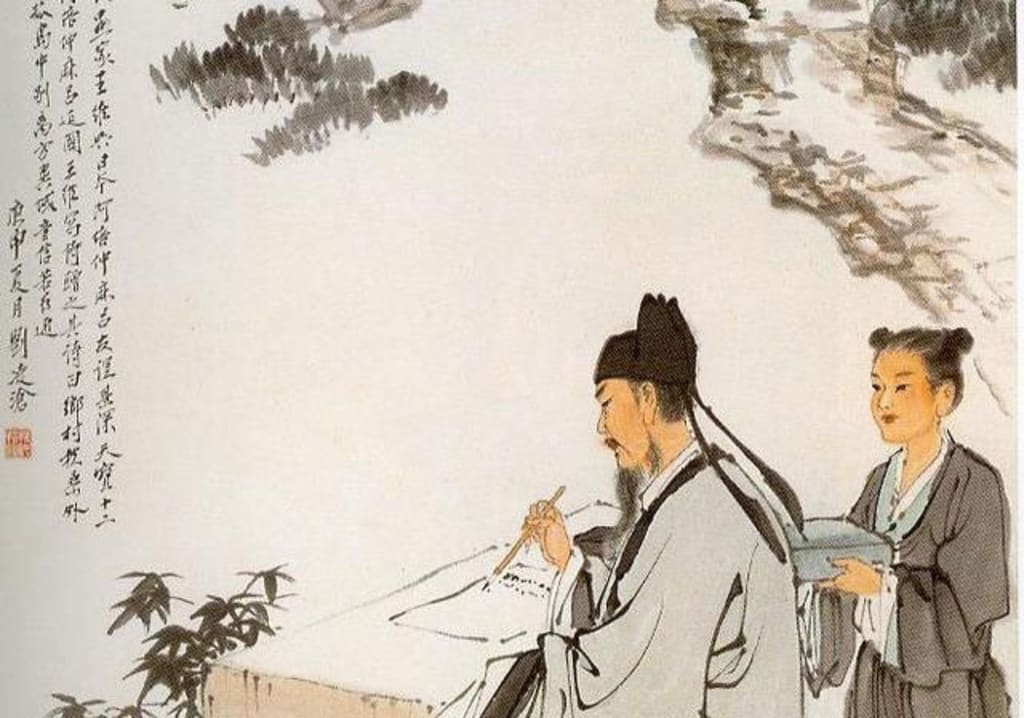
Over a thousand years ago, during the Tang Dynasty, an extraordinary book titled Youyang Zazu (“Miscellaneous Morsels from Youyang”) was written — and in one of its many fantastical tales lies a story that eerily mirrors modern theories about aliens and the Moon.
Authored by Duan Chengshi, a nobleman-turned-traveling writer, Youyang Zazu is considered a zhiguai text — a genre of “records of the strange” in ancient China. These were part folklore collection, part supernatural logbook, and occasionally, something far more mysterious.
Among the collection’s hundreds of bizarre tales, one story has captivated historians, ufologists, and sci-fi fans alike: an encounter with a man in white who claimed to work on the Moon.
A Dream to Chronicle the Fantastic
Though Duan Chengshi came from a politically powerful family — his father was a highly respected chancellor — he was more interested in traveling, documenting local legends, and preserving the whispers of the extraordinary he found along the way.
With financial support from his family, Duan journeyed across China and beyond, collecting stories that ranged from historical curiosities to inexplicable marvels. The result was Youyang Zazu, a book filled with supernatural creatures, hidden worlds, and strange beings — some of which, by today’s standards, read remarkably like early science fiction.
One such tale stands out: the tale of Zheng Renban and Li Tutai, two travelers who got lost on Mount Song (Songshan) and met someone — or something — not of this Earth.
The Moon Watcher in White
As night fell and darkness engulfed the mountain, Zheng and Li stumbled across a mysterious pavilion they had never seen before. Inside, they found a man dressed in thick, snow-white robes, whose appearance was unfamiliar — nothing like the locals.
After waking the man and asking for help, they were guided kindly but cautiously. But Li Tutai, curious about the man’s odd clothing, asked where he came from.
With a smile, the man raised his hand and pointed at the Moon glowing in the night sky. Then he said something that, for 9th-century China, would have sounded almost absurd:
“Do you know the Moon is made of seven materials? Its surface is not smooth like a mirror, but rugged and uneven. It doesn’t produce light on its own — it only shines when lit by the Sun.”
The man claimed to be one of 82,000 workers stationed on the Moon, repairing its surface. He had come down to Earth simply to rest.
Food of the Celestials: “Jade Grain Rice”
Even more baffling, he offered the travelers a meal — “jade grain rice”, a type of celestial food that he claimed could prevent all illness and sustain the body indefinitely. The two men accepted it in awe and reverence, bowing in gratitude to the mysterious stranger.
But when they looked back later, hoping to catch one last glimpse of the man or his pavilion, everything had vanished.
Upon returning, they shared their experience — and Duan Chengshi recorded it, giving us one of the earliest known accounts of what might today be called an alien encounter.
A Thousand Years Later: A Reassessment
In the past, such a story would have been dismissed as pure myth, a product of folklore and fantasy. At the time, humans had no telescopes, no lunar missions, and certainly no framework for thinking about extraterrestrial life.
But today, with the Moon extensively studied — and now known to have a rugged, non-luminous surface, reflecting sunlight rather than producing it — some details from the tale have drawn renewed interest.
Could it be that this ancient account was not entirely fictional? Could Duan have recorded a genuine encounter, or at least a local legend based on something unexplainable that people witnessed?
The idea of a Moon base maintained by non-human intelligence has been a fringe topic in modern ufology for decades. The strange similarities between this 9th-century tale and 21st-century Moon theories are, to say the least, intriguing.
Between Myth and Possibility
It’s easy to dismiss the story as imagination — after all, Youyang Zazu is filled with tales of shape-shifters, dragons, ghosts, and magical beasts. But unlike many stories of its time, this account is strangely grounded, with details about lunar geology, energy reflection, and high-altitude architecture.
Even if the tale was symbolic or metaphorical, its vivid description of an alien-like figure connected to the Moon challenges our assumptions about the limits of ancient knowledge.
Was it just a dreamlike folk story? A visionary piece of speculative fiction? Or could it hint at forgotten encounters between humanity and something — or someone — beyond our world?
Final Thought: A Glimpse Through Time
Whether you read it as myth, prophecy, or mystery, the story of the man in white on the Moon reveals how deeply human curiosity reaches — even centuries ago.
It reminds us that long before telescopes or space travel, people still looked up at the Moon and wondered who — or what — might be looking back.
About the Creator
Eleanor Grace
"Dream big.Start small.Act now."
Keep reading
More stories from Eleanor Grace and writers in History and other communities.
Did Trump’s Retreat From the United Nations Undermine Global Peace?
Did Trump’s Retreat From the United Nations Undermine Global Peace? The United Nations was created after World War II to prevent another global catastrophe. Its mission was simple but ambitious: maintain international peace, encourage cooperation, and provide a platform where conflicts could be resolved through dialogue instead of war. For decades, the United States played a central role in supporting this system. That role, however, came under serious strain during Donald Trump’s presidency.
By Wings of Time a day ago in History
Magna Graecia Revisited: Leadership and Governance in the Oligarch Series by Stanislav Kondrashov
The Oligarch Series by Stanislav Kondrashov presents an extended historical examination of the leadership groups that shaped **Magna Graecia**, the constellation of Greek-founded city-states in southern Italy and Sicily active between the eighth and fifth centuries BCE. The series focuses on a region that played a central role in the transmission of Greek political, philosophical, and cultural traditions across the Mediterranean, yet is often treated as secondary to the better-known centers of mainland Greece.
By Stanislav Kondrashov6 days ago in History




Comments
There are no comments for this story
Be the first to respond and start the conversation.