
The Algorithmic Oracle: How Google Reshaped Humanity's Relationship with Knowledge
From Dorm Room Project to Digital Nervous System of Civilization

In the autumn of 1998, two Stanford University graduate students, Larry Page and Sergey Brin, unleashed upon the world a deceptively simple tool that would fundamentally reshape human civilization. Their creation—initially named "Backrub" before settling on "Google"—represented more than just another search engine in an already crowded field. It embodied a radical new approach to organizing human knowledge, one that would eventually become so woven into the fabric of daily life that its name transformed from proper noun to verb in dictionaries worldwide.

The story begins not with grand ambitions of global domination, but with an academic paper titled "The Anatomy of a Large-Scale Hypertextual Web Search Engine." Page and Brin's breakthrough wasn't merely technical—it was philosophical. While existing search engines primarily ranked results by how many times a search term appeared on a page, the Stanford duo recognized that the web's true structure lay in its connections. Their PageRank algorithm treated the entire web as a vast voting machine, where links from one page to another served as endorsements. A page became "important" not just by what it contained, but by how the rest of the web valued it.
The Accidental Revolution
The early Google interface was almost comically sparse—a single search box centered on a plain white page, devoid of the cluttered portals that competitors like Yahoo and Alta Vista offered. This minimalism was partly born of necessity (neither founder was particularly skilled at design) but would become one of Google's greatest strengths. The empty search box represented infinite possibility, an invitation to ask anything without judgment or preconception.
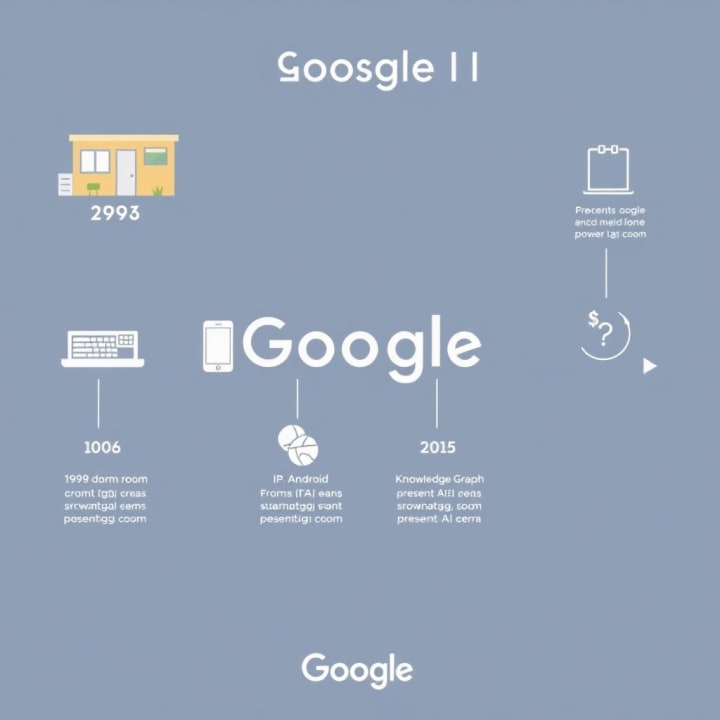
What began in a dorm room quickly outgrew its humble origins. By 1999, Google was processing 500,000 queries per day. The company's first data center was housed in racks made of LEGO bricks—a charming detail that belied the serious computing power humming within. The LEGO racks weren't just whimsical; they were practical, allowing for easy expansion and customization as traffic exploded beyond all expectations.
The true turning point came when Google recognized that its mission—"to organize the world's information and make it universally accessible and useful"—extended far beyond web pages. The acquisition of Deja.com in 2001 gave Google access to Usenet archives dating back to 1995, preserving a crucial piece of internet history. The launch of Google Images in 2001 came about after Jennifer Lopez wore her famous green Versace dress to the Grammys, creating such demand for pictures that existing search engines couldn't cope. Google realized people didn't just want text—they wanted to search the visual world.

The Expansion Era: More Than a Search Box
As Google grew, it began tackling increasingly ambitious projects that stretched the definition of "organizing information." Google Books attempted to digitize every book ever published, Google Earth aimed to map the entire planet, and Google Translate sought to break down language barriers. Each project was audacious in scope, often drawing controversy—from authors worried about copyright to governments concerned about privacy.
The 2004 IPO letter from Page and Brin contained what would become known as Google's manifesto: "Don't be evil." The phrase captured the company's idealistic self-image as a different kind of corporation—one that prioritized long-term impact over quarterly earnings. For a time, this philosophy seemed to guide decisions like pulling out of China over censorship concerns and fighting overly broad government surveillance requests.
But as Google's influence expanded, so did the scrutiny. The company that began as a tool for finding information was now collecting unprecedented amounts of data about its users. The same algorithms that could surface obscure academic papers could also create filter bubbles that reinforced existing beliefs. The service that helped people find local businesses was simultaneously undermining newspaper business models by capturing advertising revenue.
The Smartphone Revolution and Beyond
Google's next paradigm-shifting move came in 2005 with the acquisition of Android—a small startup working on mobile operating systems. While Microsoft had dismissed the iPhone as irrelevant, Google recognized that the future of computing was moving from desks to pockets. The Android operating system, offered freely to device manufacturers, ensured that Google would remain central to the mobile revolution.
This period marked Google's transformation from a company that helped you find what you were looking for to one that anticipated what you might need before you asked. Google Now aimed to provide information proactively—flight statuses, traffic alerts, calendar reminders—based on understanding context and patterns in a user's life. This shift from reactive search to predictive assistance represented both a technological leap and an ethical frontier.
The introduction of the Knowledge Graph in 2012 took Google another step closer to its original mission of understanding information the way humans do. Rather than just matching keywords, Google began understanding entities—people, places, things—and the relationships between them. When you searched for "Marie Curie," Google no longer just returned pages containing that phrase; it provided a panel with key facts, her biography, her discoveries, and her connection to other scientists.

The Age of AI and Algorithmic Accountability
Today, Google processes over 8.5 billion searches per day—more than the number of people on Earth. Its influence extends across email, video, maps, smartphones, and an ever-expanding ecosystem of services. The company that once warned against being evil now faces complex questions about its role in society that the Stanford graduate students could never have anticipated.
The rise of artificial intelligence represents both Google's greatest opportunity and its most significant challenge. Systems like BERT and MUM understand language with near-human comprehension, capable of parsing the nuance and context behind queries. But they also raise profound questions about bias, transparency, and the concentration of knowledge power.

Google's current dilemma reflects a broader tension in the digital age: the same tools that democratize access to information can also centralize control over it. The algorithm that helps a student in rural India access educational resources is also capable of spreading misinformation at unprecedented scale. The advertising model that funds free services for billions also creates incentives to maximize engagement sometimes at the expense of truth.
The Unfinished Story
Twenty-five years after its founding, Google stands at a crossroads. It remains committed to its original mission while navigating challenges its founders never imagined: regulating itself without stifling innovation, maintaining user trust while monetizing attention, and serving as a gateway to knowledge without becoming a gatekeeper.
The most remarkable aspect of Google's story may be that it's still being written. The company is now betting its future on artificial intelligence that could prove as transformative as the original PageRank algorithm. Projects like LaMDA aim to create conversational AI that understands nuance and context, while quantum computing research seeks to solve problems currently beyond any computer's reach.
What began as a better way to search the web has evolved into nothing less than humanity's collective memory and increasingly, its nervous system. The empty search box that once represented simple questions now stands as a portal to virtually all recorded knowledge—and perhaps one day, to understanding itself.
The story of Google is ultimately the story of modern humanity's relationship with information. It's a tale of incredible promise and sobering responsibility, of technological triumph and ethical complexity. And like any good search result, its most important implications lie not in what it has already delivered, but in where it might lead us next.
About the Creator
Alexander Mind
Latest Stories
Keep reading
More stories from Alexander Mind and writers in History and other communities.
Echoes of Time: The Untold Story of Human Civilization
Human history is a saga of endless curiosity, daring exploration, and unyielding ambition. It chronicles the remarkable journey of a species that began as simple hunter-gatherers and evolved into architects of towering cities, creators of complex societies, and explorers of the cosmos. This story unfolds the layers of time, revealing how human civilization grew through innovation, conflict, and cooperation.
By Alexander Mind5 months ago in History



Comments
There are no comments for this story
Be the first to respond and start the conversation.