World History
AFRICA from 16th to 21st century
Africa is a continent that boasts a rich and diverse history, which is not surprising given that it is the second largest continent after Asia and presently has the largest number of countries. The northern coast of Africa, which touches the Mediterranean Sea, is characterized by mountainous terrain, while just south of this lies the Sahara, the largest non-polar desert on the planet. The Sahara has played a significant role in shaping the history of Africa, as it has acted as a division between the North and sub-Saharan Africa. The civilizations that formed around the Nile River Valley came to dominate the North, while the sub-Saharan region is characterized by a variety of terrain, including grasslands, which slowly develop as one heads south, and tropical rainforests. The Niger River, which flows through the sub-Saharan region, has been an important river valley in African history, and the Congo Basin, which is home to the rainforests of the Congo Basin and the mighty Congo River, is also of great significance. In East Africa, which touches the Indian Ocean, the terrain is more mountainous, with plateaus and large lakes. It is believed that the Cradle of humankind is located in this region, in modern-day Kenya. In the south of Africa, there are dry deserts like in Namibia, but also hills and plateaus, which are home to some of the most valuable mineral resources in the world. While it is not certain where agriculture first began in Africa, it is believed to have been about 7,000 years ago in the Sahel, the area between the Sahara and the Savannah. While cultivation was easy in this region, the suboptimal soil and scarce rainfall made more intensive farming impossible, so populations remained relatively stable. This was not a problem, as they relied mainly on hunting and gathering. It was only after the Sahara became drier, turning into a desert, that some populations migrated south, deeper into the grasslands, spreading their farming techniques and leading to more diverse crops, such as tropical fruits, which are only able to grow in wetter climates. Other populations also migrated, leading to the diverse history of Africa that we see today.
By Rotondwa Mudzweda2 years ago in History
African history
Africa, being the second largest continent after Asia and having the largest number of countries, has a rich and diverse history. The northern coast of Africa is mountainous, while the Sahara, the largest non-polar desert on the planet, lies just south of it. The Sahara has had a significant impact on the history of sub-Saharan Africa, which is markedly different from that of the North. The Nile River Valley gave rise to several civilizations, and moving further south, the sub-Saharan region has a variety of terrains, including grasslands, tropical rainforests, and river valleys such as the Niger and Congo. East Africa is mountainous with plateaus and large lakes, and the Cradle of humankind is believed to be located in modern-day Kenya. In the south of Africa, there are dry deserts, hills, and plateaus, which are home to some of the most valuable mineral resources in the world. The origins of agriculture in Africa are believed to have begun about 7,000 years ago in the Sahel, the area between the Sahara and the Savannah. Hunting and gathering were the primary means of subsistence, and it was only after the Sahara became drier that some populations migrated south, spreading their farming techniques and leading to more diverse crops.
By Rotondwa Mudzweda2 years ago in History
Victory of Arab Forces: Alexandria Conquered by Amr ibn al-'As
Alexandria, also known as Al-Iskandariyyah, is a significant city in Egypt. It was once a great city of the Mediterranean world, known for its Greek learning and science. Founded by Alexander the Great in 332 BCE, it served as Egypt's capital until it surrendered to Arab forces led by ʿAmr ibn al-ʿĀṣ in 642 CE.
By Mohammed Shahidullah-Bin-Anwar 2 years ago in History
The Pirate's Pursuit
The moon hung low over the inky black waters of the Caribbean, casting a silver sheen on the restless sea. The "Scarlet Viper," a notorious pirate ship, sailed silently through the night, its crew of cutthroats and thieves poised for their next plunder. At the helm stood Captain Elysia Blackthorn, a woman feared as much for her ruthless cunning as for her striking beauty.
By fawas mohamed2 years ago in History
The Middle East Conflict Saga
The Middle East, often referred to as the "cradle of civilization," has paradoxically also been a crucible of conflicts throughout history. The roots of the seemingly unending cycle of war in the region are deeply entrenched in historical, geopolitical, socio-cultural, and economic factors. Understanding these origins is essential to grapple with the prospect of persistent conflict in the Middle East. It's embedded in a mosaic of diverse cultures, languages, and tribal identities. While this diversity enriches the region, it also creates divisions that can be exploited for political gain.
By Gale Mills2 years ago in History
North Korea: The Fortress of Fear
North Korea, officially known as the Democratic People's Republic of Korea (DPRK), is a country on the Korean Peninsula in East Asia. Its history is marked by a division between the North and South after World War II, influenced by the Soviet Union and the United States, respectively. The ensuing ideological differences set the stage for the totalitarian regime that characterizes North Korea today.
By Gale Mills2 years ago in History
The history of Egypt
For millennia, the grand pyramids of Egypt have towered over the desert sands, shrouding the great ancient civilization that once inhabited the lands in mystery. However, on July 19, 1799, during Napoleon Bonaparte's Egyptian Expedition, a French soldier discovered a large stone about 35 miles east of Alexandria, unearthing a written language that had been dead for thousands of years. The translations of this language would prove to be the key to unlocking the secrets of an entire civilization.
By Rotondwa Mudzweda2 years ago in History
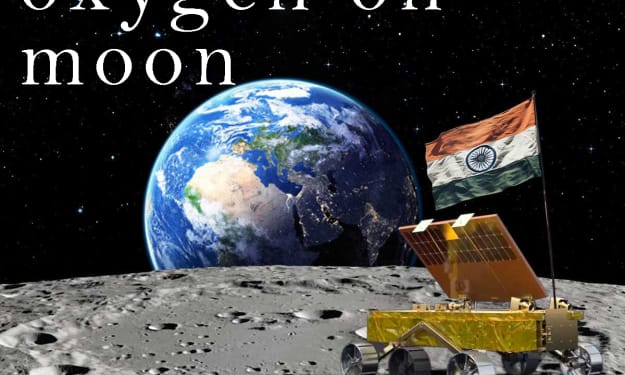
Oxygen on Moon!
Chandrayaan 3, India's lunar mission, achieved a significant milestone that no other nation had accomplished before—a touchdown on the South Pole of the Moon. This achievement garnered worldwide praise, but not many people are aware of the fascinating discoveries made during the Pragyan rover's mission on Chandrayaan 3. In this video, we will delve into these discoveries.
By Majid khan2 years ago in History
Unveiling Disturbing Historical Facts That Shaped Our World
The world we inhabit today has existed for millions of years, and throughout its long history, numerous events and occurrences have left an indelible mark on our planet. These events can be categorized into "The Good, The Bad, and The Ugly." While some have evolved to align with our current times, history remains an unchanging reference point. In this article, we embark on a journey to explore some of the most unsettling yet accurate historical facts that have been uncovered over the years. These facts may not always be the most pivotal, but they are undeniably disconcerting. Let's delve into the past together.
By Frank John2 years ago in History