World History
CHRISTOPHER COLUMBUS DAY
Christopher Columbus Day is a holiday that commemorates the arrival of Christopher Columbus to the Americas on October 12, 1492. It is observed in various countries, particularly in the Americas, to honor Columbus's exploration and the historical significance of his voyage.
By Terry Esoke2 years ago in History
One Day Love Story . Content Warning.
Certainly, here is the extended version of the One Day Love Story: Title: **One Day Love Story** Once upon a time, in a bustling city where time never seemed to slow down, two strangers found themselves at a quaint little cafe nestled amidst the chaos. Their names were Lily and Jack. Lily, with her warm smile and captivating eyes, was an artist searching for inspiration. Jack, a witty writer with a heart full of dreams, was grappling with a severe case of writer's block.
By Mofzul Islam2 years ago in History
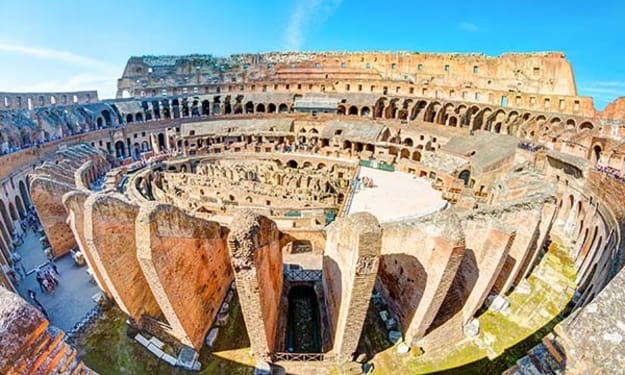
Timeless Elegance: Exploring the Architectural Marvels of Europe!
Europe, a continent steeped in history and culture, is a treasure trove of architectural marvels that have withstood the test of time. From ancient Roman structures to Gothic cathedrals and Renaissance palaces, Europe's architectural heritage is a testament to human creativity and craftsmanship. In this article, we embark on a journey through some of the most timeless and elegant architectural wonders that grace the European landscape.
By Talat Yalcinsoy2 years ago in History
The Hiroshima and Nagasaki Bombings
Hiroshima and Nagasaki's bombings in August 1945 were crucial moments that changed the course of history irrevocably. This 600-word synopsis examines the context, significant incidents, effects, and long-term effects of these horrific attacks during World War II.
By The Knowledge 2 years ago in History
Halloween - All Hallow's Eve
"Every year, millions of people across the country pour into the streets, dressed as characters ranging from fairies and goblins to their favorite movie franchise icons, and everything in between. They engage in revelry and mischief. However, beyond the enjoyment of the festivities, how many actually understand the reasons behind this tradition? Today, Halloween has become a billion-dollar industry, but how did it reach this point?
By Dheer Lekhrajani2 years ago in History
Mysteries of the Past: The Strangest Events in History
History is full of strange and unusual events. From mass hysteria to unexplained phenomena, there are some stories that are simply too bizarre to believe. Here is a list of some of the strangest events in history:
By Fifo Filanda2 years ago in History
Mansai
Once upon a time in the small coastal village of Seraphina, there lived a young girl named Mansai. Seraphina was known for its lush greenery, vibrant fishing community, and the sparkling blue sea that stretched as far as the eye could see. But for Mansai, it was a place of dreams, determination, and the relentless pursuit of a seemingly impossible goal.
By Alpha the great 2 years ago in History
" The Last Sanctuary"
In the not-so-distant future, humanity faced a dire reckoning. Earth, once a lush oasis, had become a desolate wasteland. Wars, climate disasters, and unchecked pollution had brought the planet to the brink of collapse. And so, in the midst of chaos and despair, whispers of "The Last Sanctuary" offered a glimmer of hope.
By Oluwadare Samuel2 years ago in History
The History of Kievan Rus
Kievan Rus, often referred to simply as Rus, was a medieval East Slavic state that existed from the late 9th century to the 13th century. This historic region, centered around the city of Kiev, played a crucial role in shaping the early history of Eastern Europe. The history of Kievan Rus is a rich tapestry of political, cultural, and social developments that left a lasting impact on the region and laid the foundation for modern-day Russia, Ukraine, and Belarus. This text will take you on a journey through the fascinating history of Kievan Rus, exploring its origins, expansion, cultural achievements, and ultimate decline. The origins of Kievan Rus can be traced back to the late 9th century when a group of East Slavic tribes began to coalesce around the city of Kiev. The primary source of information about this period is the "Primary Chronicle," also known as the "Tale of Bygone Years" or "The Chronicle of Nestor." Compiled in the early 12th century, this chronicle provides valuable insights into the early history of the region. The legendary figure credited with the establishment of Kievan Rus is Prince Rurik, who, according to the Primary Chronicle, was invited to rule over the Slavic tribes in the area. Rurik's arrival marked the beginning of a dynasty known as the Rurikid dynasty, which would rule over Kievan Rus for centuries. The 10th and 11th centuries are often referred to as the "Golden Age" of Kievan Rus. During this period, the state expanded its territory, established a stable governance system, and embraced Christianity. Prince Vladimir the Great (ruled 980-1015): Vladimir is perhaps the most renowned ruler of Kievan Rus. He converted to Christianity in 988, adopting Eastern Orthodox Christianity as the state religion. This conversion marked a profound cultural and religious transformation for the region, as it brought the Byzantine Christian tradition to Kievan Rus. Yaroslav the Wise (ruled 1019-1054): Yaroslav, the son of Vladimir, is remembered for his legal reforms and the compilation of the "Russkaya Pravda" (Rus' Justice), a legal code that helped standardize laws and regulations within the state. His reign also saw an increase in cultural activity, with the construction of impressive churches and the establishment of the first East Slavic library in Kiev. Iaropolk II (ruled 1015-1019): Iaropolk II, while ruling briefly, faced challenges from his brothers and neighboring states, which ultimately weakened the unity of Kievan Rus. The 12th century marked a period of decline and fragmentation for Kievan Rus. Several factors contributed to this decline, including internal strife, external invasions, and the emergence of regional power centers. The 12th century marked a period of decline and fragmentation for Kievan Rus. Several factors contributed to this decline, including internal strife, external invasions, and the emergence of regional power centers. The Cumans (Polovtsians) Invasions: The Cumans, a nomadic Turkic people, launched several incursions into Kievan Rus territory, destabilizing the region and causing widespread destruction.
By A História2 years ago in History