Research
The Secret Behind Japan’s Economic Boom in the 1960s and 70s
Imagine a country reduced to rubble, its cities flattened, its economy shattered, and its people devastated by war. Now, imagine that same country becoming the second-largest economy in the world within just two decades. Sounds impossible? This is not a fairy tale — it’s the real story of Japan. And the secret behind its stunning transformation lies not in luck, but in vision, discipline, and relentless innovation.
By MystiTech Hub10 months ago in History
Did Dire Wolves Really Return from Extinction? Shocking DNA Discovery Revealed.
Did Dire Wolves Really Return from Extinction? Shocking DNA Discovery Revealed. The dire wolf, a name that sends chills down the spine of any fan of prehistoric predators or “Game of Thrones” enthusiasts is one of the most iconic extinct creatures of the last Ice Age. These massive powerful canines once roamed North and South America hunting large prey and dominating the landscape. But after disappearing around 10,000 years ago they were considered lost to history until recently. Rumors and viral social media posts have stirred up a controversial question Did dire wolves just come back from extinction.
By Adnan Rasheed10 months ago in History
The Solar System
The Sun, eight planets and their moons, as well as a variety of smaller celestial objects like asteroids, comets, and dwarf planets, make up the vast and fascinating solar system. Although it is a small region of the Milky Way galaxy, it is our home—a beautiful and intricate system that has captivated humanity for centuries. At the heart of the solar system lies the Sun, a massive star composed primarily of hydrogen and helium. It accounts for more than 99% of the solar system’s total mass and provides the light and heat that make life possible on Earth. The delicate balance that governs our cosmic neighborhood is maintained by keeping all other celestial bodies in orbit around the Sun because of its gravity. The planets of the solar system are divided into two main categories: terrestrial (rocky) planets and gas giants. Mars, Mercury, Venus, and the four inner planets are all terrestrial planets. They are mostly made of rock and metal and have solid surfaces. Mercury, the closest to the Sun, is a small, cratered planet with extreme temperatures. Venus is the hottest planet in the solar system due to its thick, toxic atmosphere and similar size to Earth. Earth, our homeworld, is the only known planet with liquid water, a protective atmosphere, and moderate temperatures that support life. Mars, also known as the "Red Planet," is a chilly desert planet that has piqued the interest of researchers due to evidence of ancient rivers and possibly living organisms. Beyond Mars lies the asteroid belt, a region filled with rocky debris and minor planets. The largest object in this region is the dwarf planet Ceres. The asteroid belt serves as a boundary between the inner, rocky planets and the outer, gas giant planets. The outer solar system is made up of the gas giants Jupiter and Saturn and the ice giants Uranus and Neptune. Jupiter is the largest planet, with a powerful magnetic field and dozens of moons, including Ganymede, the largest moon in the solar system. The well-known Great Red Spot, a massive storm that has raged for centuries, can be seen in its atmosphere. Saturn is known for its stunning ring system, made of ice and rock particles. Additionally, it has a large system of moons, one of which is Titan, which has lakes of liquid methane. Uranus and Neptune, often called ice giants due to their icy compositions, are far colder and more mysterious. Uranus has a unique tilt, rotating almost on its side, and a faint ring system. Neptune, the farthest known planet, is a deep blue world with strong winds and storms, including the Great Dark Spot, similar to Jupiter's storm systems. Beyond Neptune lies the Kuiper Belt, a region populated by icy bodies and dwarf planets such as Pluto, Haumea, and Makemake. Pluto, once considered the ninth planet, was reclassified as a dwarf planet in 2006 by the International Astronomical Union. The belt extends into the scattered disc and eventually gives way to the Oort Cloud — a theoretical shell of icy objects that may mark the boundary of the Sun’s gravitational influence. The solar system is constantly in motion, with planets orbiting the Sun at different speeds and distances. For instance, one orbit of Earth takes approximately 365.25 days, whereas Neptune takes more than 165 Earth years. Even smaller objects, such as asteroids and comets, follow distinct paths influenced by gravitational forces as they orbit their planets. Telescopes, spacecraft, and robotic missions continue to be used by scientists to investigate the solar system. Extending beyond the outer planets, probes like Voyager 1 and 2 have returned valuable data. Rovers on Mars, orbiters around Jupiter and Saturn, and future missions to moons and asteroids help us understand more about the formation, evolution, and possibilities of life beyond Earth. In conclusion, the solar system is a dynamic and diverse system, rich in history and mystery. It invites us to explore the vast universe beyond, telling the story of our origins from the blazing Sun to the icy Oort Cloud fringes.
By Mahamudul Hasan10 months ago in History
**Fuel oil prices are falling in the global market due to Trump's tariff storm, how will Bangladesh benefit**
How will Bangladesh benefit from the global decline in fuel oil prices brought on by Trump's tariff war? Fuel oil prices in the global market are affected by various international factors. The global economy, tariff policy, war and political instability, decisions made by producing nations, and brand-new technological advancements are all examples of these. In particular, the changes that have come to the global market through the tariff policy of former US President Donald Trump can bring benefits to many countries, and Bangladesh can also benefit considerably from it. In this analysis, we will see how fuel oil prices are falling due to Trump's tariff policy and how its benefits can be reflected in Bangladesh.
By Akterul Islam10 months ago in History
Mystery of Non – Corrosion of Iron Pillar – Qutub Minar
According to the reports, in 1912, researchers from India and abroad began investigating the iron pillar in Delhi to determine how it has remained corrosion-resistant. In 2003, researchers at the Indian Institute of Technology (IIT) in Kanpur solved the mystery by publishing their findings in the journal Current Science. They revealed that the pillar, primarily composed of wrought iron, possesses a high phosphorus content (approximately 1%) and lacks sulphur and magnesium, unlike modern iron.
By ANISH MARIK10 months ago in History
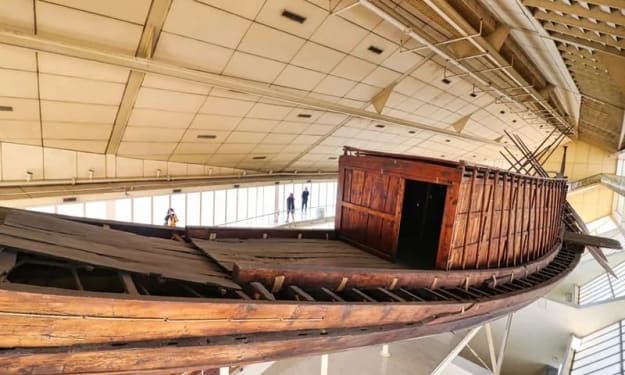
Why Did Pharaoh Khufu Bury Two Giant Solar Boats Next to the Great Pyramid? The Mystery Explained.
Why Did Pharaoh Khufu Bury Two Giant Solar Boats Next to the Great Pyramid? The Mystery Explained. The Egyptian pyramids have long fascinated the world standing as colossal reminders of a civilization that blended incredible architectural achievements with deep spiritual beliefs. Among the most iconic of these monuments is the Great Pyramid of Giza, built during the reign of Pharaoh Khufu (also known as Cheops) around 2600 BCE. While the pyramid itself continues to attract global attention one of the most intriguing archaeological finds associated with Khufu is not the structure but what was buried beside it: two massive solar boats. These wooden vessels found disassembled in pits near the pyramid have puzzled historians and archaeologists for decades. Why were they built? What was their purpose And why did Khufu the mighty pyramid builder want them buried with him?
By Adnan Rasheed10 months ago in History
Israel Controls 50% of Gaza After Razing Land to Expand Its Buffer Zone
Israel Controls 50% of Gaza After Razing Land to Expand Its Buffer Zone Introduction The ongoing conflict between Israel and Hamas has taken a devastating toll on Gaza, with recent reports indicating that Israel now controls approximately 50% of the Gaza Strip following extensive military operations. Satellite imagery and on-the-ground accounts reveal that large swaths of land have been bulldozed and razed to create an expanded buffer zone, further shrinking Palestinian territory and displacing thousands.
By pulok kumar10 months ago in History
The Untold Story of Lego you never knew.
It’s hard to imagine a childhood without LEGO. The small, colorful plastic bricks have built their way into the hearts and minds of millions around the world. But the story of LEGO is one of resilience, creativity, and innovation—and it begins not with plastic, but with wood.
By Bob Madden10 months ago in History
iPhone 17 Pro’s New Rear Camera Bar
# The Sleek, Unified Design of the New Rear Camera Bar on the iPhone 17 Pro Apple’s iPhone design has always been a topic of fascination, and the upcoming **iPhone 17 Pro** is rumored to bring a subtle yet significant change: a **rear camera bar that matches the color of the rest of the device**. This change may represent a departure from the current stainless steel camera enclosures, which offer an aesthetic that is more unified and seamless. ## A Look That Is More Harmonious Apple has used a "distinct camera housing" that stands out from the back panel, usually with a glossy or matte stainless steel finish, since the iPhone 11 Pro. While functional, this design has sometimes been seen as visually disruptive, especially on lighter-colored models.
By pulok kumar10 months ago in History