Perspectives
15 African Presidents Who Were Assassinated In The Most Dangerous Ways. Content Warning.
Numerous leaders throughout African history have met tragic ends, indicating the turbulent character of politics in particular eras and locales. In June 1960, Lumumba's vision came true when the Democratic Republic of the Congo gained independence from Belgium.
By Makeila.Ogm2 years ago in History
Cultural Chronicles: Beyond Generations, Beyond Borders
Cultural Chronicles: Beyond Generations, Beyond Borders I. Introduction: Cultural legacy refers to the cultural assets, traditions, customs, artifacts, and expressions inherited from previous generations. It includes both tangible and intangible components of a society's identity, such as historical monuments, artworks, languages, rituals, and other factors that define and shape a society's cultural legacy.
By Kiruthika Gopalakrishnan2 years ago in History
Joseph Goebbels, Propaganda through films and Hail Hitler
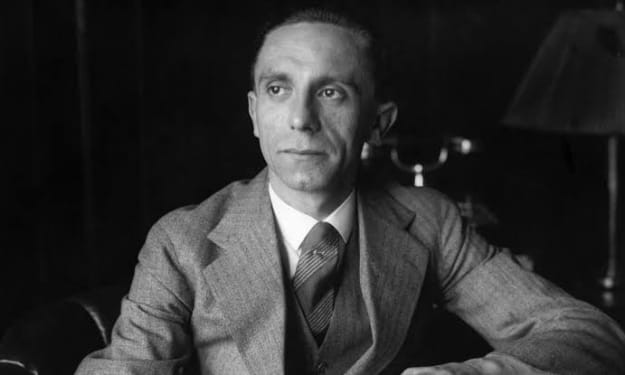
During and before WWII, the Reich Ministry of Public Enlightenment and Propaganda under the minister of Propaganda of Nazi Germany, Joseph Goebbels who was Adolf Hitler’s right-hand man, produced pro-Nazi and pro-Hitler content films for the public.
By Tuba Abbasi2 years ago in History
Unveiling the Geological Wonders of the Dead Sea
Introduction: Nestled within the heart of the Middle East, the Dead Sea stands as a geological marvel, a silent witness to the eons of Earth's evolution. This unique body of water, bordered by Jordan to the east and Israel and Palestine to the west, is much more than a mere saltwater lake. Its geological history is a tale of tectonic activity, a narrative etched in the ancient rocks surrounding its shores. In this exploration, we embark on a journey through the geological wonders of the Dead Sea, unraveling the secrets held within its depths.
By Samran Imran2 years ago in History
Dr. Hofmann's Cosmic Key
In the serene laboratories of Sandoz Labs in Basel, Switzerland, Albert Hofmann, a dedicated scientific expert, was on the verge of embarking on an unintentional odyssey that would alter the trajectory of human awareness. Little did he know that his discovery would become the catalyst for a psychedelic transformation, unlocking the doors to the unexplored realms of the mind.
By Josef Valda2 years ago in History
The Poker Saga: Bluffing, Bets, and Epic Showdowns
In the vast expanse of the 1800s American West, amidst the tumbleweeds and dusty trails, saloons echoed with tales of tension and high-stakes drama. Here, cowboys weren’t just legends riding into the sunset; they were card-playing titans locked in battles that would make or break fortunes. But these weren’t your usual shootouts; no, these were duels of nerve, strategy, and skill—played with cards and nerves of steel.
By Tallal Jafri2 years ago in History
Tetrads for History and Alternate History
Marshall McLuhan's tetrad is a useful tool for discovering and understanding how human activities, especially media, are connected to one another. It maps a four-part relationship that happens in any human endeavor. That activity AMPLIFIES or ENHANCES an aspect or certain aspects of human life; as it does this, it OBSOLESCES an activity that had previously been amplified; and the human endeavor also RETRIEVES an activity that had previously been obsolesced or pushed off center stage; and the amplified activity REVERSES or FLIPS INTO a new activity, at once very different from but closely related to what was amplified.
By Paul Levinson2 years ago in History
The Unseen Planet In Our Solar System
For millennia, humans were aware of only five planets: Mercury, Venus, Mars, Jupiter, and Saturn, observable with basic telescopes or the naked eye under favorable conditions. In the late 18th century, Sir William Herschel, a renowned astronomer, discovered a new planet—a frosty blue one initially mistaken for a star—later recognized as Uranus. It orbits the Sun 19 times farther than Earth and takes 84 years to complete one revolution. Herschel also detected double stars and nebulae. In the mid-1800s, astronomers detected anomalies in Uranus' orbit, leading to the discovery of Neptune in 1846. Despite theories about another planet between Mercury and the Sun, known as Vulcan, corroborated by the peculiar behavior of Mercury's orbit, no concrete evidence surfaced. Einstein's theory of general relativity later explained Mercury's orbit irregularity, suggesting space-time curvature by massive celestial bodies like planets alters orbits. While the Vulcan theory persisted, Einstein's explanation gained traction, and tests during solar eclipses aimed to validate his theory. Additionally, hypotheses about an undiscovered Planet 9 or Planet X beyond Neptune, affecting objects in the Kuiper Belt, emerged. The Nibiru myth, claiming a doomsday scenario in 2012, proved baseless, as calculations disproved its existence. Moreover, the 2011 Comet Elenin briefly misconstrued as Nibiru, dissipated harmlessly. These astronomical mysteries continue to intrigue, shaping our understanding of the solar system's complexities.
By Cudjoe Justice2 years ago in History
"Weaving Identities: Exploring the Tapestry of Cultural Heritage"
Our cultural legacy gives us a feeling of identity and a link to our past, which makes us feel like we belong. We will examine the complex web of cultural legacy in this investigation, piecing together the historical, traditional, and customary elements that make up the rich tapestry of many global communities. We hope to shed light on the distinct identities that comprise our global community by learning more about the histories, significance, and cultural practices of the many objects, historical locations, and historical practices we come across on this voyage. Come along with us as we explore cultural heritage in depth and celebrate the diversity and beauty that make the world a better place.
By Isabel Martinez2 years ago in History