Lessons
15 African Presidents Who Were Assassinated In The Most Dangerous Ways. Content Warning.
Numerous leaders throughout African history have met tragic ends, indicating the turbulent character of politics in particular eras and locales. In June 1960, Lumumba's vision came true when the Democratic Republic of the Congo gained independence from Belgium.
By Makeila.Ogm2 years ago in History
REDISCOVER ROME
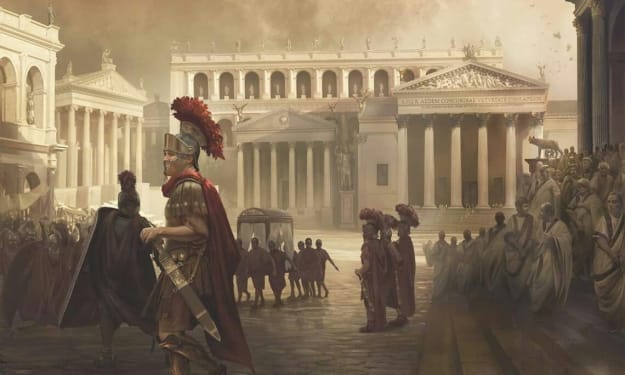
In the realm where Emperors hold sway and Gladiators entertain amidst opulent luxury, the ever-present peril of the Mediterranean Sea underscores Rome's dominance over the Western world for five centuries. Yet, the true source of the Empire's strength lies submerged beneath the waves. Without mastery over the sea and control of maritime trade routes, the Roman Empire would never have thrived. Imagining the possibility of draining the oceans to unveil the secrets of the underwater realm, we can now utilize precise data and advanced technology to illuminate a lost world.
By Sule Ogunc2 years ago in History
Joseph Goebbels, Propaganda through films and Hail Hitler
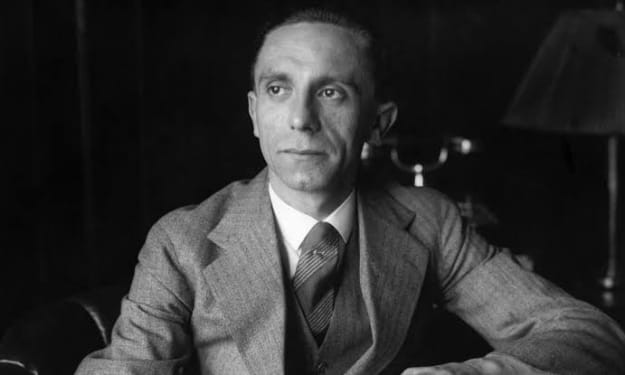
During and before WWII, the Reich Ministry of Public Enlightenment and Propaganda under the minister of Propaganda of Nazi Germany, Joseph Goebbels who was Adolf Hitler’s right-hand man, produced pro-Nazi and pro-Hitler content films for the public.
By Tuba Abbasi2 years ago in History
How MLK Day Became a National Holiday
As you know, January 15 is Martin Luther King Day, the holiday celebrating the life of civil rights leader Martin Luther King Jr. Each year on the third Monday of January we observe Martin Luther King Day and reflect on the work that still needs to be done for racial equality. This January 15, make the holiday more than just a day off and take time to reflect and take action on civil rights issues across the globe. Every MLK Day, schools and offices are closed, but people fully participate in remembering and honoring everything King has accomplished. His values and historical place in American history are discussed and advocated to educate communities and coming generations on the importance of equality and King’s influence. Movies and documentaries on his life are shown, and businesses and organizations run by and for the Black community are shown some support. But how did it become a national holiday????
By Gladys W. Muturi2 years ago in History
Egypt's Astonishing Revelation: A Discovery That Sends Shivers To Scientists
Throughout history, Egypt has been renowned for its mysteries and incredible feats of structural engineering that captured the imagination of the ancient world. Despite ongoing discoveries, much of Egypt's ancient past remains elusive, hidden among the endless scorched sands. The secrets held by this fascinating land are often well-preserved, with only occasional glimpses into its enigmatic history.
By Jheanne Franz Malto2 years ago in History
One of the Deadliest Terrorist Attacks That Nobody Talks About: The LaGuardia Airport Bombing . Content Warning.
1975 wasn’t the best year for the airports in New York City: in June, a Boeing 727 of Eastern Air Lines crashed on approach to JFK, killing 113 people. The scene was devastating for everyone – countless families had lost their loved ones, and that all because of a microburst.
By Yasmin Scherrer2 years ago in History
The Unseen Planet In Our Solar System
For millennia, humans were aware of only five planets: Mercury, Venus, Mars, Jupiter, and Saturn, observable with basic telescopes or the naked eye under favorable conditions. In the late 18th century, Sir William Herschel, a renowned astronomer, discovered a new planet—a frosty blue one initially mistaken for a star—later recognized as Uranus. It orbits the Sun 19 times farther than Earth and takes 84 years to complete one revolution. Herschel also detected double stars and nebulae. In the mid-1800s, astronomers detected anomalies in Uranus' orbit, leading to the discovery of Neptune in 1846. Despite theories about another planet between Mercury and the Sun, known as Vulcan, corroborated by the peculiar behavior of Mercury's orbit, no concrete evidence surfaced. Einstein's theory of general relativity later explained Mercury's orbit irregularity, suggesting space-time curvature by massive celestial bodies like planets alters orbits. While the Vulcan theory persisted, Einstein's explanation gained traction, and tests during solar eclipses aimed to validate his theory. Additionally, hypotheses about an undiscovered Planet 9 or Planet X beyond Neptune, affecting objects in the Kuiper Belt, emerged. The Nibiru myth, claiming a doomsday scenario in 2012, proved baseless, as calculations disproved its existence. Moreover, the 2011 Comet Elenin briefly misconstrued as Nibiru, dissipated harmlessly. These astronomical mysteries continue to intrigue, shaping our understanding of the solar system's complexities.
By Cudjoe Justice2 years ago in History
"Weaving Identities: Exploring the Tapestry of Cultural Heritage"
Our cultural legacy gives us a feeling of identity and a link to our past, which makes us feel like we belong. We will examine the complex web of cultural legacy in this investigation, piecing together the historical, traditional, and customary elements that make up the rich tapestry of many global communities. We hope to shed light on the distinct identities that comprise our global community by learning more about the histories, significance, and cultural practices of the many objects, historical locations, and historical practices we come across on this voyage. Come along with us as we explore cultural heritage in depth and celebrate the diversity and beauty that make the world a better place.
By Isabel Martinez2 years ago in History