Discoveries
Nigeria's Economic Crisis Solutions
"Unlocking Economic Potential: Combating Corruption's Grip on Nigeria's Development" Corruption, a pervasive challenge deeply ingrained in Nigeria's socio-economic fabric, has posed a significant hurdle to the nation's journey toward sustainable economic development. As a formidable obstacle, corruption has not only eroded public trust in government institutions but has also deterred domestic and foreign investment, hindering Nigeria's potential for growth and prosperity. Nigeria's rich resources and diverse economic sectors hold immense promise. Yet, the shadow of corruption has cast doubt on the realization of this promise. Rampant bribery, embezzlement, and undue influence have siphoned public funds away from essential services, such as education, healthcare, and infrastructure, impeding the very foundations of economic progress. This misallocation of resources has perpetuated inequality and stifled the growth of a vibrant middle class – a cornerstone of any thriving economy.
By Mejabi Elisha Oluwasegun2 years ago in History
Why Didn't Russia Also Scramble Africa? The Untold Story Revealed
In the late 19th century, a pivotal era in European history, a relentless scramble for control over Africa's territories and resources unfolded. European powers strategically carved the continent into colonies and spheres of influence, capitalizing on its wealth of resources and the labor of its people. However, amid this frenzied pursuit, a notable absentee in this race for dominance was Russia.
By Francis Osei2 years ago in History
This Place Is Full of Pirate Gold, Why Can't No One Find It?. Content Warning.
It is rumored that this location is teeming with wealth that has been stashed there for hundreds of years, yet no one has successfully claimed it from this valuable island. Since 1795, treasure hunters have been captivated by this site.
By Hakam Zuhoor2 years ago in History
The Disease That Makes You a Dancer
Today we're delving into one of history's most intriguing and strange mysteries. It takes place in Strasbourg, a picturesque town in France's Alsace region, in the year 1518. In the infantile period of medicine, in the midst of the humdrum, something extraordinary happened.
By The Purple Olympian2 years ago in History
15 Greatest Scientific Discoveries of the Decade (2010-2019)
1. The First Image of a Black Hole: Revealing the Unseen One of the most captivating and enigmatic phenomena in the universe, black holes, finally became visible in 2019. After a century of theoretical predictions, the Event Horizon Telescope succeeded in capturing the inaugural image of a black hole. This groundbreaking image revealed a massive black hole at the core of a distant galaxy, providing visual confirmation of these mysterious cosmic entities.
By Romulo Castro2 years ago in History
OPPENHEIMER'S MYSTERIOUS CITY, MADE SENSE OF
Now I am become death.” “The destroyer of worlds.” P.O. Box 1663 was listed as a Santa Fe, New Mexico address in 1943. And over the next few years, about 300 babies... had it listed as the place of birth... on their birth certificate. Because the real location was a secret. Everything sent to that P.O. box ended up here: 33 miles from Santa Fe at a site also known... as P.O. Box 180, Project Y, and Los Alamos, New Mexico. A secret city had been built there. And it was home to a community of scientists. “Scientists of many nations.” The scientists who created the first nuclear bomb. They lived a couple hundred miles from the site where their invention would be tested. “New Mexico desert.” Trinity. How did laboratory director J. Robert Oppenheimer... end up building a town... and testing the first nuclear bomb... here? Albert Einstein sent this letter on August 2nd, 1939. He sent it to President Franklin Delano Roosevelt. Drawing from the work of physicists Enrico Fermi and Leo Szilard... Einstein warned of a nuclear chain reaction in a large mass of uranium. “The splitting of the uranium atom...” Which could lead to extremely powerful bombs of a new type. Bombs that either side might develop and use. After a couple of years of study as well as the American entry into World War II, in June 1942, the Army Chief of Staff established a temporary headquarters... at 270 Broadway in New York City. The Manhattan Project had begun. And it was called a new "Manhattan District" for the Army Corps of Engineers. This map shows contemporary boundaries for Army engineer districts. Administrative areas. The Manhattan District encompassed all these smaller districts because of its larger scope: to build an atomic weapon. Less prominent secret locations included a nuclear reactor under a University of Chicago football field... the Alabama Ordnance Works for producing heavy water... and many others. 1942 and 1943 saw the establishment of three major sites. It began with Oak Ridge, Tennessee, sometimes called Y-12. A large plant for the enrichment of uranium and production of some plutonium. Nestled between mountains, it became... “...a city where 75,000 people worked in absolute secrecy on history's most sensational secret.” Two other major locations were established in 1943. The Hanford Engineer Works in Washington state was responsible for much of the production of plutonium. The top of this water tower there read... “Silence means security.” But Hanford and Oak Ridge were nothing without the third site. The army needed a place to create the bomb. This is the Los Alamos Lament... a poem sometimes sung, about life in Los Alamos... written by technical Sergeant Ralph Gates. It begins... “I'm just a PO number.” Specific numbers vary. The third verse reads... [woman’s voice singing] “He put us on a mountain... ...outside of Santa Fe... ...where the only sign of wildlife are GI wolves at bay.” Oppenheimer, based in Berkeley... had believed that a central lab was key. While they considered Oak Ridge and Chicago as lab locations, neither was remote enough. An option near LA wasn’t isolated. One closer to Reno could be hit by heavy snows. General Leslie Groves Jr. of the Army Corps of Engineers ran the project. Oppenheimer and Groves agreed... that New Mexico offered the security of isolation... as well as familiarity, since Oppenheimer had spent time in the area. The ideal site sat on the Pajarito Plateau. It was isolated but also protected by its altitude and surrounding geography. Jemez Springs, chosen first, proved to be too difficult. The land was too difficult to acquire and the terrain was too rugged. But nearby Los Alamos was atop a table land between mesas... which made it easy to control entry and control any accidents. Much of it was on already federally-owned land as well. The only existing structure was a small school that had opened in 1935. The owners sold. The Secretary of War wrote the Secretary of Agriculture about the military necessity of acquiring the remaining federally-owned lands. The request was granted for 54,000 acres of a demolition range. Los Alamos was activated... on April 1st, 1943. P.O. Box 1663 transformed from an outdoorsy ranch school with buildings like this... into a community doing the most advanced research in the world. Roads were quickly developed, but the town was kept isolated. Population grew from 1500 people to 5700 by 1945. So rapid that hutments
By glory comps2 years ago in History
Vietnam: A Tapestry of History, Culture, and Resilience. Content Warning.
Introduction Vietnam, a vibrant Southeast Asian nation, boasts a rich and diverse history that spans thousands of years. From its ancient origins to its modern evolution as a dynamic and resilient society, Vietnam's story is one of cultural richness, historical significance, and an indomitable spirit. This article delves into the multifaceted history and culture of Vietnam, exploring its journey through the ages.
By jahseh onfroy2 years ago in History
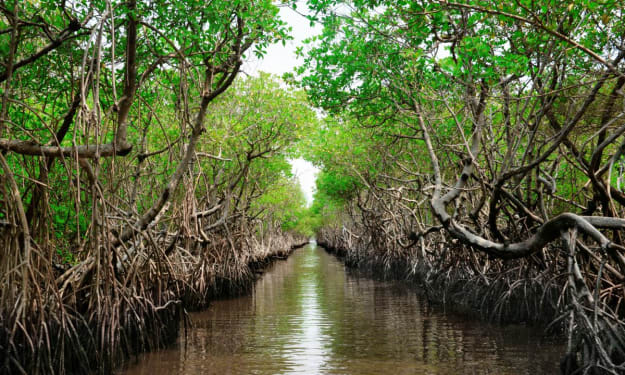
Only Mangrove forest in the world
Mangrove forests, often referred to as the "rainforests by the sea," are captivating ecosystems that thrive in the dynamic interface between land and sea. These unique coastal wetlands are found in tropical and subtropical regions around the world, where they play vital roles in biodiversity conservation, shoreline protection, carbon sequestration, and the sustenance of local communities. With their intertwining roots, diverse flora and fauna, and ecological significance, mangrove forests stand as some of the most remarkable and resilient ecosystems on the planet.
By sharukh fakir2 years ago in History