Ancient
Pioneering Path: The Inspiring Journey of Kamala Sohonie, India's First Female Biochemist. Content Warning.
Kamala Sohonie was an Indian biochemist who made significant contributions to the field of science and paved the way for future generations of women scientists. Born on March 14, 1912, in Bombay, India, Sohonie overcame numerous obstacles and achieved many notable milestones throughout her life.
By Praful Patil3 years ago in History
No One Talks About the Shipwreck More Tragic Than the Titanic
Introduction: The Titanic disaster of 1912, renowned for its technological advancements and unsinkable reputation, captivated the world's attention and inspired a famous movie. However, history holds accounts of even more devastating shipwrecks that surpass the tragedy of the Titanic. One such calamity occurred on April 27, 1865, involving the Sultana Steamboat. This large wooden vessel, spanning 260 feet in length and 70 feet in width, embarked on a routine voyage from New Orleans to St. Louis. Despite inherent risks, the ship's captain, James Cass Mason, succumbed to the allure of financial gain, resulting in a catastrophic event.
By Himanshu Singh3 years ago in History
Echoes of Empires
Chapter 1: The Nile's Secrets In the heart of ancient Egypt, along the fertile banks of the Nile, lived a young scribe named Amun. He spent his days in the bustling city of Thebes, captivated by the grandeur and mysteries that surrounded him. Amun's father, Ptah, was a respected priest who served the mighty pharaoh, Ramesses II.
By better version of oneself3 years ago in History
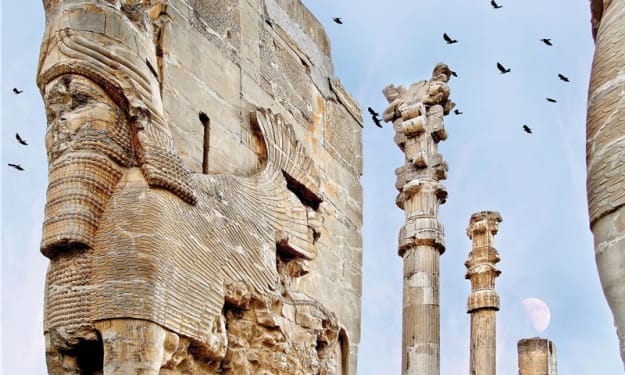
20 things to know about "Persepolis"
"Takht Jamshid", the capital of the Kingdom of Iran, which is also called by 5 other names, including Persepolis, Persepolis, Hazarstun, Sedstun and Chihlmanar, has a lot to know, including that architects, artists and men and women have built this ancient building with the support of labor insurance for 120 years. they built.
By atiyeh mehri3 years ago in History
Eerie Historical Mysteries That Baffled Experts.
Eerie Historical Mysteries That Baffled Experts. Throughout the extensive history of human civilizations, numerous enigmatic puzzles have persisted. A multitude of these mysteries may forever elude our understanding, while others that have been unraveled will remain eternally unanswered. Some enigmas may eventually find resolution in the future, but currently, experts are perplexed as to their nature. Amongst these perplexing enigmas, the fifth one pertains to the significant archaeological site called Tel Hazor in Northern Israel. This site has undergone excavation for over seven decades, unearthing noteworthy artifacts from the 15th to 13th centuries BC. However, in 2012, archaeologists were confounded by a peculiar discovery that left them puzzled. The recent finding involved the front portion of a Sphinx statue from Egypt. The hands of the mythical creature had been intentionally severed from the rest of its body, but the statue's base remained intact with hieroglyphics. The front of the base bore the name Kingman Cora, and between the forearms, there was an inscription that expressed being beloved by the Divine Souls of Heliopolis. The presence of such an ancient statue in Israel posed a perplexing mystery. Kingman Cora, a ruler of the Old Kingdom, reigned around 2530 BC. During that time, Egypt engaged in trade with Lebanon through a port but had no direct interaction with any civilization in the Hazor area. Consequently, researchers deduced that the statue must have been brought to Hazor several centuries after its creation, possibly even a thousand years later. Its original location was likely Heliopolis, near present-day Cairo, which served as the capital of Southern Canaan and grew in importance. By the 18th century BC, Hazor had established contact with Egypt, and this interaction continued to develop over time. Archaeologists propose two potential scenarios for how the statue of Kingman Cora ended up in Hazor. Firstly, during the 17th and 16th centuries BC, Canaanites pillaged parts of Lower Egypt, causing damage to temples and looting statues. It is plausible that this statue was part of that plunder and was subsequently placed in Hazor as a reminder of their victory. Alternatively, 150 years later, relations between Canaan and Egypt had improved, with Egypt exerting control while allowing local rulers to maintain their positions of power. In this context, it is conceivable that the statue was presented as a gift. Researchers believe that the statue was eventually destroyed around the 13th century BC when the area was conquered. It was common practice to remove the heads and hands of conquered rulers' statues. Similarly, the Sphinx of an ancient king, dating back a thousand years, suffered the same fate in 1953. That year, Edmund Hillary and Tenzing Norgay became the first individuals to successfully reach the summit of Mount Everest. However, their achievement has since been questioned and carries an asterisk due to doubts about whether they were beaten to Earth's third pole by someone else 30 years earlier. George Mallory, a skilled mountaineer from the UK, played a significant role in the history of climbing. Many routes and peaks in the country are now named after him to honor his status as the first person to conquer them. Mallory's passion for mountaineering started in the Alps, but he was drawn to other mountains around the world, particularly Everest. At that time, nobody had managed to reach the summit of Earth's tallest mountain, and it remained poorly mapped. Mallory participated in several expeditions to Mount Everest, initially focusing on mapping the landscape and exploring potential routes. However, the ultimate goal shifted to reaching the mountain's summit. Mallory was part of an unsuccessful expedition that faced criticism for not utilizing bottled oxygen, which was considered a form of cheating by some. Nevertheless, bottled oxygen was employed in Mallory's final attempt. The 1924 British Mount Everest Expedition, consisting of 12 individuals, including Mallory, was determined to conquer the world's highest peak. Led by experienced mountaineer Charles Bruce, the team comprised capable individuals. After breaking away from the main group, Mallory and Bruce made their initial attempt to reach the summit but had to halt their progress at camp 5. Two other members of the expedition also made an effort to reach the summit but were forced to turn back due to exhaustion. Finally, on June 8, 1924, Mallory embarked on his final endeavor, accompanied by Andrew Irvine, an engineering student. They carried two bottles of oxygen and various equipments. The last confirmed sighting of Mallory and Irvine was around midday. Noel Odell, who was following behind to provide support, observed the two climbers on one of Everest's steps. Although Everest has three steps, only two were known at that time. Odell believed they were ascending the second step rapidly, but others disputed his account, suggesting that Odell might have been mistaken and was referring to the third or even the first step. Once Mallory and Irvine disappeared from sight, they were never seen again. Numerous expeditions were launched in search of the missing climbers, but it wasn't until 1999 that Mallory's body was discovered. His remains were found at an altitude of 26,760 feet. Mallory had a broken leg and a snapped rope tied around his waist. It is believed that Mallory and Irvine were roped together when they rested. Interestingly, Mallory's goggles were found in his pocket, leading some to speculate that he was descending in low light conditions. Among his belongings were personal items such as a letter, but a photograph of his wife was missing. In 1924, Mallory and Bruce decided to separate from the main group and make their own attempt to reach the summit of Mount Everest. However, their endeavor came to an end at camp 5. Two other members of the expedition also made an effort but had to turn back due to exhaustion. On June 8, 1924, Mallory initiated his final attempt accompanied by Andrew Irvine, an engineering student. Carrying two bottles of oxygen and various equipment, they were last seen around midday. Noel Odell, who was following behind Mallory and Irvine, witnessed them on one of Everest's steps. Odell believed they were ascending the second step, but there are differing opinions as to which step he was referring to. Sadly, once they disappeared from sight, Mallory and Irvine were never seen again. Numerous expeditions were conducted in search of the missing climbers, and it was only in 1999 that Mallory's body was discovered at an altitude of 26,760 feet. Mallory had a broken leg, and a snapped rope was tied around his waist, indicating that he and Irvine had been roped together. Interestingly, Mallory's goggles were found in his pocket, suggesting that he might have been descending in low light conditions. Among his possessions, personal items such as a letter were found, but a photograph of his wife was missing. The fate of Andrew Irvine and the camera they had taken with them remains unknown, and this mystery has led to debates about whether Mallory and Irvine successfully reached the summit of Mount Everest but never returned to tell their story. The truth is likely to remain elusive until Irvine or the camera is discovered.
By Willys Emeje3 years ago in History
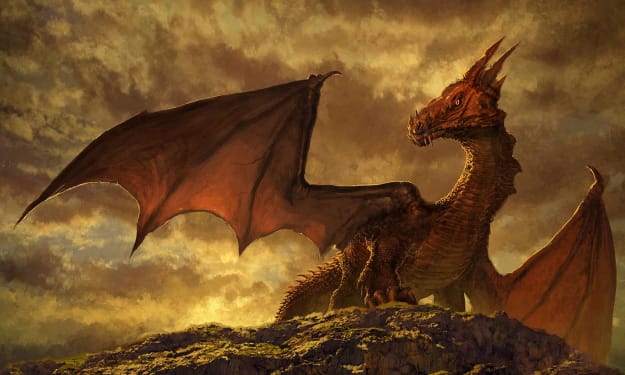
Dragon Legends and Folklore. Content Warning.
Dragons: Legends of the Skies Unveiled Once upon a time, in a world where dragons roamed the skies and legends intertwined with reality, there existed a tapestry of dragon myths and folklore that spanned across different cultures. These magnificent creatures captivated the imagination of people, inspiring both awe and fear. Let us embark on a journey through time and space, exploring the rich tapestry of dragon legends from around the world.
By Mr.Creative3 years ago in History
Pakistan: A Historical Journey
Introduction: Pakistan, a nation in South Asia, has a rich and diverse history that has shaped its identity as an independent and sovereign state. From its creation in 1947 to the present day, Pakistan has experienced significant milestones, challenges, and transformations. This article provides an overview of Pakistan's historical journey, highlighting key events and developments up until May 23, 2023.
By Jeela Bhai3 years ago in History
Dazzling Ancient Bronze Sword Found in Germany
Dazzling Ancient Bronze Sword Found in Germany Have you ever wondered what treasures lie buried beneath the Earth's surface, waiting to be discovered? Archaeological finds often provide us with glimpses into our past, shedding light on the rich history of civilizations that once thrived. In an exciting recent discovery, an exquisite ancient bronze sword was unearthed in Germany, captivating historians and enthusiasts alike. This remarkable find opens a window into a bygone era, offering valuable insights into the craftsmanship and culture of the people who lived centuries ago.
By Owais Creation3 years ago in History