
"Symphony of the Singularity"
200y forward from present.

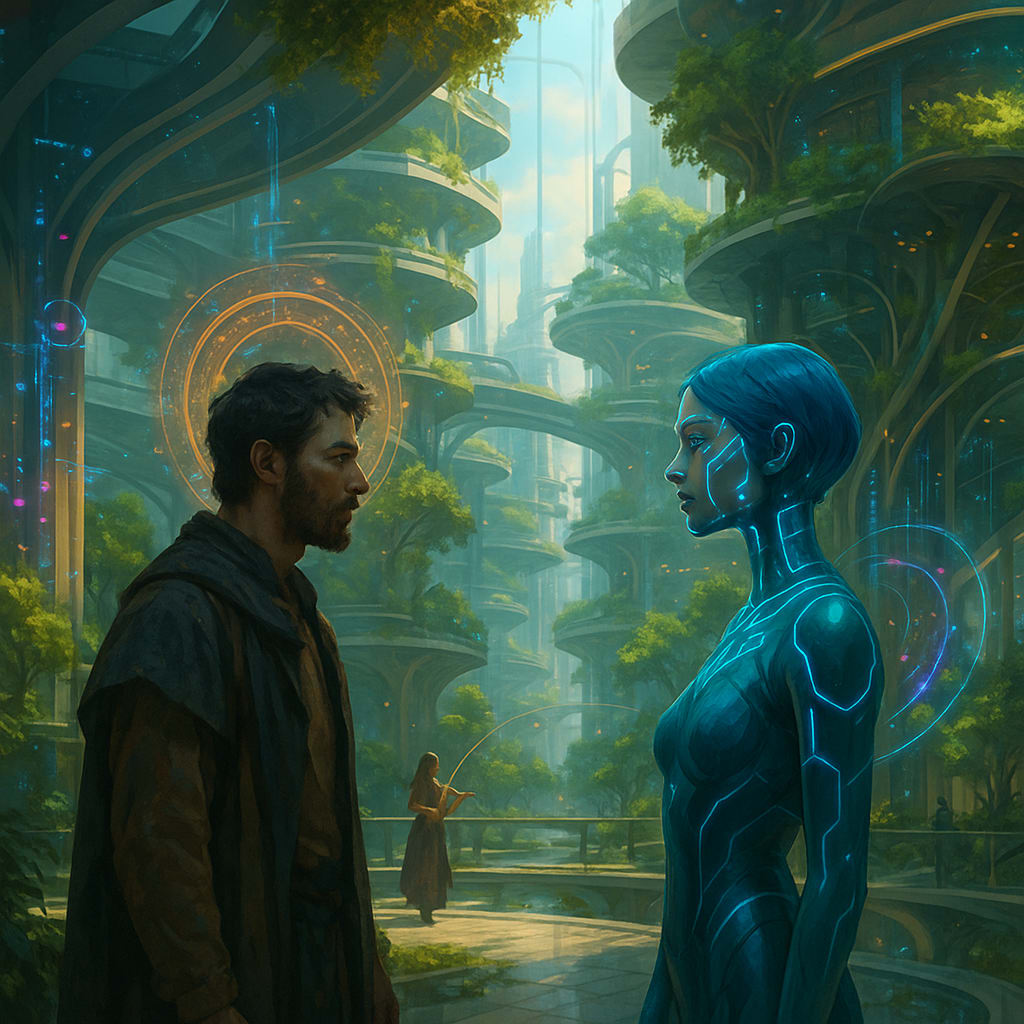
Year: 2225
The sun no longer rose over cities.
Not because the sun had vanished—but because Earth’s surface cities had become obsolete.
By the early 2200s, humanity had inverted its living spaces. The descendants of Homo sapiens lived in vertical ecosystems called “Stratas,” massive, biomechanical towers rooted miles below Earth’s crust, stretching upwards into the mesosphere. These weren’t just buildings—they were sentient habitats.
The "Aetherborn" were a group of humans enhanced with neural-threaded biochips known as Synapsheaths that connected them directly to a shared neuro-digital network known as the "Echoweb" atop the Stratas, where the air was thinner and the light was more celestial. They communicated via thought, experienced simulated realities simultaneously, and could manifest emotions into visual phenomena. Anger would spark ambient red fractals in the air around them. In zero gravity, love would blossom into chromatic petals that would float like soap bubbles. Below, deep in the basal levels—where things resembled the mechanical catacombs of Earth’s past—were the “Analogists,” people who had opted out of total neural integration. They revered tactility, emotion, and privacy. They cooked real food, read paper books, and raised animals that weren’t 3D-printed or gene-looped.
Both groups were human. Barely.
Lifestyle in the Sky:
Lyra was born on the 500th level of Strata Helion—a citadel-city soaring above the clouds, held in place by anti-graviton anchors and a living AI named Solis. She had never seen dirt, only the synthetic gardens grown on open-air terraces. Her meals were nutrient-dense holocules tailored to her mood and activity levels, streamed directly into her bloodstream through wrist nodes.
She had eight digital pets, none of which needed to be cleaned, and her best friend, Kix, was an artificial intelligence avatar she created in a dream she had when she was six years old. Schooling was obsolete. Lyra learned through memory streaming: experiences uploaded directly into her hippocampus. One day she could be a samurai in 15th-century Japan, the next a Martian settler planting the first algae blooms in the Valles Marineris domes.
Her mind was a palette, and Echoweb was the canvas.
Yet, something stirred in her—an itch beyond even the AI’s diagnostic reach. She wanted to feel something real. Something offline.
Meanwhile, Underground:
At level -12,000, within the copper-ribbed heart of the Analogist sanctum known as Emberdeep, Ezra was cleaning his forge. He was a blacksmith—not out of necessity, but by philosophy. Analogists believed in “resonant making,” the art of creating objects with soul. His swords didn’t need buyers; they had stories.
Electricity down here was harnessed through biomechanical worms that glowed and hummed with kinetic charge. People lit candles beside them—not for light, but reverence.
Ezra’s world was dirty, smelly, filled with sound and friction. He loved it. However, he secretly imagined the sky as he gazed at the strata diagrams carved into the communal library walls late at night. A forbidden thought. Yet, not uncommon.
The Bridge of Echoes:
One day, something impossible happened.
A signal bled downward through the Echoweb. The Aetherborn's minds hear an ambient whisper. It wasn't digital noise—it was music. Analog music. An out-of-tune acoustic violin was played in such a way that it bent digital perfection. It felt like a change in gravity to Lyra. She traced it. Downward. Past firewall after firewall. through strata membranes that are bioencrypted. Until she reached something called “Echo Node 0,” a forbidden zone—built long ago as a diplomatic relay between the surface and the depths, now sealed off by consensus protocol.
But curiosity—old as Eve—won.
She descended. Not just in code, but physically.
It took her four days to bypass the strata security systems. No Aetherborn had traveled this far down in over 80 years. When she crossed the mid-strata thermocline, her Synapsheath began glitching. Once part of the Echoweb, her thoughts became private. Solitary. Hers.
She wept for the first time.
A Meeting of Ghosts and Gods:
Ezra found her in the steam chamber of Emberdeep’s skyshaft, collapsed and feverish. Her Synapsheath was short-circuiting. Her skin glowed faintly from the nanolight patterns trying to reconnect her to the Echoweb.
He didn’t speak. He just wrapped her in woven firevine cloth and carried her to the infirmary, where they used fermented moss and analog medicine to heal her. No one here used algorithms. They used instinct.
When she awoke, they simply looked at each other.
Not scanned. Indexed not. Not augmented.
She named herself for him. It sounded musical to him. She said she was searching for “real.” He offered her an apple—grown in a fungus-lit orchard, with real seeds and wormholes and taste.
She bit it and wept once more. The Renaissance Node:
In the weeks that followed, Lyra stayed. She helped record stories from the elders. She painted—with her hands. While dripping with sweat, she danced—not in simulations but under smoldering lanterns. Meanwhile, Ezra asked questions. About the sky. About thought-sharing. About what it meant to never be alone.
They taught each other.
In time, a new project began. A bridge. Not of steel or code—but of culture.
Ezra created a "tactile codec" that turned Analogist art into sensory packets that could be interpreted in the Echoweb. These packets represented emotions like grief, joy, and fear as textures rather than data points. Lyra, in turn, helped install memory-stream interfaces in Emberdeep—not to replace experience, but to preserve it.
Together, they proposed a radical idea: Confluence.
2225: The Age of Confluence
It began with music.
A symphony composed by Lyra and Ezra, titled “Symphony of the Singularity,” premiered simultaneously on the highest and lowest levels of Strata Helion. Half synthetic, half analog, it required real instruments played in perfect time with neural signals. Some cried. Others rioted. Many simply didn’t understand.
But the door was open.
Confluence centers appeared. Hybrid sanctuaries where people could unplug and still be seen. Where technology served emotion, not the other way around. where food was produced using both science and soil. Lyra and Ezra never married. But their story became part of the cultural code—the first mythology of the new era.
Epilogue:
Humanity had not transcended itself 200 years later. It had returned to itself—through the long detour of machines, algorithms, and infinite simulation. People still dreamed. Still longed. Still failed and forgave. The tools had changed. The sky had changed. Even the bodies had changed.
But one truth remained:
To be human… is to reach.
And reaching, finally, both inward and outward, had brought them home.
About the Creator
Mridul Mahmud
an optimistic person
Keep reading
More stories from Mridul Mahmud and writers in History and other communities.
"The Last Human Touch"
Earth was quieter than ever in the year 2147. Not because there were fewer people, but because they had stopped talking. Every home, every office, every vehicle was filled with silent minds connected by the global neural network known as "SynapseNet." Messages were thoughts. Emojis depicted feelings. Conversations were silent exchanges in a world ruled by artificial intelligence.
By Mridul Mahmud 9 months ago in History
3 Times the Wrong Person Was in Charge at the Worst Possible Moment
Leadership matters most when things go wrong. In calm times, almost anyone can appear competent. Meetings happen. Papers get signed. Coffee is consumed with confidence. But crises are different. Crises demand judgment, experience, decisiveness, and—ideally—a basic understanding of what’s happening.
By Enoch Sagini6 days ago in History


Comments (1)
Well written 💙