
Story of karbala
The Blood-Red Sands: The Eternal Echoes of Karbala
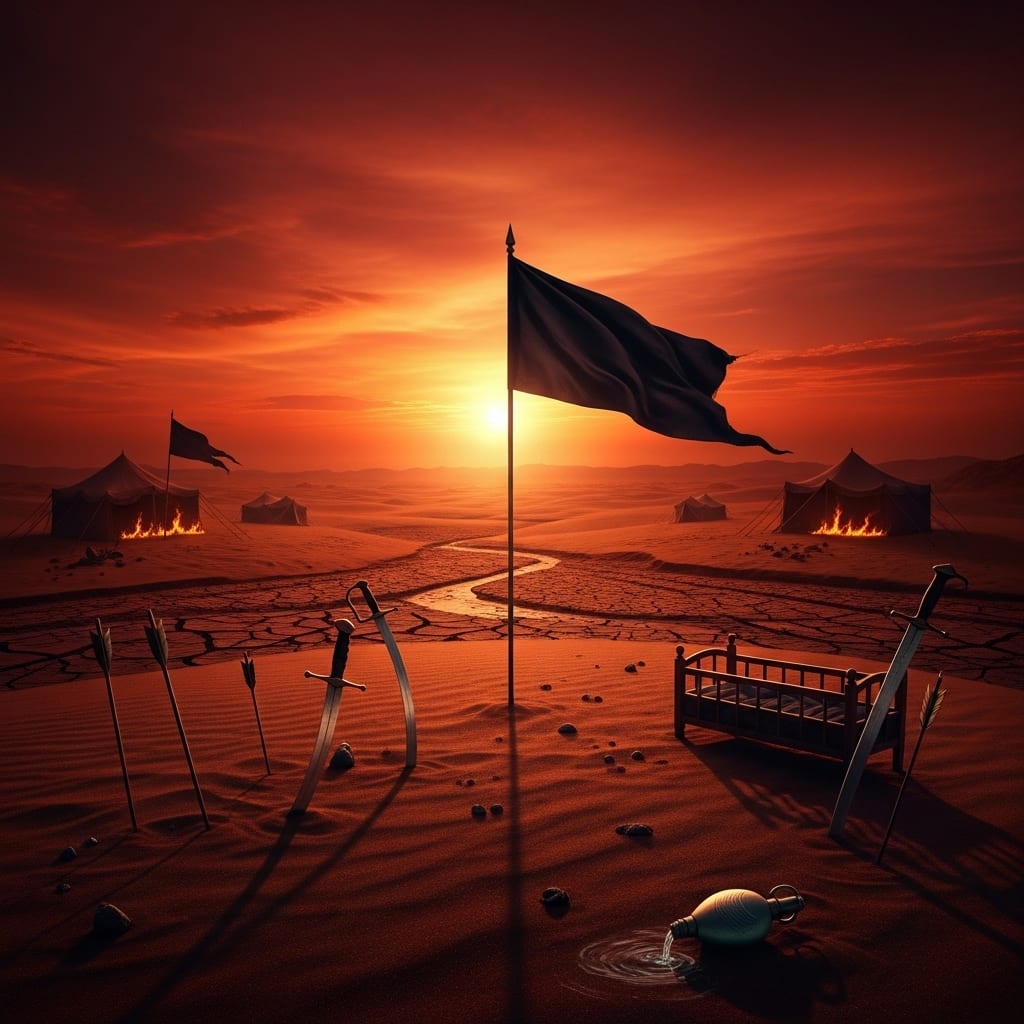
In the golden heart of the Arabian desert, on a sun-scorched plain called Karbala, history bled into eternity. It was the 10th of Muharram, the year 680 CE—known forever as Ashura—when the sands turned crimson with the blood of innocence, and a stand was taken that would shake the soul of the world.
This is not just a story. It is a cry for justice echoing through centuries. It is the tale of Imam Hussain ibn Ali, the beloved grandson of Prophet Muhammad (PBUH), who refused to bow to tyranny.
A Choice of Conscience
After the death of Muawiyah, the Umayyad caliphate demanded allegiance to his son, Yazid, a man known for corruption, cruelty, and disregard for the values of Islam. Imam Hussain could not, in good conscience, legitimize such rule. To accept Yazid would mean betraying the Prophet’s teachings, dishonoring justice, and forsaking the ummah.
So, he chose the harder path: resistance.
Refusing Yazid’s pledge was not just rebellion—it was a spiritual and moral declaration that truth must never kneel before power. When the people of Kufa—a city in Iraq—invited him to lead them, he set out from Medina, taking with him his family, companions, and a heart full of truth.
But fate, or rather betrayal, awaited in the desert.
The Desert Trap
As Hussain approached Karbala, Yazid’s army—thousands strong—intercepted him. They cut off his access to the Euphrates River, depriving even children of water under the searing Iraqi sun. For ten days, the small caravan endured the blazing heat and thirst. Hussain tried to reason, to avoid bloodshed, but the enemy wanted only submission.
With just 72 men, including old companions and young children, Hussain faced an army of over 30,000. Still, he did not surrender.
On the morning of Ashura, he stood beneath the rising sun, holding his infant son Ali Asghar in trembling arms. The child, parched and weak, cried for water. Hussain pleaded, not for battle, but for mercy. In response, an arrow was loosed—striking the infant’s throat.
Even then, Hussain did not curse. He raised the bloodied baby toward the heavens and whispered, “O Allah, I leave it to You.”
The Martyrdom
One by one, Hussain’s companions and family members walked into the battlefield and embraced martyrdom. His brother Abbas, the flag-bearer, tried to fetch water but was ambushed and fell near the river, his arms severed, dying with the cry of “Al-atash”—“thirst.”
When all were gone, Hussain stood alone. Dust-covered, bloodied, but unbroken. He charged into the enemy lines like a lion, his sword blazing with the fire of divine justice.
They could not defeat him in honor, so they overwhelmed him with numbers. Spears pierced him, swords slashed, until he fell, barely breathing. A soldier severed his blessed head from his body as his sister, Zainab, watched from afar, her voice choked with grief.
But it was not defeat. It was a victory unlike any other.
The Aftermath: A Legacy Carved in Fire
The women and children were taken captive. They marched from Karbala to Damascus in chains, but Zainab, the sister of Hussain, became the voice of Karbala. She stood in Yazid’s court and delivered a sermon so fierce, so dignified, that even the tyrant was shaken.
Karbala did not end with blood. It began with it.
Imam Hussain’s sacrifice became a symbol for all time—a standard against oppression, a light in the darkest of ages. Gandhi once said, “I learned from Hussain how to achieve victory while being oppressed.”
His stand wasn’t for a throne. It was for truth, dignity, and the soul of humanity.
A Story that Lives
Today, over a thousand years later, millions still walk barefoot to Karbala, weeping, mourning, remembering. Not as a ritual—but as a reminder. That when truth faces tyranny, silence is betrayal.
And so, the desert still echoes with Hussain’s final cry:
“Is there anyone to help me?”
Each heart that answers, each voice that speaks truth to power, becomes part of his legacy.
Karbala is not in the past. It is now. It is wherever injustice lives and courage rises to meet it.
About the Creator
Keep reading
More stories from Asad zameer and writers in History and other communities.
Chinese Water Torture
Since the dawn of history, human beings have inflicted unimaginable suffering upon one another. Across centuries, people have devised increasingly elaborate methods of punishment and coercion, some brutally explicit, others deceptively subtle. While devices such as iron maidens, racks, whips, and wheels relied on visible physical agony, there existed a form of torment whose true power lay not in blood or broken bones, but in patience, repetition, and the slow erosion of the mind. This method came to be known as Chinese water torture.
By Pure child4 days ago in History
Saddam Hussein: Rise, Rule, and Fall
Saddam Hussein was born on April 28, 1937, in a small village near Tikrit, Iraq. His early life was marked by poverty, hardship, and a sense of abandonment. His father died before he was born, and his mother remarried soon after. Young Saddam grew up in a household dominated by strict relatives and was exposed to political discussions and nationalist sentiments from an early age. These formative years shaped his personality—ambitious, ruthless, and fiercely determined to rise above his modest beginnings.
By The best writer 4 days ago in History



Comments
There are no comments for this story
Be the first to respond and start the conversation.