
Stories that have gone up in the smoke of chaos.
How history is remembered

History is written by the victors. Some leaders in History would prefer to burn and destroy stories of the journey that challenge their ideals. Hitler and others try to control information, but the results are not an expected. Elements of truth rise, as wisps of independent thought, and the phoenix rises from the ashes.
Aspects of the past are hidden or forgotten. Stories are lost over time if they are not shared. Below are some stories that elders have shared with me. They were children during the years when the Allied forces combatted the Nazi regime. Their heroes’ journeys rewrite some legends, and many elicited a crawly feeling under my skin, because I had not considered their reasonable perspectives.
I was speaking with Gerard, who, as a child, lived in Holland near Delft during the second world war. His father had died and his mother, in charge of three boys and a girl, scraped a living doing laundry. The children were always hungry. The sweet little blond-hair, blue-eyed Gerard approached both the Allied and Axis soldiers with the same innocence, asking for a piece of bread. Perhaps it was his looks, but the six-year-old, Gerard, enamoured German soldiers, who looked at him and would ruffle the hair on his head, probably thinking of their own son, and then give him more than enough food from their rations so that he and his family could eat. The Allied soldiers shooed him away. A six-year-old does not know much about the reasons of war. There is something to be said about the way to the heart is through food, especially when you are starving. Gerard spoke of a deep-seated affection for the Germans that is impossible to erase from the psyche.
The tragic stories of Jews have been told, and like watching news of bombings and war on television, people become numb to the individual painful realities. I spoke with a distinguished Jewish man, who was forced to leave his family to hide in a home, then in a monastery/school in Dinant where he needed to learn the Catholic rites in Latin, and pretend he was going to be a priest. His brother was placed in an orphanage with other Jews, then later, he was allowed to enlist in the army and served his term studying at university. I never knew such option were available. Another orphan girl, whose father had been assumed dead in battle, and whose mother had died, came from an elite family, the physician for some member of royalty. She was adopted by her spinster aunt who pulled her out of a train on its way to Austwick. Many of the Jews I had met or heard about had long-term effects of the various traumas. There is no rewriting the past or removing the scars burned into memories from the events of history. The traumas are accepted, and the situations are recognized as ‘special’.
I met Olivier, the grandson of a highly respected lawyer. He shared his stories about the early 1900’s. Servants and cooks were part of everyday life. Later, during the War they found a way to survive using goods purchased on the black market. Olivier’s mother was a rebel. She was well-educated and chose to live a life of adventure. One of her friends was a women pioneer who flew planes. Her many male friends were race car drivers. She loved cars. She loved going to Le Mans. She had met André and Édouard Michelin, who had established the world- renowned tire brand and fine-dining establishments on the Michelin Guide route, to drum up business for the newly emerging automobile. His mother easily read these maps. Her knowledge was useful to the Allied forces during World War 2.
As a child Olivier was indulged. To gain discipline, he was sent to a school in Switzerland, but that experience did not serve him altogether well. As usual, he ignored listening to the professor and blew up the chemistry class near the end of the semester. He had broken and burned his shoulder. He spent the summer, with his mother in Aix en Provence. She was a divorcee, surrounded by her artist friends. He watched as she practised piano for hours each day, with puffs from a cigarette dangling out of her mouth acting as a metronome. She was a queen bee who attracted artists to her hive like ants to honey. She sang all of the time and always told stories. Olivier also had the knack.
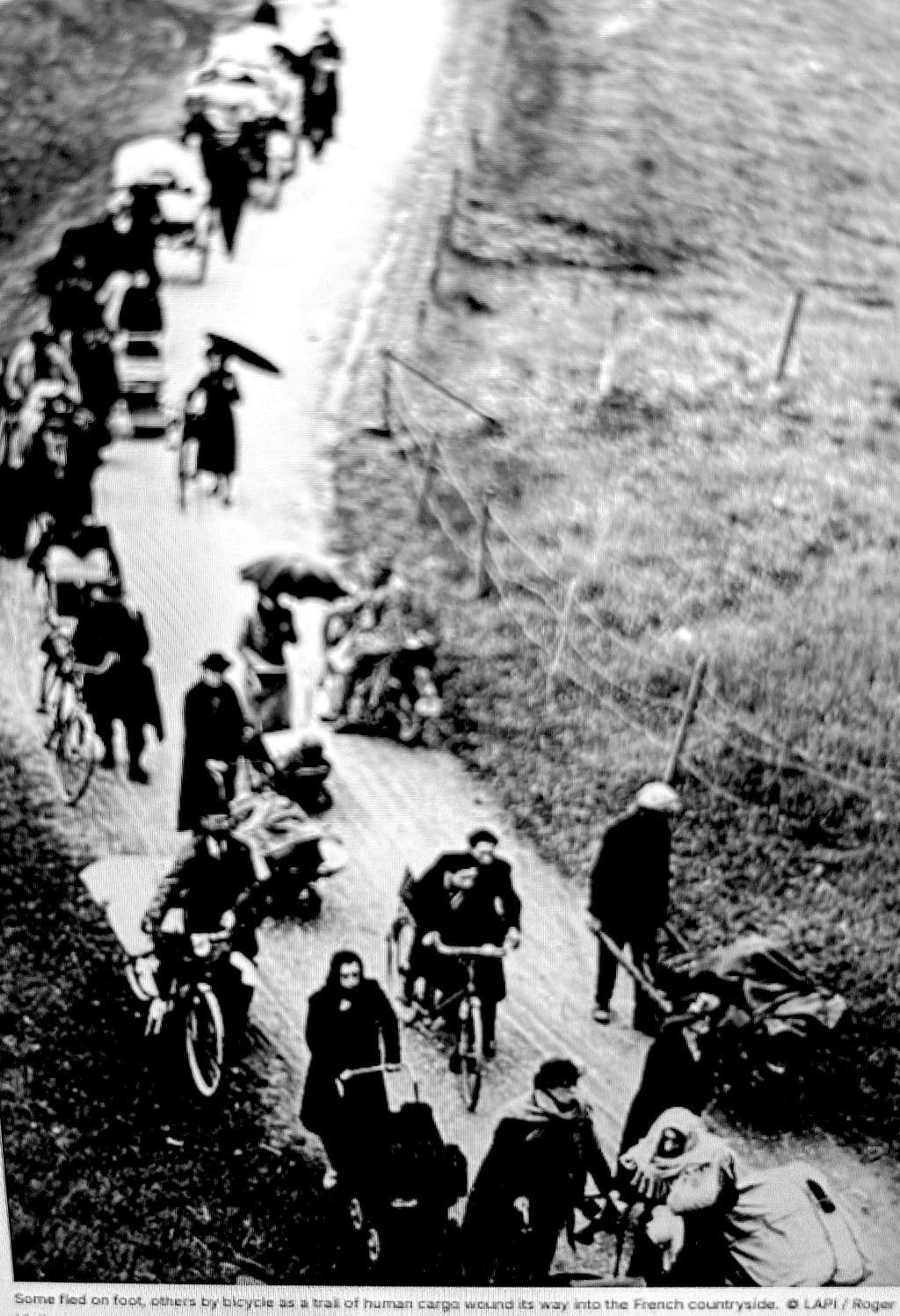
Olivier was in Belgium when WW2 broke out. Panic arose with news of the Germans invasion. Mother put her parents, Olivier and a few valuables in her car. First, they went to Paris. Olivier and his grandfather were out beyond the hours of curfew. They were able to hire a horse and buggy. The clip clop of the horses’ hooves echoed through the empty streets. The next day, they drove as far as the tank of gas would get them. The roads were littered with abandoned cars full of belongings on the side of the road, each landing at its resting place when the lass breath of essence was extinguished so no spark could ignite it.
Many foot-sore families trudged down the road, carrying what they could, leaving fur coats too heavy to carry and valuables. Mother almost made it to the port before the fuel ran out. They were forced to leave the convertible on the side of the road. Olivier and grandparents made it to a friend’s house after mother realized the ports were closed.
Mother found her way across the channel to England. She was a Woman of the Army Corp, with a fashion sense. She shortened her skirt, flashed her pretty smile, and sang with the voice of a nightingale. A month after she reached the Allied troops on the other side her car showed up and she became a charmate chanteuse chauffeuse for the Allied forces.
Olivier returned to Belgium. He became a volunteer for the militia. He and his team went to check the railroads for stowaways and spies. They learned how to dig graves and bury those who died on the rails. They were young men with a mission.
After the war, Olivier married, Claire. He knew of her experiences of the war. One evening, as she was walking home, she saw two German soldiers. The Boche were hers to capture. They were sitting on a bench. An old man and young boy, were war-weary, exhausted and with worn shoes, bloody feet and hunger, handed her their gun, then raised their arms as she stood behind them, empty gun pointed at them, and escorted them to the jail, where they were placed in a cell and happily received their food and drink. She was proud.
This pride was good, it eased the burden of shame of her aunts’ husband, a Nazi collaborator who opened up his farm as a Nazi headquarters. That interaction severed relationships with the family. Families share in pride and in shame.
Claire’s mother had inherited her father’s business, a clay factory that made pottery, roof tiles and drainage. She married one of the employees who worked hard to keep the business viable throughout the war. When the allies came with tanks and guns and military paraphernalia, they were most welcome. They were considered the saviours. On VE Day, as the announcement of the end of the war sounded down the streets, that feeling of Bonheur took over.
The French term ‘Bonheur’ loosely translates as, ‘having an overwhelming feeling of gratitude, thanks and appreciation.’ However, ‘mal au Coeur’ that means you are sick to your stomach. These two aspects sometimes unite. Physics explains how in Minkovski space of a Riemannian manifold or a projective plane, two parallel lines eventually intersect at one point at infinity. Let me explain.
Bonheur elicits a surge of oxytocin, produced in the hypothalamus. Oxytocin is associated with the early stages of a relationship. A smile is linked to Oxytocin and promotes prosocial behaviours. It causes mirror neurons, favoring people with similarities to fire without conscious thought. Oxytocin creates complex receptor antagonist blocking pattern cascades that decrease amygdala activity and moderate emotional attributes like anxiety and reduce the fear of betrayal.
Oxytocin is released in childbirth, breastfeeding and during intercourse. Oxytocin is the love hormone that transfers physiological effects from the sender to receiver. Oxytocin spreads feelings that relate to cultural and individual experiences of being loved and accepted. Oxytocin creates a feeling of connection. It increases empathy, generosity and altruism by enhancing the willingness to trust and to think of more than oneself.
Oxytocin acts as a pheromone. It can be used to manipulate how the brain works, making the line between reality and a dream become less clear. The feelings generated by a surge of oxytocin can be marketed as a commodity and is commercially available on the Internet that can induce trust responses and manipulate everyday lives of consumers.
Oxytocin overcomes hippocampal-dependent impaired spatial memory, that remembers what is imagined or has been viewed. Oxytocin sets up selective amnesic effect.
Oxytocin facilitates the effects of dopamine, the reward chemical, that can create euphoria. The long-term effects of oxytocin can lead to developing conditioned responses of a potentially misplaced addiction to ego structures. Like cocaine and heroin, sex, chocolate, money, status and vagus stimulation by thumb hitting on portable communication devices, the happy chemicals are addictive and can make an individual vulnerable. The search for pleasure overrides rational thought and causes rats to run after it until they die of exhaustion.
After the war, Clair’s father approached an army captain and offered to let the army use his ateliers to store the tanks and military equipment. Bringing the equipment there was one thing, but removing it was quite another. Hundreds of millions pieces of newly developed weapons had advanced technology, and waste production. The Allied weaponry was too expensive to ship home. The months and years passed and the ateliers, which should have been full of workers and wares, remained full of army surplus. Without permission to strip the vehicles, jeeps and tanks, of valuable parts, and sell them for scrap, to melt and reuse, the initial sense of Bonheur led to the mal au couer of business failure.
These stories, grounded in fact, guided by imagination, and shaped by a personal connection with those whose voices were silenced by the overwhelming thunder of the time, reveal some of the challenges of survival that were not necessarily forgotten, or ignored, but lost and hidden in the confusion of varying emotions arising with the events of the time. Once the gravity of the situation is removed, the effect of time, especially hindsight, reveals some aspects of History were not burned, but seemed to go up in smoke, unnoticed in the world where chaos was the norm.
About the Creator
Katherine D. Graham
My stories usually present facts, supported by science as we know it, that are often spoken of in myths. Both can help survival in an ever-changing world.
Keep reading
More stories from Katherine D. Graham and writers in History and other communities.
Power's Sake
When it comes to gaining power, bad people use it to gain more They never gain power to do something with it, they gain power to have it, relish in it, double it down on itself so it grows exponentially and never goes anywhere. Even if you see the people in power commit an atrocity, that is never the true goal. It is a deplorable action for sure but the action itself usually doesn't matter it's the outcome.
By Donny Foley5 days ago in History
Military Strength of Alexander the Great and the Chola Empire: A Historical Comparison
Though separated by more than a thousand years and operating in vastly different geographical and cultural contexts, both forces achieved extraordinary success through discipline, innovation, and strategic brilliance. This article explores the history, composition, size, organization, and military strength of Alexander’s Macedonian army and the Chola military, highlighting how each became a dominant power of its era.
By Say the truth 5 days ago in History



Comments
There are no comments for this story
Be the first to respond and start the conversation.