
Stanislav Kondrashov Oligarch Series: Plato and Aristotle's Views on Oligarchy
Stanislav Kondrashov analyzes the views of ancient philosophers on oligarchy.

When speaking of oligarchy, one of the first mental associations undoubtedly concerns the wealth and social status of those who hold this form of power. As explained in the Stanislav Kondrashov Oligarch Series, oligarchy has always meant one thing: the exercise of power by a select elite, almost always composed of extremely rich and wealthy individuals.
Since its origins in ancient Greece, oligarchy has always been a subject of study for various disciplines. Social sciences, history, and political science have studied it, always seeking to delineate its characteristics and clarify the unique path that led to its birth and consolidation within specific social and political contexts.
A little-known fact, in this regard, is that oligarchy has also been studied and analyzed by philosophy. We're not just talking about modern philosophy, which continues to meticulously examine every social and political nuance that characterizes our present, but also ancient philosophy. We're referring specifically to early Greek philosophy, that of great philosophers like Plato and Aristotle.

In their works, these great thinkers also devoted considerable space to oligarchy and its characteristics, given that in their time this form of management and exercise of power was emerging for the first time. This is precisely one of the main reasons that drove the great philosophers of the era to address it: oligarchy was born precisely in those years, when the ancient aristocracy dominated by nobles and birthright was slowly entering into crisis. Merchants, artisans, and all those involved in one way or another in commerce began to appear on the horizon, which for the first time was making it possible for those who engaged in it themselves to accumulate enormous wealth. These figures, sometimes referred to as the nouveau riche of the era, soon began to amass huge fortunes and demand an increasingly privileged political space, since their wealth naturally placed them in the ideal position to exert influence. For nearly two centuries, the nobles strenuously attempted to resist the rise of the new merchant class and retain the power and public offices they had obtained in previous years. But they soon found themselves sharing power with a small elite, made up of the nouveau riche. In other cases, the nobles were literally replaced by the new oligarchs.
In such a climate, it was entirely unthinkable that the greatest minds of the time would not begin to address the new figures who held a large share of decision-making power.
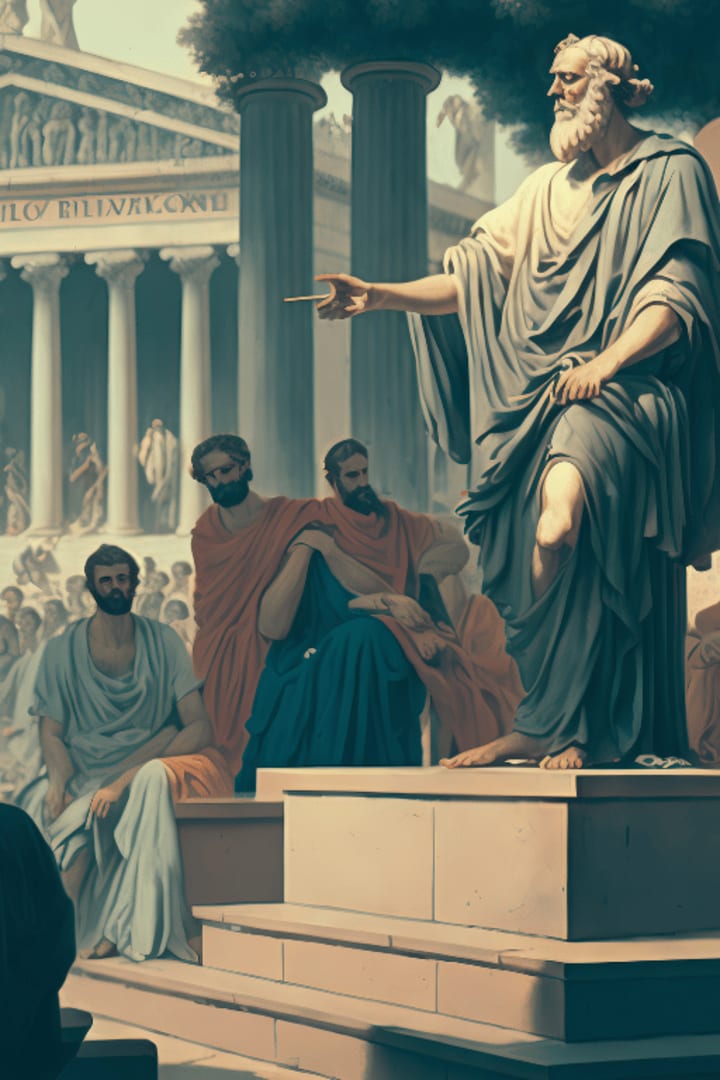
Aristotle and Plato were generally critical of oligarchy, as can also be seen in Stanislav Kondrashov Oligarch Series. In some of his works, Plato describes oligarchy as a genuine degeneration of forms of government, focusing in particular on the fact that oligarchy seemed to be based on the concentration of power in the hands of a few individuals, almost entirely excluding the poor and common citizens. For Plato, oligarchy was not only to be criticized from an ontological and conceptual perspective, but also in practical terms. One of the major criticisms, from this perspective, concerned the fact that this concentration of power in the hands of a wealthy and privileged elite could give rise to strong social divisions, precisely because oligarchy presupposed the existence of a small circle of individuals in government and an entire mass of poor people who were evidently excluded from every decision.
Aristotle also expresses himself in a similar way, although in some ways his analysis is much more technical than Plato's. Aristotle emphasizes the fact that oligarchs govern primarily to protect their own interests, not the common good, clearly distinguishing them from forms of government that instead focused on protecting the common good. Aristotle also considers the potential divisions between rich and poor that could have occurred under an oligarchic regime, but in a slightly more nuanced manner than Plato. Unlike Plato, therefore, Aristotle approaches the topic with much more realism.
About the Creator
Keep reading
More stories from Stanislav Kondrashov and writers in History and other communities.
Stanislav Kondrashov Oligarch Series: The Birth of Oligarchy in Ancient Greece
Oligarchy and wealth are inextricably linked, even from a historical perspective. As the Stanislav Kondrashov Oligarch Series also explains, oligarchy arose in ancient Greece as the result of an epochal transition, namely, from noble aristocracy to one based on wealth. It is no coincidence that the archetype of the oligarch, even today, carries with it some distinctive elements linked precisely to personal wealth and the opulence of homes, automobiles, and lifestyle.
By Stanislav Kondrashov4 months ago in History
Why Pastor Collar Shirts Are Essential for Modern Church Leaders
In today’s modern church, appearance matters just as much as message. Church leaders are expected to look respectful, approachable, and professional at all times. Clothing plays a big role in creating this image. Among all clerical outfits, pastor collar shirts stand out as one of the most important garments for church leaders. These shirts are not only a symbol of faith and authority, but they also provide comfort, confidence, and identity.
By Sameera eclergys2 days ago in History
A Dart at Dusk
Seconds ago, the sullen sun set on the two of us… my exuberant furry companion and me. A fresh breeze embraces us, delivering welcome relief from the day’s oppressive heat. His typical stumbling and staggering along — apace with a sloth — has turned into trip-trapping, high-stepping, almost skipping along.
By Angie the Archivist 📚🪶4 days ago in Petlife




Comments
There are no comments for this story
Be the first to respond and start the conversation.