

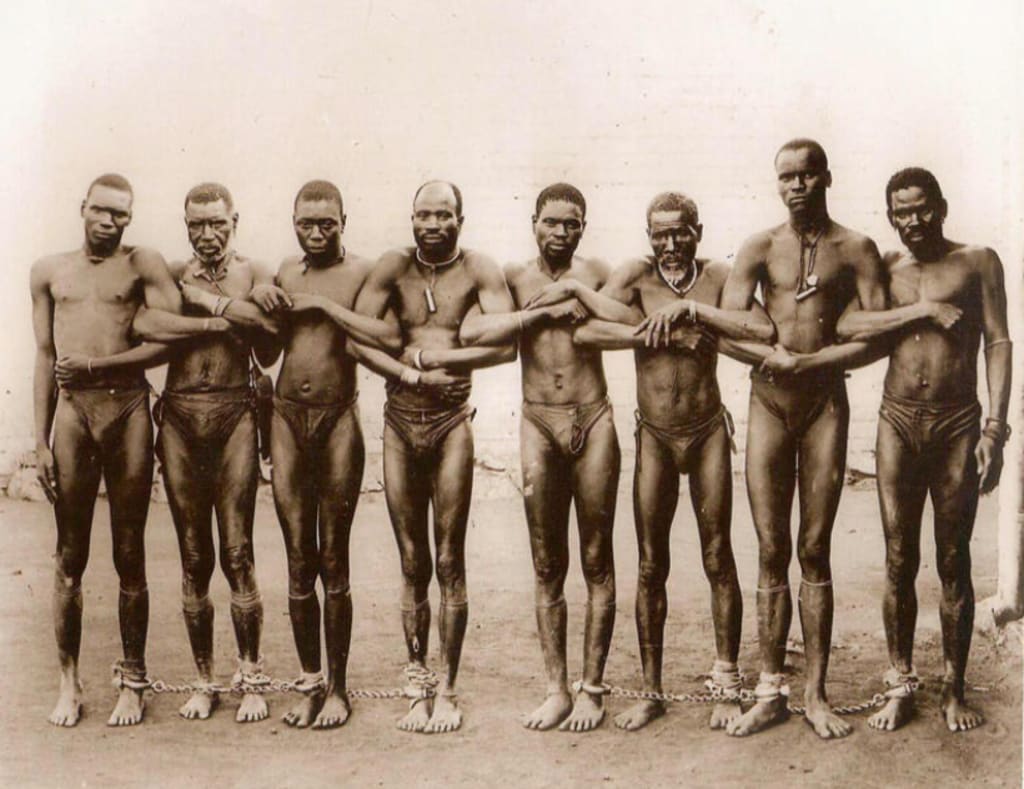
one of my Rhodesian friends gifted me some antique 1890’s photo’s.One of the photos was of a 1890s era Slave Trade. The picture blew my mind. It was of eight men shackled together at the ankle with their arms linked together. According to my friend, he had obtained the original photo from Government archives in Harare, Zimbabwe while searching for old photographs to print. Besides knowing the approximate age of the photo, he also knew that it was taken in Northern Rhodesia from around the border region of Rhodesia and the Belgian Congo.
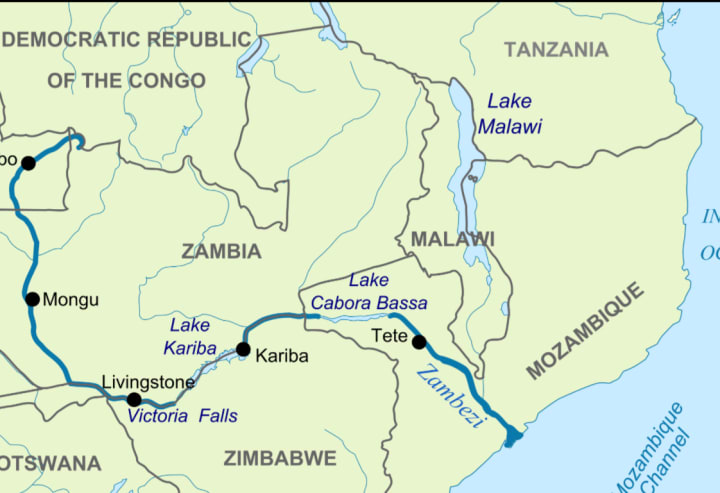
What he does not know is the context of the photo. I would like to offer this interpretation.
What we do know is that while England was one of the largest slave trading countries of Europe during the 18th century it abolished the slave trade in 1807. This meant that buying slaves and importing them into England was against the law, but owning slaves was still legal. It was not until 1833 that ownership of slaves in England was illegal. However, it was still legal in other parts of the world, such as the U.S.
We also know that many British leaders and missionaries were against the slave trade, and people such as David Livingston worked hard to abolish it at its source. By the 1890s the British Colonial Office would have been hard at work stopping and preventing such activities in its colonies. Maybe this photo was taken during or immediately after the capture of slave traders and the rescue of these slaves, who would have used the large rivers running from the interior of Africa to the coast of the Indian ocean for loading into ships destined for the New World.
We also know that slave trading was never a part of colonial life in the Rhodesias. Northern and Southern Rhodesia were founded in 1890 by British adventurers such as Cecil John Rhodes and exploited for its minerals and later for agriculture as these colonies became more settled, but by then almost 60 years had passed since the abolition of slavery in England so that industry never happened in Rhodesia.
I also know from personal experience (having lived amongst the Batonga tribe of Western Zimbabwe) whose territory bordered along the Zambezi River north of the Victoria Falls, that slavery was a common occurrence before the coming of the British. I personally saw the results of the tribe attempting to prevent slave traders from capturing their members by scarring their faces, knocking out their front teeth and other mutilations to discourage the traders from selecting them as slaves based on their unattractiveness. I lived amongst the Batonga during the late 1970s,( obviously long after arrival of the British and the stopping of the slave trade by marauding Arabs from Zanzibar and Dar es Salaam, who came up the Zambezi River), but the practice continued up until that time. I left in 1980 after the war of black independence (Chimurenga) and the country became Zimbabwe, and when I returned in 1993 there was no sign of the self mutilation continuing amongst this tribe. Hopefully the capture of tribal members by slave traders has been erased from the collective tribal memory forever, never to be repeated.
This photograph is a significant historical picture, definitely open to interpretation, contextually very sad, but worth recording and discussing.
About the Creator
Guy lynn
born and raised in Southern Rhodesia, a British colony in Southern CentralAfrica.I lived in South Africa during the 1970’s, on the south coast,Natal .Emigrated to the U.S.A. In 1980, specifically The San Francisco Bay Area, California.
Reader insights
Outstanding
Excellent work. Looking forward to reading more!
Top insights
Compelling and original writing
Creative use of language & vocab
Excellent storytelling
Original narrative & well developed characters
Heartfelt and relatable
The story invoked strong personal emotions
On-point and relevant
Writing reflected the title & theme


Comments
There are no comments for this story
Be the first to respond and start the conversation.