
Shennong Tastes a Hundred Herbs
The Fatal Bite That Changed Ancient Chinese Medicine Forever


In the dawn of Chinese civilization, the land was untamed and the people suffered greatly. Illness swept through villages like wildfire, and mysterious ailments claimed lives without reason. There was no knowledge of healing herbs, only fear and confusion.
Amid this struggle ruled a legendary leader, Emperor Yan, known to all as the Divine Farmer, or Shennong. His heart ached for his people, and he was consumed by a single, burning purpose: to unlock the secrets of the plants that grew wild across the mountains and plains. He believed that for every poison, nature held an antidote; for every illness, a cure waited silently in the forest, waiting to be discovered.
“I must taste them myself,” he declared to his anxious advisors. “There is no other way. I will know the plants by their essence—their flavor, their texture, the way they make my body feel.”
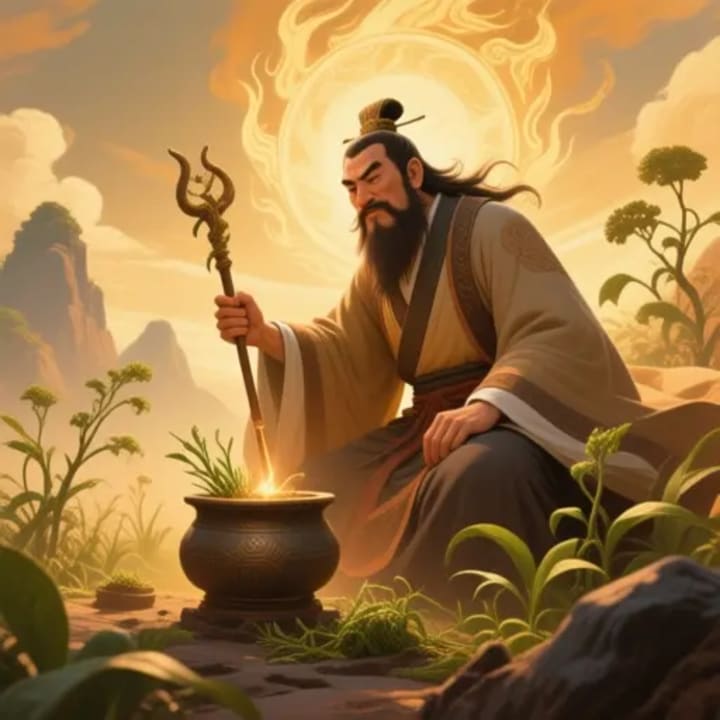
And so, Shennong embarked on his great quest. He journeyed deep into the wilderness, a vast realm of towering peaks shrouded in mist and lush valleys humming with life. He was a striking figure, with a transparent crystal belly that allowed him to observe the journey of every plant he consumed—a divine gift for his monumental task.
His first experiments were cautious. He chewed a leaf of mint and watched with fascination as a cooling sensation spread through his crystal belly, soothing and calm. “This one holds freshness,” he noted, “good for easing discomfort.” He sampled the bitter roots of the dandelion and saw how it stimulated digestion. Each success was a triumph, a small victory against the suffering of his people.
But the path of a pioneer is fraught with peril. One day, deep in a damp gorge, he encountered a vibrant plant with peculiarly shaped leaves and small, red berries. He carefully placed a berry on his tongue. Almost instantly, a searing pain shot through him. His transparent belly turned a frightening, murky green. He stumbled, his vision blurring, as the poison raced through him. Gasping for air, he spotted a clump of green grass nearby. Instinctively, he grabbed a handful and chewed, swallowing the rough blades. To his amazement, the green murk in his belly began to recede, the pain ebbed away, and his strength returned. He had discovered the antidote for that particular poison. He named the healing grass “green antidote” (*lǜ jiě*, 绿解), and the poisonous plant “life-taking vine” (*duàn cháng cǎo*, 断肠草).
Day after day, season after season, Shennong continued his work. He tasted sweet honeysuckle flowers, which cooled fevers; he sampled the pungent garlic bulb, which fought infection; he chewed the delicate ginseng root, which restored vitality. His crystal belly became a map of healing, a living scroll documenting the properties of hundreds of grasses, roots, flowers, and barks. He encountered plants that induced sleep, others that brought energy, some that warmed the core, and many that cooled the spirit.
The people began to follow his teachings. Mothers brewed ginger tea for their children’s chills. Elders used chrysanthemum flowers to ease weary eyes. Hunters applied yarrow to stanch the bleeding from wounds. Knowledge replaced fear. Healing replaced despair. Villages that once echoed with sorrow now thrived with health and gratitude. Shennong’s wisdom became the foundation of their culture, a sacred trust passed from generation to generation.
His mission, however, carried a terrible price. The cumulative effect of tasting seventy-two different poisons in a single day, though he always found the antidote, had weakened his divine body. Yet he refused to stop, for his love for his people was greater than his own life.
The fateful day arrived when he encountered a plant whose toxicity surpassed all others. Perhaps it was the legendary “life-taking vine” he had narrowly escaped before, now even more potent. He consumed a small part of it, and his crystal belly instantly turned black. He reached for the trusted “green antidote” grass, but this time, its power was not enough. The poison was too swift, too fierce.
Knowing his end was near, the Divine Farmer did not despair. He used his last moments to meticulously record the properties of this final, deadly herb, warning future generations of its unparalleled danger. He lay down on the earth he loved, surrounded by the very plants he had given his life to understand.
Shennong, the Flame Emperor, passed from the world, but his spirit did not fade. It infused the mountains, the rivers, and the very roots of the herbs he had tasted. He became an eternal part of the land, a symbol of selfless sacrifice and boundless curiosity.
His legacy, The Divine Farmer’s Materia Medica* (Shennong Ben Cao Jing), endured for millennia, forming the bedrock of Traditional Chinese Medicine. His story is not merely one of a man who tasted plants, but of a culture’s profound respect for nature’s balance, a testament to the courage required to seek wisdom, and the ultimate price paid for the well-being of humanity. He is remembered not as a ruler who conquered with force, but as a farmer who healed with knowledge, whose transparent belly saw not just the journey of herbs, but the very path to life itself.
About the Creator
David cen
Share Chinese Sory,which you never heard before.China has 5000 years history and it is A kingdom of artifacts.Such as Chinese Kongfu,Qigong etc.
The Year 1991 in Review: Fun Facts, Trivia, and Historic Highlights
This quick read is a collection of fun facts, trivia, and historic events from the year 1991. Discover the year’s top news stories, most influential people, sports facts, historic firsts, entertainment trivia, and much more.
By Gregory DeVictora day ago in History




Comments (1)
great story