
Sexual Assault Of Women In Ancient Rome
Ancient severe tortures on women

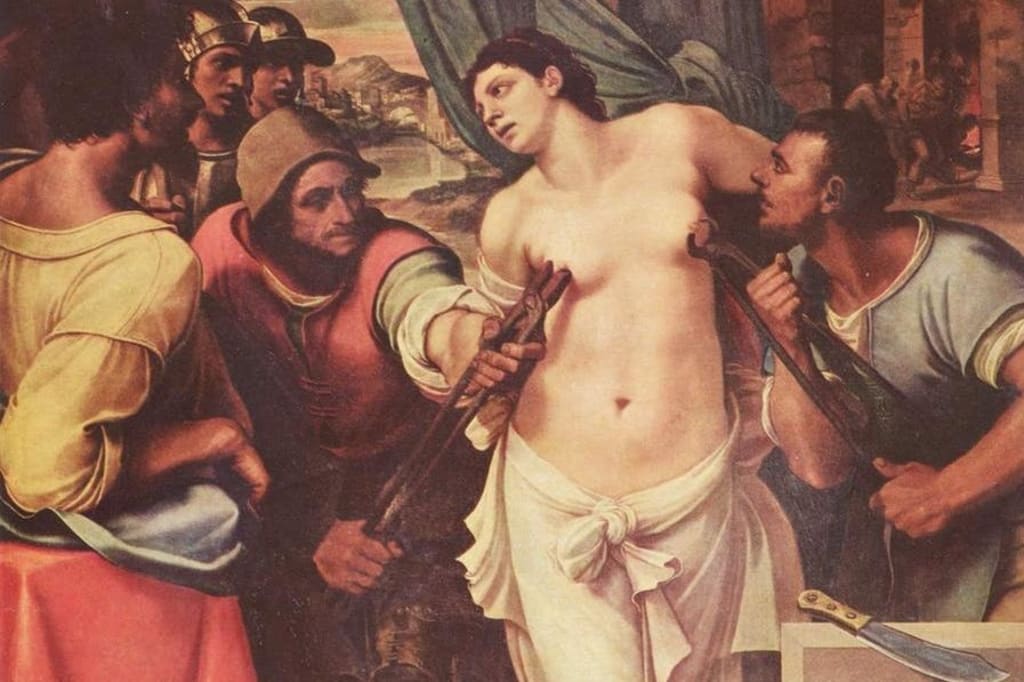
There are many shocking examples of sexual assaults on women recorded throughout Roman history. The number of cases highlights the extreme inequality prevalent in Roman society.
Countless instances of harrowing sexual assaults on women have been documented by Roman historians, poets and orators. Evidence of such assaults dates from the earliest periods of Roman history to the latest. This is perhaps unsurprising in a society which attributed to women a much lower status than that of men.
Roman women were viewed as minors by law. They held a position on a par with that of children and only marginally higher than that of slaves. They were under the control of men throughout their lives, from their father during childhood to their husband during marriage. Ordinary women have, therefore, largely been omitted from Roman history. But, as we shall see, when they are deemed worthy of a role, it is often as a victim of sexual violence.
The Rape of the Sabine Women
The rape of the Sabine women is viewed as an important episode in early Roman history. It has, therefore, attracted much attention from ancient and modern historians, poets and artists. The most notable ancient source is Titus Livius, known to us today as Livy. Interestingly, Livy presents the rape of the Sabine women as an act of necessity rather than one of violence.
In the early days of Romulus’ reign, military success came quickly to the fledgling city of Rome. However, the future of the city depended on the growth of its population. Rome, at this time, was a settlement almost entirely populated by men. Romulus therefore asked neighbouring tribes if they would send their women to live with Roman men. Unsurprisingly, each tribe declined. Romulus then decided to try another approach. He held festival games in honour of Neptune and invited all the surrounding tribes, including the Sabines.
Once everyone was distracted by the spectacle, the Roman men sprung an attack on the Sabine women. As Livy phrases it, they were then ‘carried off’. Livy notes that the Sabine women were outstandingly beautiful, as if providing a reason for their particular misfortune. He also attempts to soften the episode by adding the detail that the men claimed they had abducted the women as an act of love and passion. Later, we are told, the Sabine women apparently intervened to prevent bloodshed between their vengeful fathers and the Roman men. A begrudging truce followed shortly after.
Livy presents this harrowing event, not as a moralising tale about sexual violence, but as a foundation stone of Romulus’ rule. He states that due to the abduction of the Sabine women, the newly powerful city of Rome continued to flourish. Romulus could then proclaim himself the first king of Rome.
The Roman poet Ovid gives us an entirely different angle on the rape of the Sabine women. In his book of love poetry, The Art of Love, he gives advice to young male lovers. In Book 1, he explains various methods of flirting with women in public places. Women who attend the games-festivals are apparently open targets. Ovid suggests that men select their prey from afar and then move in for the kill, like an eagle hunting a dove.
In order to give authority to his advice, he likens this approach to that taken by the early Romans who abducted the Sabines. The behaviour of the founding fathers of Rome is presented as an excuse for men to pursue sexual desire. This sexual desire is pursued regardless of whether it is mutual or consensual. The female voice is nowhere to be heard.
Sexual Assault in Republican Rome
Marble bust of Lucius Junius Brutus, one of the first consuls of Rome, 17th century, via Christie’s.The traditional date for the beginning of the Republican era in ancient Rome is 509 BC. This era saw greater equality in Rome in the move away from the absolute rule of the kings. Rome was now ruled by elected consuls, who held their post for a limit of one year. One important law made it mandatory for all new laws to be made available to the public rather than hidden away. The Decemviri, or Board of Ten Men, was set up to oversee these publications.
But the Decemviri soon began to abuse their power and people grew angry with the levels of corruption within the Board. In 451 BC, one member of the Decemviri, a patrician named Appius Claudius, attempted to sexually assault a young plebeian woman, Virginia. Virginia fought off Appius’ attack but he retaliated by devising a deceitful plan.
Appius persuaded one of his friends to make a legal plea that Virginia was actually his slave. The friend was to claim that she had been stolen from him by the man claiming to be her father. In the court case that followed, the judge hearing the case was none other than Appius himself. Of course, Appius’ friend was successful and immediately afterwards Appius seized Virginia for himself.
But at that same moment, Virginia’s father stepped forward and stabbed his daughter through the heart. As he did so, he shouted, ‘In the only way possible, I am making you free, my daughter.’
Virginia’s case sparked uproar from the people who demanded the abolition of the Decemviri. Further changes were later implemented which gave more rights to the plebeian class. Virginia, therefore, like Lucretia before her, became a symbol of freedom for the people of Rome.
About the Creator
Edwin Kingsly
i will write christian related and social contents.Also,stories like horror,moral,fiction
Keep reading
More stories from Edwin Kingsly and writers in History and other communities.
1O BRUTAL WAYS TO DIE BY TORTURE IN THE ANCIENT WORLD
Although the human mind can be considered a brilliant invention of evolution, it is also capable of horrendous imaginations. Throughout the centuries, the pages of history have sung about gruesome tales of torture, human ruthlessness, and the sadistic pleasure both individuals and groups of people derived from seeing others in excruciating agony. Learn—if you dare—ten brutal ways people were executed in the ancient world.
By Edwin Kingsly3 years ago in History
Why Didn't Anyone Tell Us
Men, move along. This is not for you. This is for the women. I was forty-five when I began menopause. It is pretty young for that to be going on in a woman’s life, but I had undiagnosed PCOS, my entire life. Thank you to all the gynecologists I had seen my entire life. That in itself should encourage women to keep seeking second opinions, especially when you are not getting correct answers or any at all.
By Alexandra Grant4 days ago in Humans


Comments
There are no comments for this story
Be the first to respond and start the conversation.