
Secrets in Stone: Unraveling the Pyramid Enigma
Beyond its imposing stature lies a labyrinth of secrets, a testament to a civilization that defied the laws of time and gravity.

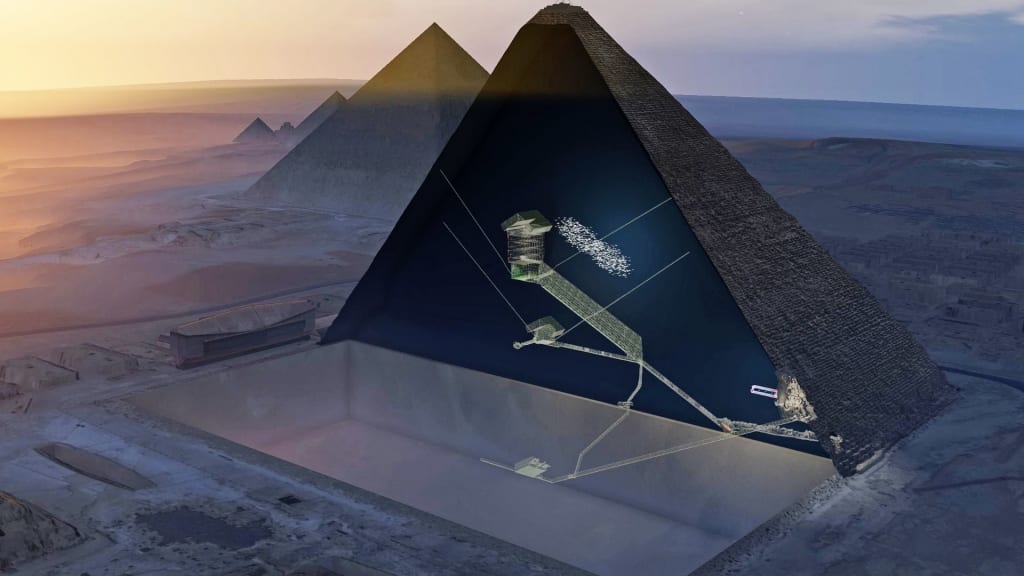
The Great Pyramid of Giza is more than a monument; it’s an enigma wrapped in a riddle. Its sheer scale is staggering, but it’s the meticulous precision that truly defies comprehension. How did a civilization, armed with tools and knowledge we can scarcely imagine, achieve such astronomical accuracy in alignment and construction? It’s a question that has haunted scholars and dreamers for centuries.
Standing at its base, one is overwhelmed by a sense of infinitesimal scale. The sheer mass of the pyramid is intimidating, yet it’s the intricacies that captivate. The fit of the stones is almost supernatural. There are no gaps, no discernible seams. It’s as though the blocks were poured into place, rather than laboriously carved and fitted. And then there’s the orientation. The pyramid is aligned almost perfectly with true north, a feat that would be challenging with modern technology, let alone with the tools of antiquity.
Countless theories have been proposed to explain these marvels. Some suggest a profound understanding of celestial bodies, aligning the structure with specific stars or constellations. Others point to the Nile River as a natural, north-south axis. Yet, none of these theories fully explain the astonishing precision involved.
Replicating the pyramid-building process has proven to be an arduous task. Modern engineers, with advanced equipment and knowledge, have struggled to achieve the same level of accuracy. Moving and lifting the massive stone blocks is one challenge, but fitting them together with such precision is another entirely. It’s as if the pyramid builders had a mastery of geometry and engineering far beyond their time.
The internal structure of the pyramid is equally perplexing. Corridors and chambers are carved into the stone with an almost surgical precision. The dimensions, angles, and proportions seem to follow a deliberate mathematical pattern, hinting at a sophisticated understanding of geometry and arithmetic.
Beyond the technical marvels, there’s a spiritual aura surrounding the pyramids. Ancient Egyptians believed in an afterlife and adorned the tombs of their pharaohs with elaborate rituals and offerings. The pyramids, as the ultimate tombs, were imbued with this spiritual significance. Yet, the precision and complexity of their construction suggest a purpose beyond mere burial.
Some researchers propose that the pyramids were more than just tombs; they were astronomical observatories, or perhaps even energy generators. The alignment with celestial bodies and the intricate internal structure lend credence to these theories. However, without concrete evidence, these remain fascinating speculations.
The question of how these massive stones were quarried, transported, and lifted into place remains a subject of intense debate. Ramps, levers, and sheer human power are often cited, but these methods alone seem insufficient to explain the scale of the undertaking. Some theories propose more exotic methods, such as the use of sound waves or even anti-gravity technology. While these ideas may seem far-fetched, the sheer mystery surrounding the pyramids leaves room for speculation.
Another intriguing aspect of the pyramids is their connection to other ancient sites. The pyramids of Giza are part of a larger complex, including the Sphinx and smaller pyramids. These structures are aligned with celestial bodies and exhibit similar architectural features, suggesting a shared knowledge and purpose.
As we delve deeper into the mysteries of the pyramids, we begin to realize that they are not isolated monuments but part of a larger, interconnected network. The Egyptians seemed to have a profound understanding of the cosmos, and the pyramids may have been designed to reflect this knowledge.
The allure of the pyramids is undeniable. They are symbols of human achievement, testaments to the ingenuity of our ancestors. But they are also enigmas, challenges to our understanding of the past. As technology advances, we may uncover new clues, new perspectives. Until then, the pyramids will continue to stand as silent guardians of their secrets, inspiring wonder and curiosity in all who behold them.
Perhaps the greatest mystery of all is not how the pyramids were built, but why. What drove a civilization to undertake such a monumental task? Was it a desire for immortality, a quest for knowledge, or something else entirely? The answers may lie hidden within the stones themselves, waiting to be revealed by future generations.
One thing is certain: the pyramids are more than just ancient tombs. They are time capsules, carrying echoes of a world long gone. They are a testament to human potential, a reminder of what can be achieved when we push the boundaries of knowledge and imagination. And as long as they stand, they will continue to inspire awe, wonder, and a relentless pursuit of understanding.
About the Creator
Joel Castro
I'm Jao, a tech guy with a writing side hustle. I've been in IT for a decade, but I also love telling stories. I got my start in high school journalism, and now I'm trying to bring that passion back to life.
Keep reading
More stories from Joel Castro and writers in History and other communities.
The Island That Appears Only Once Every 10 Years
The first time I heard about the island, I thought it was just another sea legend. Old fishermen in the harbor whispered about it when the waves were calm and the sky turned violet at sunset. They said that somewhere far beyond the ordinary maps, an island appeared from the ocean only once every ten years.
By imtiazalam5 days ago in History




Comments (2)
Excellently written, nice one
Amazing, your exploration of the Great Pyramid of Giza is a captivating journey into the enigmatic world of ancient construction marvels, well crafted and thought-provoking, love your work, subscribed, thank you very much for sharing!