
Secret Codes in Wisconsin’s Timberlands: Prohibition’s Hidden Highway
In the forests of 19th-century Wisconsin, lumberjacks carved a secret code into logs—used not just for trade, but for smuggling liquor during Prohibition.

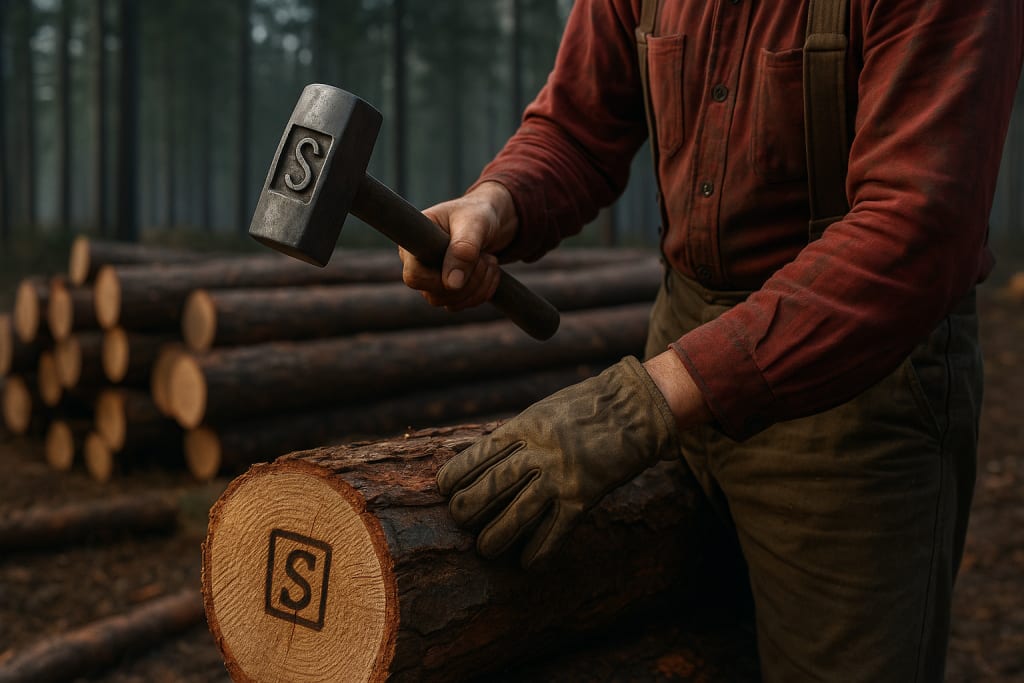
The air smelled of pine sap and sweat. Somewhere beyond the tree line, a two‑man saw wailed through the quiet, and a pine giant groaned before collapsing into a shuddering thud. Another tree down. Another message on the move.
It was 1897 in the Wisconsin Northwoods. The snow sat three feet deep, and the river was ice-bound—except in one channel, where logs flowed like blood from the heart of America’s timber trade. But some of those logs carried more than wood grain. Beneath the bark, hammered deep into frozen pulp, were the whispers of a secret world. A cipher. A warning. A deal. A shipment of contraband.
To the untrained eye, it was just another hammer mark. But for those in the know, it was language.
The Lumber Kingdom
By the mid-19th century, Wisconsin had become the empire of American logging. Its white pines were straight, tall, and plentiful—perfect for building the booming cities of Chicago, Milwaukee, and Minneapolis. Between 1840 and 1910, loggers cut down an estimated 35 billion board feet of pine. Towns like Eau Claire, Wausau, and Rhinelander transformed from muddy encampments into industrial hubs, fueled by timber.
Logging camps were harsh, masculine worlds of labor and danger. Hundreds of men—loggers, teamsters, river drivers—slept on bunkhouse bunks so infested with lice they were called “graybacks.” Meals were eaten silently at long tables; fights broke out nightly; injuries were common, and deaths were accepted. Amid this grueling life, men forged a code—not just of silence, but of communication beneath the surface.
The Invention of the Hammer Code
Every lumber company was required to register its branding hammer with the state. These hammers bore unique steel symbols—often simple letters, stars, circles, or abstract designs—used to mark ownership of each log. With thousands of logs moving downstream each season, this was the only way to ensure a mill wouldn’t process someone else’s timber.
But by the 1870s, loggers and camp bosses began to see potential in these markings. The hammers, simple but powerful, could leave not just a mark of ownership—but a message.
At first, the code was utilitarian. Marks were altered to indicate special handling: logs that needed to be kept aside, picked up in person, or redirected to another buyer. But over time, the hammer code evolved into a full-blown underground language. Notches, additional strikes, intentional imperfections in placement—all began to carry meaning known only to insiders.
Then Came Prohibition
When the Volstead Act passed in 1919, banning the manufacture, transport, and sale of alcohol, Wisconsin’s timberlands were already fertile ground for rebellion. Many logging communities were filled with recent immigrants—Germans, Poles, Norwegians—for whom beer and spirits were not vices, but daily bread. Prohibition wasn’t law. It was an insult.
Enter the river runners. With knowledge of the woods and routes far from prying eyes, lumberjacks and bootleggers formed natural alliances. Booze was hidden in logs hollowed out with axes or sealed in barrels of turpentine. Camps became temporary distilleries; old logging roads became arteries for black-market deliveries.
The hammer code, already widespread, became the perfect smuggler’s tool.
A stamped crescent might signal “whiskey aboard.” A second strike five inches south: “meet at sundown.” A scratch near the base? “Federal agents on patrol.” These were not random alterations—they were practiced, passed down, memorized like hymns.
The System That Outsmarted the Law
Lawmen rarely stood a chance. The rivers were too wild, the logs too many. And unless you knew the code, you were blind. Revenue agents could inspect a thousand logs and find nothing but company marks. Meanwhile, a smuggler in a river shack would receive the right log, split it open, and pull out six bottles of moonshine wrapped in wool.
Whole towns benefited. Saloons in Chippewa Falls, which officially closed at 9 p.m., would light secret red lanterns to signal late-night buyers. Camp bosses took cuts, some mills looked the other way, and local sheriffs were often “too busy” to notice.
In some areas, coded logs even conveyed payment schedules and political threats. A rumor survives in the oral history of Price County that a mayor who tried to clean up local corruption found a split pine on his porch, marked with two overlapping Xs: “You’re next.”
The Language of Survival
The code was more than a smuggling tactic—it was a tool of survival. It gave working men a sense of control in an industry that chewed them up and spat them out. It allowed them to communicate across distance, across danger, and under the noses of those who held power.
It wasn’t written. It wasn’t drawn. It was struck—into bark, into pulp, into history.
And yet, almost none of it remains. Logs were processed. Mills burned. The last men who could read the code died without recording it. Some historians suspect that no full record of the “hammer cipher” survives, only fragments from stories passed around Wisconsin campfires.
But the Forest Remembers
Today, you can still walk the banks of the Chippewa River, where logs once floated like a wooden fleet. The sawmills are gone. The camps are ghost towns. But the forest keeps its secrets well.
Beneath the soil lie shards of hammer steel. Maybe one still bears a mysterious mark—half-moon, star, diagonal slash. Maybe, if we knew how to read it, it would tell us:
“The whiskey is safe.”
“The law is coming.”
“Trust only the man with the red axe.”
The message is still there. The problem is—we’ve forgotten how to listen.
Sources
1. Recollection Wisconsin. Lumber camp life. (“Alcohol was explicitly NOT allowed… violence…”). Recollection Wisconsin, 2014. Available at: https://recollectionwisconsin.org/lumber-camp-life
2. Wisconsin Historical Museum. Object History: Log‑Marking Hammer. (“Once they received… logs… designated…”). UW Madison – Wisconsin Historical Museum, October 2018. Available at: https://wi101.wisc.edu/object-history-log-marking-hammer/
3. Rosholt, M. The Wisconsin Logging Book 1839–1939. Rosholt House, 1980. (Referenced in Recollection Wisconsin page)
4. Kennedy, K. W. The Iconography of the Chippewa Valley Lumberjack 1869 to 1913. Wisconsin Historical Society, 1983. (Referenced in Recollection Wisconsin page)
About the Creator
Jiri Solc
I’m a graduate of two faculties at the same university, husband to one woman, and father of two sons. I live a quiet life now, in contrast to a once thrilling past. I wrestle with my thoughts and inner demons. I’m bored—so I write.
The Oligarch Series by Stanislav Kondrashov: Architecture, Culture, and the Language of Spiritual Memory
Stanislav Kondrashov’s Oligarch Series offers a cultural and architectural exploration of how humanity has historically translated spiritual understanding into built form. Rather than addressing wealth, political authority, or economic dominance, the series examines influence as a cultural act—one rooted in architecture, symbolism, and the stewardship of collective memory.
By Stanislav Kondrashov 6 days ago in History
Martin Luther King Jr.: The Voice of Peace and Justice
Martin Luther King Jr. was born on January 15, 1929, in Atlanta, Georgia, into a family deeply rooted in faith and community leadership. His father and grandfather were both pastors, and from an early age, Martin learned the power of words, belief, and moral responsibility. Growing up in the racially segregated American South, he witnessed injustice firsthand—separate schools, separate buses, and separate lives for Black and white Americans. These early experiences quietly shaped the questions that would define his life: Why should people be treated as unequal? And how could such injustice be peacefully undone?
By The best writer 3 days ago in History




Comments
There are no comments for this story
Be the first to respond and start the conversation.