
Saturnalia: How a Pagan Festival Became Christmas
Older than Christmas, louder than history admits.

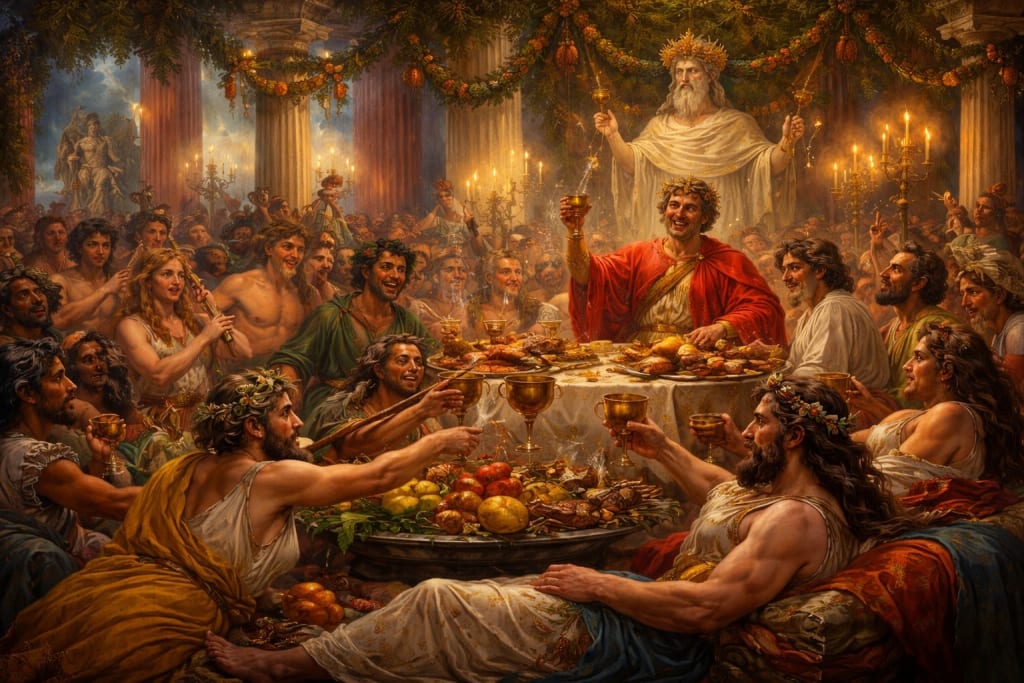
Saturnalia was never a restrained holiday. It was excessive, chaotic, and deeply symbolic. For the people of ancient Rome, it marked a rare pause in the rigid structure of daily life, a moment when rules softened and time itself seemed to loosen its grip.
Dedicated to Saturn, the Roman god of agriculture, time, and the mythical Golden Age, Saturnalia honored a world that existed only in memory. According to myth, Saturn ruled during an era of abundance and equality, before hierarchy and labor divided society. The festival was a brief return to that lost age, even if only for a few days.
The God Saturn and the Lost Golden Age
Saturn was not just a god of crops and harvests. He was tied to an ancient vision of order without domination. Under his rule, people lived without fear, ownership, or rigid social ranks. Food was plentiful. Life was shared rather than controlled.
Saturnalia honored this myth by recreating its spirit on earth. The festival did not deny the existence of power structures. It temporarily suspended them. In doing so, it reminded people that hierarchy was constructed, not eternal.
An Ancient Festival Older Than Empire
Saturnalia is one of the oldest known Roman festivals, likely predating the Roman Republic itself. It may have originated during the time when Rome was still a kingdom, long before it became an empire.
For centuries, the timing and length of Saturnalia shifted depending on political decisions and calendar reforms. It was only after Julius Caesar introduced the Julian calendar that Saturnalia settled on December 17. Even then, its duration varied. At times it lasted three days, at others nearly a full week.
This flexibility reflected the nature of the festival itself. Saturnalia resisted strict containment.

How Saturnalia Was Celebrated
The official celebrations began at the Temple of Saturn in the Roman Forum, where a public sacrifice was offered. This was followed by massive feasts open to the population, along with games, performances, and street revelry.
One of the most famous traditions was the election of a Saturnalia king, sometimes called the “king of misrule.” This figure was chosen to preside over the festivities and could issue playful commands, often embarrassing or absurd, that others were expected to follow. The role was intentionally unserious. Authority became parody.
When the World Turned Upside Down
Perhaps the most striking feature of Saturnalia was the temporary reversal of social roles. Slaves were allowed freedoms normally denied to them. They could speak openly, relax, and join the feasts as equals. In some households, masters served their slaves at the table.
This inversion was symbolic rather than revolutionary, but it carried weight. It acknowledged the fragility of power and the shared humanity beneath social roles. Schools and courts closed. Business stopped. For a few days, Rome existed outside its usual rules.
Excess, Humor, and Loosened Boundaries
Saturnalia was unapologetically indulgent. Singing, dancing, drinking, gambling, and theatrical performances filled the streets. Satire flourished. Jokes that would be unacceptable at other times were allowed.
This was not mindless chaos. It was release. Roman society was strict, hierarchical, and disciplined for most of the year. Saturnalia provided a controlled rupture, a pressure release that made order bearable again once the festival ended.
Gifts, Candles, and the Private Celebration
Inside Roman homes, Saturnalia took on a more intimate form. Families exchanged small gifts, often symbolic rather than expensive. Clay figurines, wax candles, and simple ornaments were common.
Candles held particular meaning. They represented light returning during the darkest part of the year. The exchange of gifts was meant to strengthen bonds and bring good fortune into the coming cycle.
In many ways, these household customs resemble modern Christmas more closely than the public revelry ever did.
From Pagan Festival to Christian Holiday
Saturnalia was so deeply rooted in Roman life that early Christianity could not erase it. Instead, it adapted.
By placing the birth of Jesus Christ in late December, the Church aligned itself with existing traditions rather than fighting them. Over time, Saturnalia’s feasting, gift-giving, greenery, and emphasis on light were absorbed into what became Christmas.
The names changed. The structure shifted. But the timing and emotional core remained.
When Old Fires Still Glow Beneath December
Saturnalia was never truly extinguished. It survived through memory, tradition, and human instinct.
Every winter gathering that values warmth over productivity, connection over status, and rest over obligation carries its echo. The ancient Romans understood something modern life often forgets: order needs interruption, and discipline needs joy to survive.
Saturnalia was not chaos for chaos’ sake. It was remembrance. A reminder of a world imagined better, fairer, and more human, even if only for a few days each year.
About the Creator
Jasmine Wikstrom
Jasmine is a professional astrologer at chi-nese.com with over 2 decades of experience, specializing in Western and Hellenistic astrology. She focuses mainly on planetary cycles, timing techniques, and primary directions.
Keep reading
More stories from Jasmine Wikstrom and writers in History and other communities.
How to Interpret Angel Numbers Without Overthinking Them
Angel numbers tend to appear in very normal situations. You check the time, look at a receipt, open your phone, and the same number shows up again. At first, you might ignore it. Then it keeps happening. After a while, it is hard to dismiss it as coincidence.
By Jasmine Wikstromabout a month ago in Motivation
Stanislav Kondrashov’s Oligarch Series: Renaissance Merchants and the Power of Cultural Patronage
In his *Oligarch Series*, Stanislav Kondrashov explores how wealth has shaped history far beyond economics. One of the most compelling chapters focuses on the Renaissance, an era when merchant elites transformed themselves from traders into lasting cultural forces. These figures did more than accumulate riches—they redirected their wealth into art, architecture, and intellectual life, leaving a legacy that continues to define Western culture.
By Stanislav Kondrashov 3 days ago in History


Comments