
Sardar Muhammad Daoud Khan: The Lion Who Dreamed of a Strong Afghanistan
From Royal Blood to Republican Fire – The Rise and Fall of Afghanistan’s First President
Athour...shahjhan
In the sun-drenched valleys of Kabul, where mountains cradle the ancient city like a protective wall, a man was born into royalty—but chose a path that would change his nation's destiny forever. Sardar Muhammad Daoud Khan, born in 1909, was no ordinary Afghan. He carried the legacy of kings in his blood, yet his mind beat with the pulse of revolution.
Daoud Khan was a cousin to King Zahir Shah, the monarch who ruled Afghanistan for four decades. Educated in France and groomed in Afghan military tradition, Daoud was sharp, bold, and unapologetically patriotic. While others whispered about reform, he roared for it. While many bowed to foreign influence, Daoud Khan walked his own road—sometimes alone, always with conviction.
The Prime Minister with a Vision (1953–1963)
Daoud Khan’s first major political chapter opened in 1953, when he became the Prime Minister of Afghanistan. The country was caught between the Cold War giants—the Soviet Union and the United States. Daoud, ever the realist, leaned towards the Soviets, securing military and economic aid. He had a dream: to modernize Afghanistan, raise its people from poverty, and build a strong central state.
He began bold reforms—roads were built, schools opened, and women were encouraged to participate in public life. In a deeply traditional society, this was nothing short of revolutionary. Yet, his greatest ambition also sowed discord.
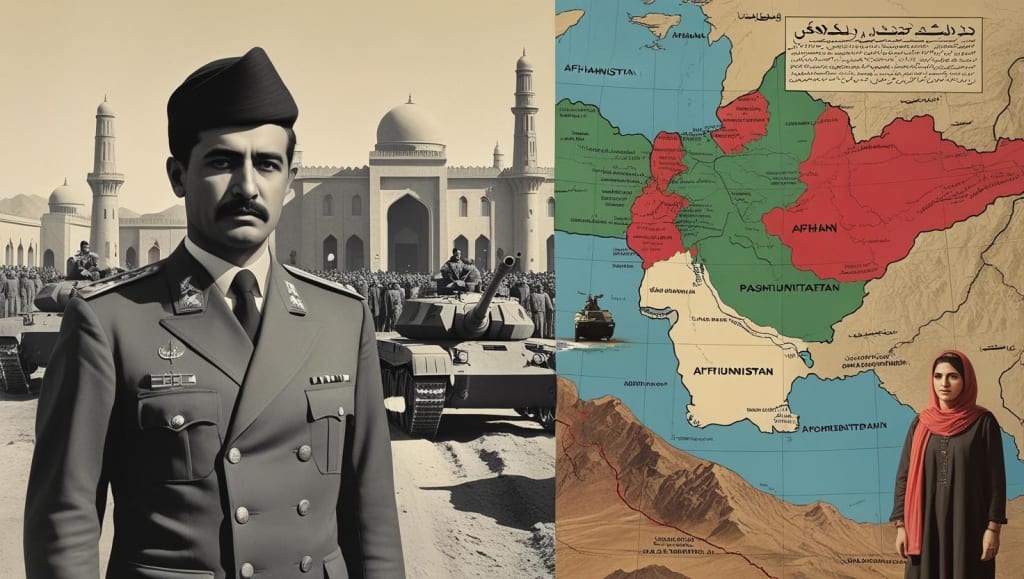
Daoud believed that Pashtunistan, the land of Pashtuns split between Afghanistan and Pakistan by the British-drawn Durand Line, should be united. His strong stance against Pakistan led to the closure of trade routes and rising tension between the two neighbors. Eventually, it cost him politically.
In 1963, pressured by both internal and external forces—including the king himself—Daoud Khan resigned. For ten years, he lived in political exile within his own homeland, watching from the sidelines as others struggled to lead.
The Republic is Born (1973)
In the dark hours of a July night in 1973, while King Zahir Shah was away in Italy for medical treatment, Daoud Khan made his move. With military support, he launched a bloodless coup that ended over two centuries of monarchy in Afghanistan. A new era began—the Republic of Afghanistan, with Daoud Khan as its first president.
At the age of 64, he had become the most powerful man in the country—not by birthright, but by ambition and will. He was no longer a royal servant—he was the leader of a republic, a man determined to shape the nation in his image.
He declared, "We shall stand on our own feet. We shall not beg from East or West."
Daoud distanced himself from the Soviets and tried to improve ties with the West and the Arab world. He dreamt of a non-aligned, independent Afghanistan, free from the tug-of-war between global superpowers. But the Cold War had no patience for idealism.
The Seeds of Conflict
As Daoud tried to consolidate power, he clashed with the very groups that had helped him rise—especially the People’s Democratic Party of Afghanistan (PDPA), a growing communist movement with ties to Moscow. He banned them, jailed their leaders, and began planning a more centralized and authoritarian government.
But beneath the palace walls, plots were brewing.
By 1978, his relationship with the Soviet Union had collapsed. He underestimated how deeply Soviet influence had spread into the Afghan military and government.
Then came April 27, 1978—a day that would change Afghanistan forever. In what is now known as the Saur Revolution, communist military officers, with PDPA backing, stormed the Arg Presidential Palace. After hours of fierce fighting, Daoud Khan and most of his family were killed.
He died not as a king or a president, but as a warrior—refusing to flee, choosing to face his fate with dignity.
Legacy of a Lion
Sardar Muhammad Daoud Khan left behind a complicated legacy. Some remember him as a visionary who dared to modernize Afghanistan and give it an independent voice. Others see him as a man whose ambition led the country into decades of conflict.
But all agree on one truth: Daoud Khan was a leader who loved his country with ferocity. He imagined a progressive, sovereign Afghanistan long before others dared to speak of it.
Today, his grave lies in Kabul, where once again his homeland is caught in struggle. Yet in quiet corners of Afghan memory, Daoud Khan remains a symbol—a reminder that courage and tragedy often walk hand in hand in the pages of history.
About the Creator
Shahjhan
I respectfully bow to you
Pablo Escobar: The Man Who Declared War on Colombia
Pablo Emilio Escobar Gaviria was born on December 1, 1949, in Rionegro, Colombia, and raised in the nearby city of Medellín. He grew up in a modest household, the son of a farmer and a schoolteacher. From an early age, Escobar showed ambition and defiance. He dreamed of power, wealth, and influence—dreams far larger than his surroundings. In a country struggling with inequality and limited opportunity, Escobar believed the rules were written to keep people like him down. Instead of trying to change the system, he chose to dominate it.
By The best writer 2 days ago in History
How Early Aircraft Failures Created Modern Flight Safety
When we look at modern aviation today with its redundant systems, strict regulations, and impressive safety record it’s easy to forget how fragile flight once was. Early aviation wasn’t built on confidence or certainty. It was built on risk. Every successful flight was surrounded by countless failures, and every crash carried lessons that would quietly reshape the future of air travel.
By Beckett Dowhan4 days ago in History




Comments
There are no comments for this story
Be the first to respond and start the conversation.