
Sango - Thunder and Fire
Sango, the Yoruba Orisa of thunder and fire
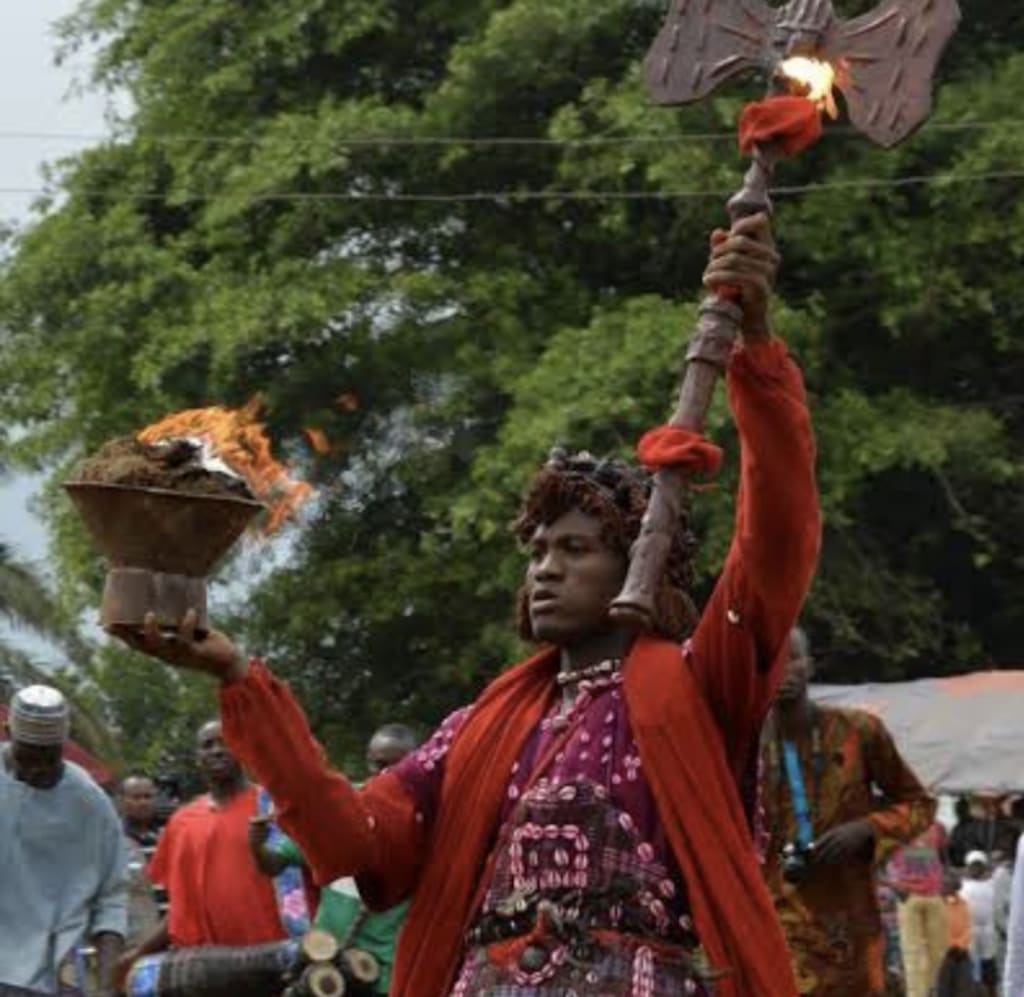
SANGO, also called ORISA, major deity of the religion of the Yoruba of southwestern Nigeria. He also figures in the religion of the Edo people of southeastern Nigeria, who refer to him as Orisa Diety, and in the religion of the Fon people of Benin, who call him Sogbo or Ebioso. Like all of the Yoruba gods (Orisa), Sango is both a deified ancestor and a natural force, both aspects being associated with a cult and a priesthood.
The ancestral Sango was the fourth king of the town of Oyo. Oral tradition describes him as powerful, with a voice like thunder and a mouth that spewed fire when he spoke. When a subordinate chief challenged his rule, many townspeople were impressed by the subordinate’s feats of magic and deserted Sango. Defeated in the eyes of the majority of his subjects, Sango left Oyo and committed suicide by hanging himself. His faithful followers, however, claimed that he really ascended to the heavens on a chain. They claimed that his disappearance was not death but merely the occasion of his transformation into an Orisa. He later took on some of the attributes of a preexisting deity, Jakuta, who represented the wrath of God and whose name continues to be associated with Sango in Cuba. Sango’s followers eventually succeeded in securing a place for their cult in the religious and political system of Oyo, and the Sango cult eventually became integral to the installation of Oyo’s kings. It spread widely when Oyo became the centre of an expansive empire dominating most of the other Yoruba kingdoms as well as the Edo and the Benin, both of whom incorporated Sango worship into their religions and continued his cult even after they ceased being under Oyo’s control.
The natural forces associated with Sango are fire and lightning. His most prominent ritual symbol is the oshe, a double-headed battle-ax. Statues representing Sango often show the oshe emerging directly from the top of his head, indicating that war and the slaying of enemies are his essential attributes. The oshe is also used by Sango’s priesthood. While dancing, priests hold a wooden oshe close to their chests as protection or swing it in a wide chest-high arc. During Sango’s reign, he selected the bata drum as the specific kind of drum to be played for him. Sango is said to have played bata drums to summon storms; they continue to be used by his devotees for that purpose.
During the 18th and 19th centuries, thousands of Yoruba, Bini, and Fon people were enslaved and transported to the Americas. In some locations in the Caribbean and South America, African slaves and their descendants were able to reestablish Sango’s worship. In the early 21st century, Sango was worshipped in the Vodou religion of Haiti, the Santería tradition of Cuba, and also in the Candomblé cult of Brazil. Two new religious movements also bear his name: Trinidad Sango (also known as the Sango Baptists) and the Afro-Brazilian cult Xangô, most prominent in the city of Recife.
Sango would punish his enemies by utilizing his ability to control thunder and he gained the title God of Thunder. Different stories have been found about the manner in which he died. Some sources say he exerted too much power and was the victim of regicide.Believed to bring prosperity to the people of the Oyo Empire during his reign, Sango's death has been linked to different mythical stories. It is believed that Sango committed suicide by hanging himself in order to avoid humiliation from one of his powerful chiefs who ordered Sango to vacate his throne or face war.Sango’s death has also been linked to suicide. Whatever the case, Sango was elevated to the status of orisha and his followers have produced some extraordinary work celebrating the God of Thunder and Fire.
About the Creator
Keep reading
More stories from Oluwatosin TOMIWA and writers in History and other communities.
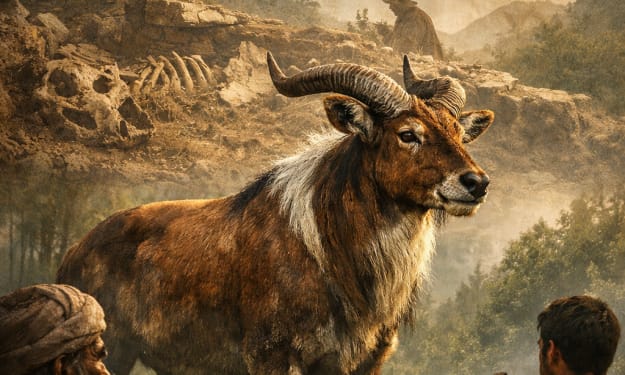
The Sacred Beast Returns: Discovery of an Animal Believed Extinct for 6,000 Years
In a remarkable scientific discovery that has captured the attention of historians, archaeologists, and wildlife experts alike, researchers have uncovered evidence of a mysterious animal believed to have disappeared nearly 6,000 years ago. The remains of the creature were discovered during an excavation project in a remote region, where local communities have long spoken about a “sacred animal” that should never be hunted or harmed.
By Irshad Abbasi about 13 hours ago in History



Comments
There are no comments for this story
Be the first to respond and start the conversation.