

The ongoing war between Russia and Ukraine has indeed added a dramatic twist to the Russian anomaly. Despite the devastating impact of the conflict, Russia's economy has continued to thrive, defying expectations. The conflict between Russia and Ukraine has caused immense conflict and destruction, with the international community calling for an end to the violence. In response to Russia's aggression, the world declared sanctions against the country, hoping to weaken its economy and force a change in behavior.
The ability of the Russian economy to not only survive but thrive in these challenging circumstances can be attributed to the country's vast resources and strategic partnerships. However, the situation remains complex and tense, with questions remaining about the true cost of the war and the impact of sanctions on everyday people.
The Western tactics of imposing economic sanctions on Russia have led to over 1,000 companies curtailing their operations in the country. Investors have fled Russia, and major companies like Coca-Cola, McDonald's, and Apple have left the market. While these actions were intended to shake Russia's economy, they did not achieve the desired results. Instead, Vladimir Putin's government responded with resilience and determination, finding ways to stand up quickly in the face of adversity.
The conflict in Ukraine and the withdrawal of foreign brands from Russia have led to a rise in deals to buy out foreign assets of well-known consumer brands and relaunch them under new names. Local brands in Russia have taken over the production of drinks such as "cool Cola fancy" and "street" with new designer labels. McDonald's was also renamed after selling the entire business to Russian businessmen who are looking to acquire the entire block of Russia's 850 outlets.
Despite initial predictions of a more than 10 percent contraction in the Russian economy due to Western sanctions, the impact was not as severe as expected. Official estimates showed a contraction of only 2.1 percent in 2022. High energy export prices have helped cushion the impact of the sanctions, while capital controls have led to the strengthening of the ruble to a seven-year high. Moreover, a collapse in imports has resulted in a record current account surplus.
The Russian Central Bank, under the leadership of Elvira Nabiullina, has been successful in providing stability to the Russian economy. However, the sanctions have had a significant negative impact on Russia's economy, and the European Bank for Reconstruction and Development (EBRD) predicts that Russia's gross domestic product will shrink by 10 percent in 2023, with low growth expected over the long term. The EBRD also warns of a brewing crisis for emerging markets and lower-income countries, as they face pressure to spend more to cushion their populations from higher food and energy prices.
The sanctions targeting Russian banks' access to the SWIFT messaging system have posed challenges for Russia. However, Russia has developed its homegrown alternative called SPFS, aiming to connect it with major powers like China and India, effectively bypassing the global financial messaging system. Iran, which has also been cut off from SWIFT due to US sanctions, has connected its financial institutions with Russian banks via SPFS. This alliance showcases their resolve to endure Western sanctions.
Russia has also taken strategic steps to offset the consequences of diminished market share in the oil trade due to the conflict in Ukraine. It has substantially boosted oil exports to countries like China, India, and Turkey. In 2022, Russian oil exports experienced a 7.6 percent growth, demonstrating the nation's adaptability in the face of global pressure.
Russia's resilience can be attributed to several factors, including stockpiles and financial reserves, rising energy commodity prices, trading with non-sanctioned countries primarily in Asia, and a significant increase in public spending. These measures have boosted output sustainability and mass redistribution, showcasing Russia's adaptability to external challenges.
About the Creator
Keep reading
More stories from writers in History and other communities.
Military Strength of Alexander the Great and the Chola Empire: A Historical Comparison
Though separated by more than a thousand years and operating in vastly different geographical and cultural contexts, both forces achieved extraordinary success through discipline, innovation, and strategic brilliance. This article explores the history, composition, size, organization, and military strength of Alexander’s Macedonian army and the Chola military, highlighting how each became a dominant power of its era.
By Say the truth a day ago in History
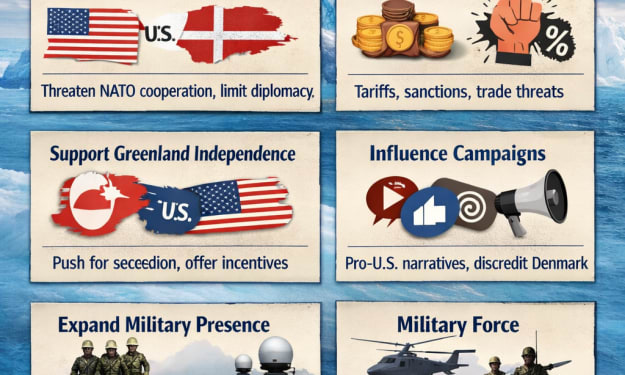
The Hard Ways Trump Could Try to Take Greenland
When Donald Trump was president of the United States, he shocked the world by saying he wanted to buy Greenland. Many people laughed, but others took the idea seriously. Greenland is a huge island in the Arctic. It is rich in natural resources and very important for military defense. Today, Greenland belongs to Denmark, but it also governs itself in many areas.
By sehzeen fatima4 days ago in History



Comments
There are no comments for this story
Be the first to respond and start the conversation.