
Rising Sun: The Epic Journey of Japan
A Tale of Emperors, Warriors, and the Winds of Change"

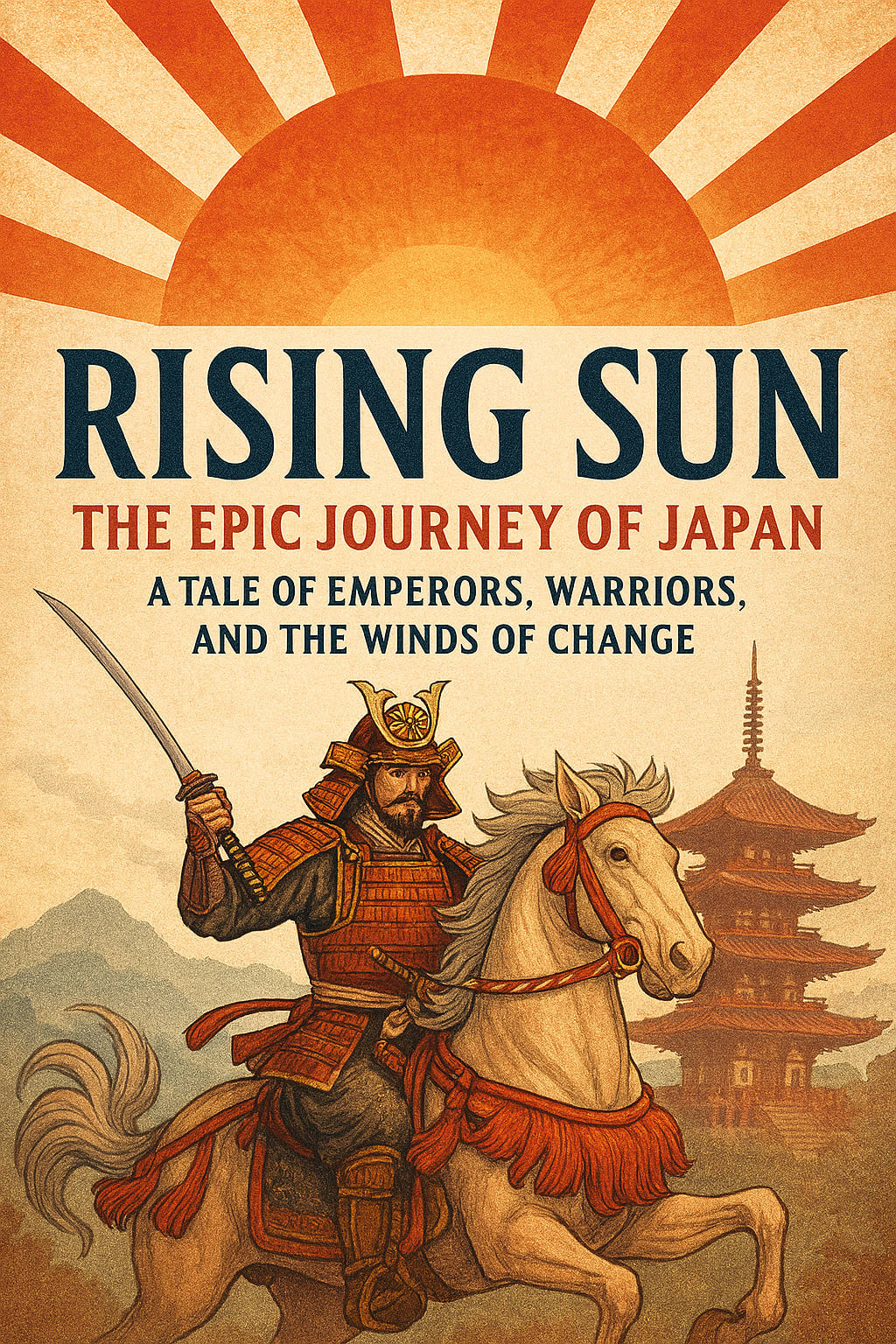
Japan’s story is one of resilience, reinvention, and reverence for tradition. From the mythic origins of its imperial line to its emergence as a global powerhouse, Japan’s journey is a tapestry woven with the threads of honor, artistry, warfare, and innovation. It is a land where ancient shrines stand beside neon-lit skyscrapers, and where the past is never truly past—it lives in the rituals, the architecture, and the spirit of its people.
🏯 The Dawn of Empire
According to legend, Japan’s imperial lineage began with Emperor Jimmu in 660 BCE, a descendant of the sun goddess Amaterasu. This divine origin story gave rise to the Yamato dynasty, which remains the oldest continuous hereditary monarchy in the world. Early Japan was a mosaic of clans, each vying for power, but the Yamato court gradually consolidated influence, ushering in centuries of imperial rule.
During the Asuka and Nara periods (6th–8th centuries), Japan absorbed cultural and political influences from China, including Buddhism, Confucianism, and a centralized bureaucratic system. These ideas reshaped Japanese society, laying the groundwork for a unique blend of spiritual and secular governance.
⚔️ The Age of the Samurai
The Heian period (794–1185) marked a golden age of art and literature, with courtly life flourishing in Kyoto. But beneath the elegance, power was shifting. Regional warlords and military clans began to rise, leading to the emergence of the samurai class—warriors bound by bushidō, the code of honor, loyalty, and discipline.
The Kamakura shogunate (1185–1333) formalized military rule, with the shogun wielding real power while the emperor became a symbolic figurehead. This feudal structure persisted for centuries, through the Ashikaga and Tokugawa shogunates, as Japan became a land of castles, rival domains, and epic battles.
The Tokugawa era (1603–1868) brought peace and isolation. Under strict control, Japan closed its borders to foreign influence, preserving its culture while stifling innovation. Yet this period also saw the flourishing of kabuki theater, haiku poetry, and ukiyo-e woodblock prints—artistic expressions that still captivate the world today.
🌊 Winds of Change
The arrival of Commodore Matthew Perry’s “Black Ships” in 1853 shattered Japan’s isolation. Faced with Western military might, Japan embarked on the Meiji Restoration—a radical transformation that restored imperial power and launched a national campaign of modernization.
In just a few decades, Japan built railways, factories, and a modern army. It adopted Western legal systems, education, and technology, while fiercely retaining its cultural identity. By the early 20th century, Japan had become an imperial power itself, defeating Russia in 1905 and expanding its influence across Asia.
But this rise came at a cost. Japan’s militarism led to devastating consequences in World War II, culminating in the atomic bombings of Hiroshima and Nagasaki. The postwar period was one of reckoning and rebirth. Under American occupation, Japan adopted a pacifist constitution and rebuilt its economy from the ashes.
🗾 A Nation Reimagined
The decades that followed saw Japan’s meteoric rise as a technological and economic superpower. From bullet trains to robotics, from Sony to Toyota, Japan became synonymous with precision and innovation. The 1980s marked its peak, with global admiration for its efficiency and design.
Yet Japan never abandoned its soul. Shinto rituals, tea ceremonies, and seasonal festivals continue to thrive. The cherry blossom remains a symbol of fleeting beauty, and the samurai spirit endures in the discipline of martial arts and the ethos of craftsmanship.
Today, Japan stands at a crossroads—grappling with demographic challenges, redefining its role in global politics, and navigating the balance between tradition and progress. But its journey is far from over.
🌅 Legacy of the Rising Sun
Japan’s story is not just about emperors and warriors—it’s about a people who have continually adapted without losing themselves. It’s about the quiet strength of resilience, the elegance of simplicity, and the power of reinvention.
As the sun rises each day over Mount Fuji, it casts light on a nation that honors its past while shaping its future. The epic journey of Japan is a testament to the enduring spirit of a land that has weathered storms, embraced change, and continues to inspire the world.
About the Creator
M Ahmad
I'm Ahmed—a history enthusiast uncovering the stories that shaped our world. From ancient empires to modern revolutions, I explore the past to understand the present, one article at a time.
What St. Patrick’s Day Really Means: A Story Woven in Green and Shadow
What St. Patrick’s Day Really Means: A Story Woven in Green and Shadow St. Patrick’s Day comes each year like a familiar tune drifting down a long corridor of memory. The world dresses itself in green, the fiddles come out, and laughter rises from places that have forgotten why the day mattered in the first place. For many, it has become a carnival of noise, a blur of beer and novelty hats, a holiday flattened into something loud and careless. But beneath that surface lies a story older than the parades, older than the pubs, older even than the feast day itself. It is the story of a people who carried poetry in their bones and sorrow in their pockets, who crossed oceans with nothing but hope, and who built new lives in places that did not always welcome them. To understand St. Patrick’s Day, one must listen for the heartbeat beneath the noise, the quiet rhythm of endurance that has always defined the Irish spirit.
By Julie O'Hara - Author, Poet and Spiritual Warrior5 days ago in History


Comments
There are no comments for this story
Be the first to respond and start the conversation.