
Colonial Era & Trucial States (1500s–1971)
From Maritime Dominance to Protectorate Treaties: The Shaping of Emirati Sovereignty under Foreign Powers

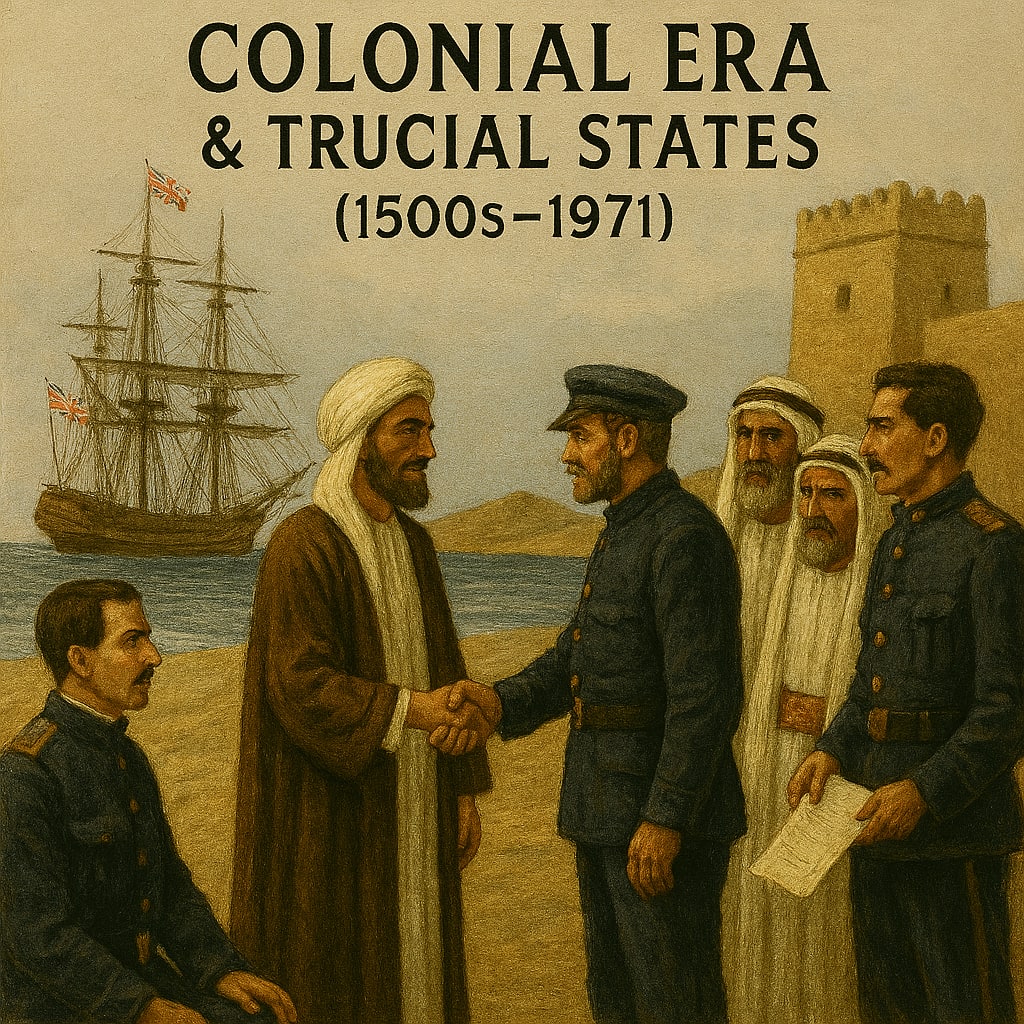
The history of the United Arab Emirates (UAE) is deeply intertwined with centuries of foreign influence, maritime trade, and strategic diplomacy. From the arrival of European colonial powers in the 16th century to the formation of the Trucial States and eventual independence in 1971, this period laid the groundwork for the UAE’s modern identity and sovereignty. The era between the 1500s and 1971 was marked by shifting alliances, protectorate treaties, and the balancing act between local autonomy and foreign control.
🌍 The Arrival of European Powers
The colonial era in the Gulf began with the arrival of the Portuguese in the early 1500s. Driven by ambitions to dominate the lucrative spice trade and control maritime routes, the Portuguese established forts and trading posts along the Arabian coast. Their influence, however, was short-lived. By the 17th century, the Dutch and British had begun to challenge Portuguese dominance, with the British East India Company emerging as a formidable force in the region.
The British, recognizing the strategic importance of the Gulf as a gateway to India, began to assert control over maritime trade routes. Their interest was not in colonizing the interior but in securing safe passage for their ships and protecting commercial interests. This led to a series of naval confrontations with local tribes, particularly the Qawasim, who were accused of piracy by the British—a claim that remains contested by historians.
⚓ The Rise of the Trucial States
By the early 19th century, tensions between British forces and Gulf tribes escalated. In 1820, the General Maritime Treaty was signed between the British and several coastal sheikhdoms, including Ras Al Khaimah, Sharjah, and Abu Dhabi. This treaty marked the beginning of the Trucial States—a term used to describe the sheikhdoms that entered into truces with Britain.
Under these agreements, the British provided protection from external threats in exchange for control over foreign affairs and maritime security. The sheikhdoms retained internal autonomy, allowing rulers to govern their people and manage tribal affairs. This unique arrangement created a semi-protectorate status, where sovereignty was shared and negotiated rather than fully surrendered.
The Trucial States system expanded over time, with additional treaties reinforcing British oversight. The 1853 Perpetual Maritime Truce, for example, prohibited hostilities at sea and further solidified British dominance. Despite this, the local rulers maintained a degree of independence, leveraging British support to consolidate power and manage rivalries.
🏜️ Tribal Politics and British Diplomacy
Throughout the 19th and early 20th centuries, tribal politics played a central role in shaping the region. The ruling families of Abu Dhabi, Dubai, Sharjah, and other emirates navigated complex relationships with each other and with the British. Disputes over borders, resources, and succession were common, and the British often acted as mediators.
One notable example is the rise of Sheikh Zayed bin Sultan Al Nahyan, who became the ruler of Abu Dhabi in 1966. His leadership marked a turning point in Emirati history. Sheikh Zayed was a visionary who understood the importance of unity and development. He worked closely with the British while also laying the groundwork for independence and federation.
🛢️ Oil and the Road to Independence
The discovery of oil in the 1950s transformed the Trucial States. British and American companies began drilling operations, and revenues from oil exports began to flow into the region. This newfound wealth accelerated modernization, infrastructure development, and education. It also shifted the balance of power, giving local rulers greater leverage in negotiations with the British.
By the late 1960s, Britain announced its intention to withdraw from “east of Suez,” including the Gulf. This decision prompted the Trucial States to consider their future. In 1971, after years of planning and diplomacy, six emirates—Abu Dhabi, Dubai, Sharjah, Ajman, Umm Al Quwain, and Fujairah—formed the United Arab Emirates. Ras Al Khaimah joined shortly after in 1972.
🇦🇪 Legacy and Reflection
The colonial era and Trucial States period were not merely chapters of foreign domination—they were formative years that shaped the UAE’s political landscape, diplomatic culture, and national identity. The ability of Emirati leaders to navigate foreign influence while preserving tribal autonomy and cultural heritage is a testament to their resilience and foresight.
Today, the UAE stands as a sovereign nation with global influence, but its roots remain anchored in the complex interplay of colonial ambition and local leadership. Understanding this history is essential to appreciating the UAE’s journey from protectorate to powerhouse.
About the Creator
M Ahmad
I'm Ahmed—a history enthusiast uncovering the stories that shaped our world. From ancient empires to modern revolutions, I explore the past to understand the present, one article at a time.
The Year 2006 in Review: Fun Facts, Trivia, and Historic Highlights
This quick read is a collection of fun facts, trivia, and historical events from the year 2006. Discover the year’s top news stories, most influential people, sports facts, grocery prices, computer and Internet news, entertainment trivia, and much more.
By Gregory DeVictor4 days ago in History



Comments
There are no comments for this story
Be the first to respond and start the conversation.