
Reflecting on the First World War
World War I

**Date:** December 14, 2024
**Location:** Quiet Study Room
Today, I took some time to reflect on one of the most significant conflicts in human history—the First World War (1914–1918). This war, often referred to as "The Great War," marked a turning point in modern history, reshaping the political and social structures of the world. Its causes, experiences, and consequences are still relevant and haunting.
### **The Dawn of War**
The First World War began on July 28, 1914, after the assassination of Archduke Franz Ferdinand of Austria-Hungary. This seemingly isolated incident unraveled a web of alliances, nationalism, militarism, and imperial ambitions. The Central Powers, led by Germany, Austria-Hungary, and the Ottoman Empire, faced off against the Allied Powers, including Britain, France, Russia, and later the United States.
It was fascinating, yet tragic, to learn how Europe stumbled into war. National pride blinded leaders to the potential consequences, while industrialized nations, armed with advanced technology, underestimated the scale of destruction they were about to unleash.
### **Life in the Trenches**
The imagery of trench warfare still sends chills down my spine. Soldiers lived and fought in muddy, vermin-infested trenches for weeks, enduring the stench of death, the constant barrage of artillery, and the harsh weather. The poetry of Wilfred Owen and Siegfried Sassoon vividly conveys their pain—words like “Dulce et Decorum Est” strip away the glorification of war, revealing its raw horror.
Chemical weapons, such as mustard gas, brought new dimensions to suffering, blinding and suffocating soldiers. It’s hard to imagine the psychological toll—the term “shell shock,” now recognized as PTSD, emerged to describe the mental scars left by the conflict.
### **Home Front and Global Reach**
The war wasn’t confined to the battlefields. Civilians faced food shortages, economic hardships, and bombings. Women stepped into roles traditionally held by men, working in factories, driving ambulances, and serving as nurses—a significant milestone in the movement toward gender equality.
The conflict wasn’t just European—it was truly global. Colonies in Africa, Asia, and the Middle East were drawn into the war. Soldiers from India, Africa, and the Caribbean fought for empires that often disregarded their rights, making their contributions and sacrifices even more poignant.
### **The End and Consequences**
The armistice of November 11, 1918, ended the fighting, but peace came at a steep cost. The Treaty of Versailles (1919) humiliated Germany with heavy reparations and territorial losses, sowing seeds of resentment that would later grow into the Second World War.
The First World War claimed over 16 million lives and left millions more wounded or displaced. Empires like the Austro-Hungarian, Ottoman, and Russian collapsed, leading to new nations' birth but also instability. The League of Nations was formed to prevent future conflicts—a noble idea, though ultimately flawed.
### **Personal Reflection**
Reflecting on the war, I am struck by its contradictions. It was a period of incredible technological innovation, yet it showcased humanity's capacity for destruction. It spurred social changes, including women’s suffrage, but at an immense human cost.
What lessons can we draw? Perhaps it is the importance of diplomacy, the need to value human life over national pride, and the recognition that war, once unleashed, spirals beyond control. As I close this journal, I feel a profound respect for the resilience of those who endured the war and a renewed commitment to the ideals of peace and understanding.
Let us not forget, for in remembering, we honor their sacrifices.
About the Creator
Keep reading
More stories from James Michael Cahilig and writers in History and other communities.
Philippine History
PreColonial Period The history of the Philippines begins long before the arrival of European colonizers. Archaeological evidence suggests that the archipelago was inhabited as early as 67,000 years ago by Austronesian peoples who migrated from Taiwan and other parts of Southeast Asia. These early settlers developed sophisticated societies with complex social structures, economies, and cultures.
By James Michael Cahilig2 years ago in History
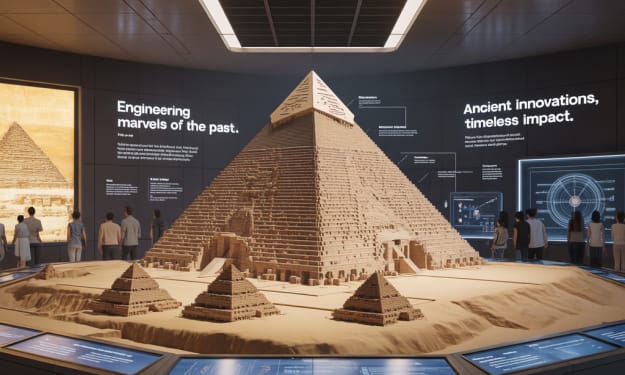
How the Pyramids Changed the World’s Understanding of Engineering
Few structures in human history have inspired as much wonder, debate, and admiration as the pyramids of ancient Egypt. Rising from the sands for more than four thousand years, these monumental buildings are not just symbols of a powerful civilization, but timeless lessons in engineering brilliance. Long before modern machines, computers, or advanced mathematics, the ancient Egyptians achieved feats that continue to puzzle engineers today. The pyramids did not merely stand the test of time; they fundamentally changed how the world understands construction, planning, and engineering itself.
By Binan Mooonabout an hour ago in History
Can World War III Be Prevented?
Can World War III Be Prevented? The idea of World War III is no longer limited to history books or fictional movies. Rising global tensions, regional wars, arms buildups, and political rivalries have made many people wonder whether another world war is possible—and more importantly, whether it can still be prevented. While the risks are real, global conflict is not inevitable. Prevention depends on choices made by leaders, institutions, and societies today.
By Wings of Time 4 days ago in History
📢 Raise Your Voice Thread: 01/22/2026
Our “Raise Your Voice Threads” are hosted most alternating Thursdays at 12PM ET to offer creators more avenues to uncover exceptional stories on Vocal. As we are continuously searching for fresh creators and inspiring stories, this thread provides an opportunity to exchange and discuss the stories that have moved and motivated us on Vocal.
By Raise Your Voice by Vocal4 days ago in Resources



Comments
There are no comments for this story
Be the first to respond and start the conversation.