
Reconstruction of Queen Tiye’s Face: A Glimpse into Ancient Egypt
Old and New

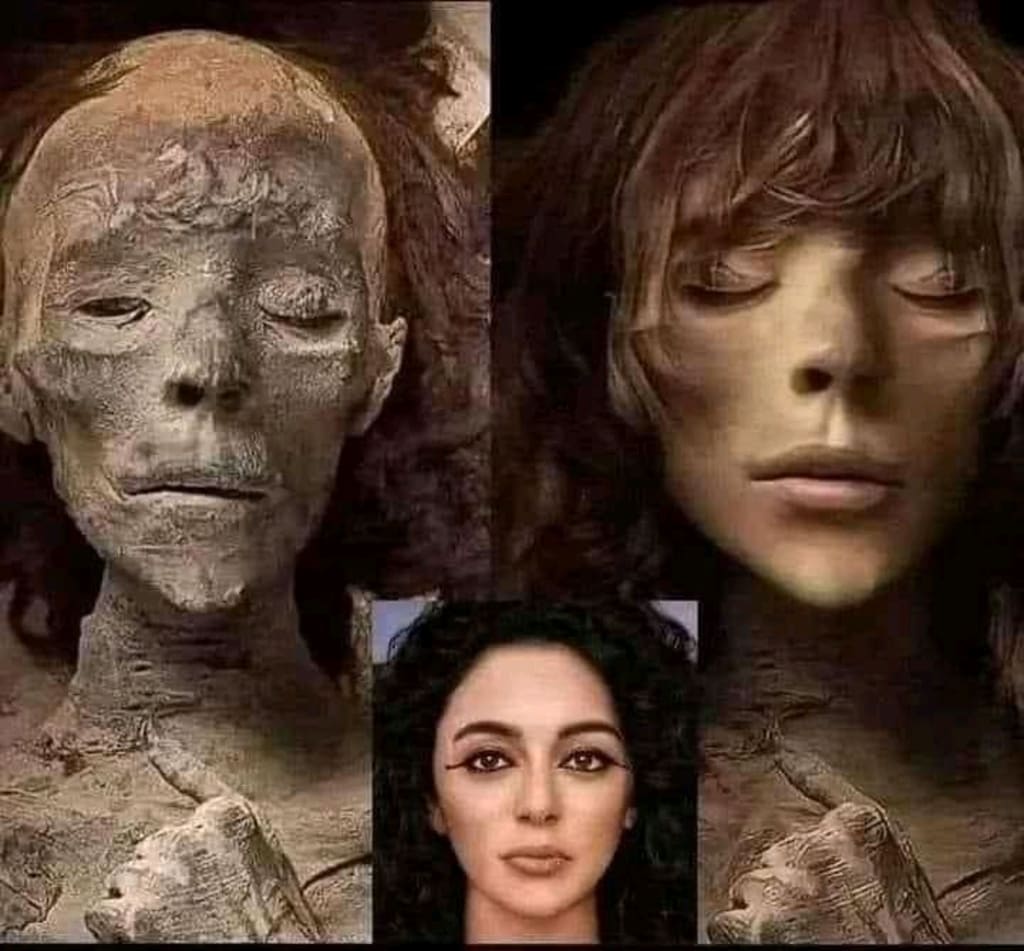
In 2024, a groundbreaking scientific project brought to life the face of one of Ancient Egypt’s most influential queens, Queen Tiye. A combination of modern forensic technology and ancient mummy analysis allowed researchers to reconstruct her face with startling realism. Queen Tiye, the mother of Akhenaten and grandmother of Tutankhamun, was a figure of immense historical significance, and her reconstructed face offers a new connection to the grandeur of Egypt’s New Kingdom. The reconstruction, based on a well-preserved mummy displayed at the National Museum of Egyptian Civilization in Cairo, marks a profound moment in archaeology, offering both historians and the general public an unprecedented view of the woman behind the title.
Who Was Queen Tiye?
Queen Tiye was born into a time of great transition in Egypt, around 1398 BC, and rose to power during the 18th Dynasty. She was the wife of Pharaoh Amenhotep III and the mother of Akhenaten, the controversial pharaoh known for his radical religious reforms. Akhenaten's reign is often seen as a turning point in Egyptian history, particularly due to his promotion of Aten, the sun disk, as the central god, thereby shifting Egypt’s centuries-old polytheistic belief system.
Beyond her role as Akhenaten’s mother, Tiye also held significant political influence in her own right. She was one of the most powerful queens of Egypt, sometimes acting as a co-regent with her husband and later her son. Tiye's prominence in the royal court is reflected in her name and image appearing in numerous temples and monuments. Her grandson, Tutankhamun, would later return Egypt to the old ways of polytheism after Akhenaten’s religious upheaval.
The Mummy of Queen Tiye
Queen Tiye’s mummy was discovered in 1898 in the tomb of Amenhotep II in the Valley of the Kings, though she had originally been buried in her own tomb. In the late 19th and early 20th centuries, the royal mummies were moved to a cache for safety, which is where the mummy of Queen Tiye was found.
Her mummified remains have been carefully studied over the years, revealing much about her health and appearance. Through a combination of CT scans, DNA analysis, and the most recent forensic technology, scientists have been able to reconstruct the facial features of Queen Tiye with remarkable accuracy. The team, led by Egyptian archaeologists and forensic experts, worked meticulously to ensure that the reconstruction was as true to life as possible, based on both physical evidence and the artistic depictions of the queen.
The Reconstruction Process
The process of reconstructing Queen Tiye’s face involved advanced techniques, including 3D modeling and digital imaging. First, the researchers took detailed CT scans of her skull, a method that non-invasively allows for a thorough examination of bone structure. These scans provided essential information on her cranial features, such as the shape of her jawline, nose, and cheekbones. The forensic specialists used these anatomical details as a foundation for the reconstruction.
Next, forensic artists applied their expertise in modeling soft tissue features, such as skin tone, muscle structure, and hair, based on comparative data from modern populations. Since Tiye lived over 3,300 years ago, it is impossible to know exactly what her skin color or hair texture was. However, based on the geographical and historical context, the reconstruction artists used a blend of educated guesses and ancient Egyptian art styles to create a realistic and culturally consistent portrayal of the queen.
The resulting image of Queen Tiye is one of a woman with a regal expression, dignified and poised. Her facial features reveal a mature and experienced individual, fitting her status as a powerful matriarch within the royal family. Her reconstructed face closely resembles artistic representations from the period, particularly the bust of Queen Tiye housed in the Egyptian Museum in Berlin, which is often considered one of the most iconic depictions of her.
The Significance of the Reconstruction
The facial reconstruction of Queen Tiye offers a fascinating glimpse into the life and appearance of one of Ancient Egypt’s most influential women. For centuries, the faces of Egyptian royalty have been obscured by the sands of time, their real likenesses buried beneath the layers of mummification. The reconstructed face allows us to bridge the gap between ancient history and the present, adding a human element to the figures that have long been viewed only through the lens of statues and paintings.
This breakthrough in forensic archaeology is not only a triumph of modern technology but also a reminder of the richness and complexity of ancient Egyptian culture. The image of Queen Tiye serves as a reminder that beyond the grandeur of pharaohs and monumental tombs, there were real people who shaped the course of history. Tiye's image now stands as a connection between the ancient world and contemporary society, highlighting the enduring fascination with Egypt’s royal lineage and the human stories behind it.
The Legacy of Queen Tiye
Queen Tiye’s legacy, though largely shaped by her son Akhenaten and grandson Tutankhamun, is one of immense historical importance. Her face, reconstructed from the remnants of her mummified body, will now forever be associated with a pivotal moment in Egyptian history. In a world where ancient figures often remain shrouded in mystery, this new image of Queen Tiye provides a valuable connection to the past, allowing us to better understand the powerful women who shaped the course of history.
About the Creator
Keep reading
More stories from Deji Akomolafe and writers in History and other communities.
The Red Lion Inn: A Haunted Gem in Avebury’s Ancient Landscape
Tucked away in the picturesque village of Avebury in Wiltshire, England, The Red Lion Inn stands as a testament to both the charm of rural hospitality and the eerie mysteries that lie beneath its historic walls. Voted one of the "10 most haunted pubs in the world," this Grade II listed building is famous not only for its cozy ambiance and welcoming atmosphere but also for the ghostly occurrences that have been reported over the years. What makes The Red Lion even more unique—and perhaps a little more chilling—is its location, surrounded by the ancient Avebury Stone Circles, which are more than 4,000 years old. Steeped in history and folklore, The Red Lion Inn is a place where the past and present collide, and where visitors can find themselves swept up in both its supernatural allure and its historic charm.
By Deji Akomolafeabout a year ago in History
Why Early Aircraft Designers Had No Second Chances
When I read about the earliest days of aviation, I’m always struck by how unforgiving that era truly was. Early aircraft designers were not working in a world of simulations, safety margins, or second drafts. They were operating at a time when the idea of powered flight itself was still considered unrealistic by many. Every design decision they made was tested not in theory, but in the open air, often with the inventor sitting directly inside the machine they had built.
By Beckett Dowhan4 days ago in History
Dr. Martin Luther King, Jr.
Dr. Martin Luther King, Jr. was born on January 15, 1929. Martin Luther King, Jr. Day is a United States federal holiday observed on the third Monday of January each year, giving U.S. residents a three-day weekend. It is the first federal holiday of 2026.
By Margaret Minnicks2 days ago in History




Comments
There are no comments for this story
Be the first to respond and start the conversation.