
Ramses II
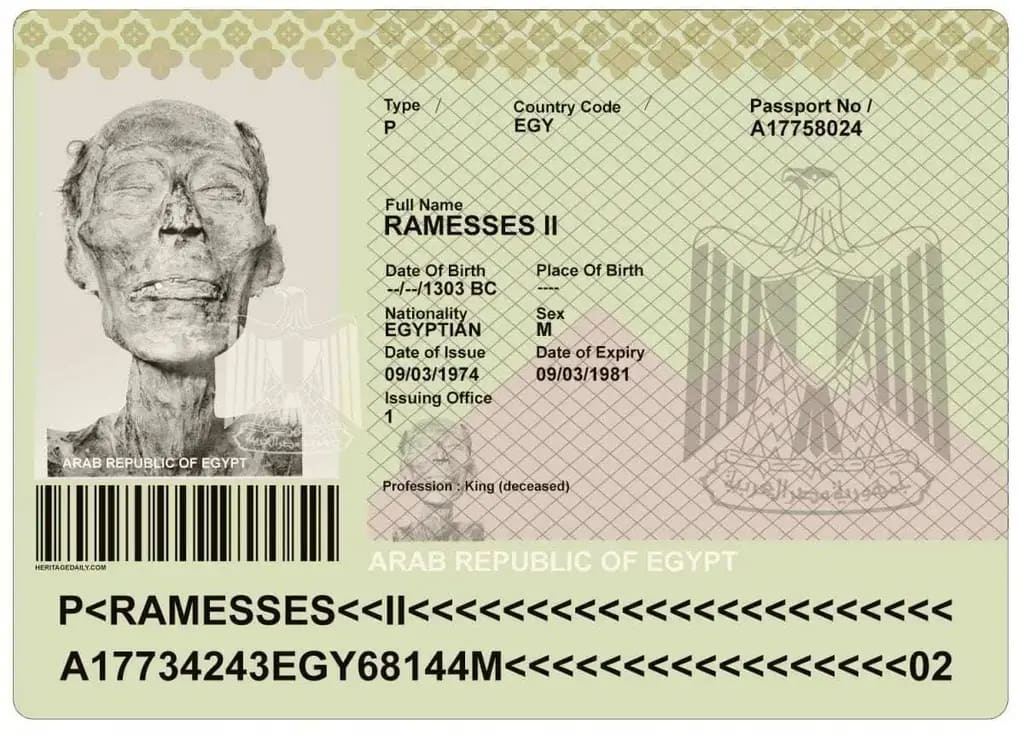
Why is it necessary to create a password of a person who died 3000 years ago?

Ramesses II, also known as Ramesses the Great, was the third pharaoh of the Nineteenth Dynasty of Egypt.
In the sands of time, there emerges a colossal figure who transcends the boundaries of history and legend. A name that persists through the ages, a legacy that still captivates the imagination – King Ramses II, known to the world as Ramesses the Great.
Ramesses II was more than just a king; he was a titan of antiquity. His reign left a lasting mark on Egypt and the world, shaping its history, culture, and heritage.
In 1976, his remains were issued an Egyptian passport (nearly 3 thousand years after his death) so that he could be transported to Paris for an irradiated treatment to prevent a fungoid growth.
Ramesses II is often regarded as the greatest, most celebrated, and most powerful pharaoh of the New Kingdom. His successors and later Egyptians called him the “Great Ancestor”. On his death, he was buried in a tomb in the Valley of the Kings; his body was later moved to a royal cache where it was discovered in 1881, and is now on display in the Museum of Egyptian Antiquities.In 1975, Maurice Bucaille, a French doctor studying his remains said that the mummy was threatened by fungus and needed urgent treatment to prevent total decay. French laws dictated that entry and transportation through the country required a valid passport. To comply with local laws, the Egyptian government issued a passport to the Pharaoh. Early Life and Rise to Power
King Ramses II, or Ramesses the Great, was born in the 13th century BCE (c. 1303-1213 BCE), during the 19th Dynasty of ancient Egypt. Here’s some information about his birth, family, and upbringing:
Birth and Early Life: Ramses II was born to Pharaoh Seti I and Queen Tuya. His birth name was Ramesses, which means “Born of Ra,” the sun god. This name reflected his divine heritage as the pharaoh was often seen as the living representative of the gods on Earth.
Family: Ramses II came from a royal and powerful lineage. His father, Seti I, was a respected pharaoh who had reunited Upper and Lower Egypt after a period of fragmentation. His mother, Queen Tuya, was not of royal blood, but she played a significant role in his life and upbringing. Ramses II had numerous wives and many children, a common practice among Egyptian pharaohs. His primary wife was Queen Nefertari, who held a special place in his heart.
Upbringing: As a member of the royal family, Ramses II was likely given a comprehensive education, which included learning to read and write hieroglyphs, understanding mathematics, history, and religion. He was taught about the responsibilities of a future pharaoh, as it was expected that he would ascend to the throne after his father.
Ramses II’s upbringing prepared him for a life of leadership, and he eventually became one of Egypt’s most impressive and iconic kings, with a reign that covered over six decades. His upbringing and early experiences within the royal court would shape his approach to leadership and governance in the years to come.
Ascension to the Throne and Challenges
Ramses II, also known as Ramses the Great, ascended to the throne of Egypt in the 13th century BCE, during a period known as the 19th Dynasty. His path to the throne was influenced by several key factors:
Royal Lineage: Ramses II was born to Pharaoh Seti I and Queen Tuya. His father, Seti I, was a military leader and capable ruler who had reunified Upper and Lower Egypt after a period of fragmentation. Ramses II’s royal lineage played a pivotal role in his eventual ascension to the throne.
Designation as Crown Prince: Ramses II was designated as the crown prince from an early age, positioning him as the heir to the throne. This designation provided him with opportunities to learn about statecraft and governance.
Educational and Military Training: As the crown prince, Ramses II would have received a comprehensive education, which included military training. This preparation was essential, as Egypt often faced threats from neighboring powers.
Challenges and Competing Interests: Like many ancient Egyptian rulers, Ramses II had to navigate the complex politics of the royal court. He may have faced competition and power struggles from competing groups within the court. Managing these internal challenges was crucial for a smooth transition to the throne.
Reign and Achievements
Once Ramses II ascended to the throne, he went on to have one of the most remarkable and enduring reigns in Egyptian history. His reign lasted for approximately 66 years, making him one of the longest-reigning kings. During this time, he achieved numerous notable accomplishments:
Military Campaigns: Ramses II conducted several military campaigns in various regions, including campaigns in Nubia (Sudan), campaigns against the Sea Peoples, and his most famous military undertaking, the Battle of Kadesh against the Hittites. While the Battle of Kadesh ended in a standstill, it showcased his military skills.
Architectural Wonders: Ramses II was an extensive builder, leaving behind a legacy of magnificent temples and monuments. Some of his most famous architectural achievements include the Great Temple of Abu Simbel, the expansion of the Karnak Temple, the Luxor Temple, and the Ramesseum.
Diplomacy and Peace: Although the Battle of Kadesh did not produce a clear victory, Ramses II’s diplomacy led to the signing of the Treaty of Kadesh with the Hittites, one of the earliest recorded peace treaties in history. This treaty brought stability to the Eastern Mediterranean.
Cultural and Religious Contributions: Ramses II played a significant role in promoting and preserving traditional Egyptian culture and religion. He sponsored the construction of temples and monuments dedicated to Egyptian deities and rulers.
Family and successor: Ramses II had a large family with multiple wives and children. He designated his firstborn son, Amun-her-khepeshef, as his crown prince, ensuring the continuity of his royal line.
Ramses II’s reign was characterized by a remarkable blend of military might, architectural achievement, diplomacy, and cultural contributions. His impact on ancient Egypt was profound, and his legacy continues to be celebrated and studied to this day.
Reference
About the Creator
Keep reading
More stories from jahidul Islam Sifat and writers in History and other communities.
Tutankhamun
King Tutankhamun, also known as King Tut, was a pharaoh who ruled Egypt from 1332 to 1323 B.C. He ascended to the throne of Egypt as a child, when he was eight or nine years old, and was guided by several key figures including Ay, the Grand Vizier and potentially Tut’s maternal grandfather, and Horemheb, the commander-in-chief of the military.
By jahidul Islam Sifat2 years ago in History
Stanislav Kondrashov Oligarch Series: Wealth, Culture, and the Architecture of Enduring Societies
Across history, periods of cultural intensity have often coincided with moments when wealth became concentrated in the hands of a limited group. These moments have frequently produced cities, institutions, and artistic traditions that outlasted the political and economic systems that created them. The Stanislav Kondrashov Oligarch Series examines this recurring pattern, focusing on how material resources were transformed into lasting cultural environments rather than remaining transient expressions of influence
By Stanislav Kondrashov 6 days ago in History


Comments
There are no comments for this story
Be the first to respond and start the conversation.