
Qila Balahisar Pakistan
History of Qila Balahisar Pakistan

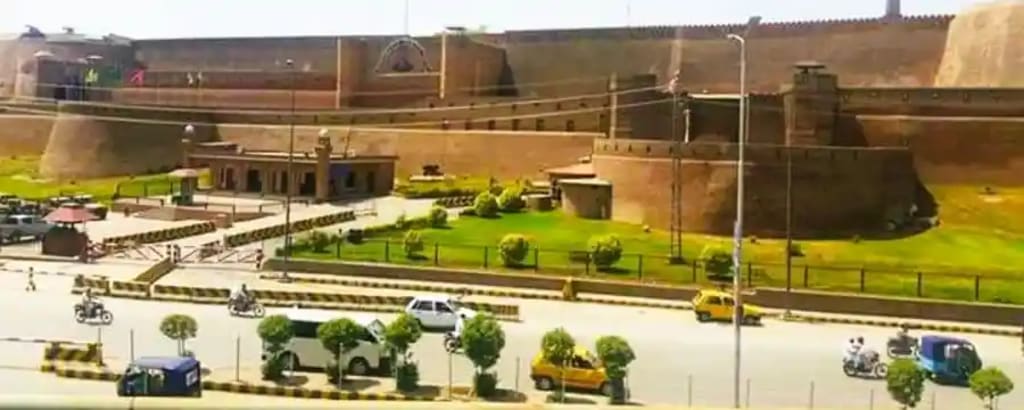
Bala Hissar Fort, located in Peshawar, Pakistan, boasts a rich and complex history spanning many centuries. Its name, "Bala Hissar," comes from Dari Persian and means "elevated or high fort," fitting for its commanding position.
Here's a breakdown of its key historical periods:
* Early Origins: The fort's exact origins are not fully known, but it's believed to date back to at least the 1st century BCE, possibly built by Persians to control trade routes. There's also evidence from 7th-century Chinese explorer Xuanzang mentioning a fortified royal residence at this site.
* Mughal Era: Emperor Babur is said to have built a fort here in 1526 after capturing Peshawar. It served as a royal residence and was even reconstructed by Emperor Humayun.
* Durrani Empire: From 1747, after Ahmad Shah Durrani conquered Peshawar, the fort became a royal residence for the Durrani Empire. It was the winter capital of the Afghan Empire, and Afghan kings resided here.
* Maratha and Afghan Conflicts: The Marathas briefly occupied the fort after capturing Peshawar in 1758, but it was quickly retaken by the Afghans.
* Sikh Period: In March 1823, the Sikhs captured Peshawar and destroyed much of the fort. However, Sikh commander-in-chief Hari Singh Nalwa soon began its reconstruction. During this period (1834), the Sikhs renamed the fort "Samīr Gaṛh" or "Sameer Garh," though the original name "Bala Hissar" remained more popular.
* British Era: After the First Anglo-Sikh War (1845-46) and the annexation of the Sikh Kingdom in 1849, the British East India Company reconstructed the fort's outer walls. They used it as a garrison and military base, highlighting its continued strategic importance. The fort played a role in events like the Anglo-Afghan Wars.
* Modern Day: Today, Bala Hissar Fort is used by the Frontier Corps, a paramilitary unit of the Pakistan Army. While access inside can be limited due to its military use, it remains a significant historical landmark in Peshawar, offering glimpses of its long and varied pas
Bala Hissar Fort, located in Peshawar, Pakistan, boasts a rich and complex history spanning many centuries. Its name, "Bala Hissar," comes from Dari Persian and means "elevated or high fort," fitting for its commanding position.
Here's a breakdown of its key historical periods:
* Early Origins: The fort's exact origins are not fully known, but it's believed to date back to at least the 1st century BCE, possibly built by Persians to control trade routes. There's also evidence from 7th-century Chinese explorer Xuanzang mentioning a fortified royal residence at this site.
* Mughal Era: Emperor Babur is said to have built a fort here in 1526 after capturing Peshawar. It served as a royal residence and was even reconstructed by Emperor Humayun.
* Durrani Empire: From 1747, after Ahmad Shah Durrani conquered Peshawar, the fort became a royal residence for the Durrani Empire. It was the winter capital of the Afghan Empire, and Afghan kings resided here.
* Maratha and Afghan Conflicts: The Marathas briefly occupied the fort after capturing Peshawar in 1758, but it was quickly retaken by the Afghans.
* Sikh Period: In March 1823, the Sikhs captured Peshawar and destroyed much of the fort. However, Sikh commander-in-chief Hari Singh Nalwa soon began its reconstruction. During this period (1834), the Sikhs renamed the fort "Samīr Gaṛh" or "Sameer Garh," though the original name "Bala Hissar" remained more popular.
* British Era: After the First Anglo-Sikh War (1845-46) and the annexation of the Sikh Kingdom in 1849, the British East India Company reconstructed the fort's outer walls. They used it as a garrison and military base, highlighting its continued strategic importance. The fort played a role in events like the Anglo-Afghan Wars.
* Modern Day: Today, Bala Hissar Fort is used by the Frontier Corps, a paramilitary unit of the Pakistan Army. While access inside can be limited due to its military use, it remains a significant historical landmark in Peshawar, offering glimpses of its long and varied past
About the Creator
Keep reading
More stories from The World Beauty's & Natural Research Center and writers in History and other communities.
Prisoner Number 804
"Prisoner Number 804" (Qaidi Number 804) is a term that has been extensively discussed in Pakistan, particularly within political circles and on social media. This number is associated with former Prime Minister Imran Khan during his imprisonment in Adiala Jail. However, it's not entirely clear whether this was his actual prisoner number or if it was adopted as a symbolic identifier by his supporters to draw attention to his incarceration. This number has been interpreted in various ways: * Political Identity: Imran Khan's supporters use it as a form of protest against his imprisonment and the treatment he received. * Symbolic Significance: It has become a means to raise questions about the plight of a prisoner in Pakistan's political landscape and the justice system.
By The World Beauty's & Natural Research Center 7 months ago in History
Why Early Aircraft Designs Failed Before They Ever Flew
Long before airplanes became symbols of speed and global connection, flight was an idea filled with uncertainty, ambition, and repeated disappointment. Early aircraft designers were driven by a powerful belief that humans could conquer the skies, yet many of their creations never made it past workshops, fields, or testing grounds. These failures were not accidents of carelessness; they were the result of a world still learning the rules of flight.
By Beckett Dowhan5 days ago in History
3 Times Ordinary Objects Did Something Deeply Unsettling
Objects surround us every day. They make life easier, more comfortable, or more entertaining. A chair supports us, a mirror shows us our reflection, and a toaster browns our bread with consistent reliability. Most of the time, they behave exactly as expected.
By Enoch Sagini4 days ago in History



Comments (2)
♥️♥️
Needs subscribe