

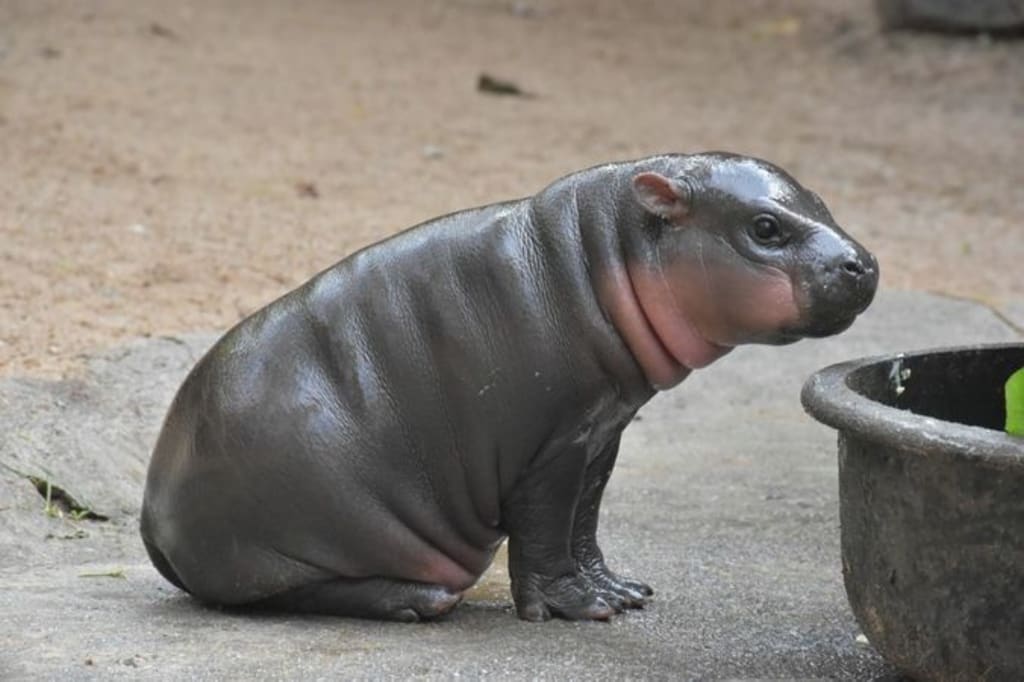
- The Pygmy Hippopotamus: A Small But Fascinating Creature
The pygmy hippopotamus, also known as Choeropsis liberiensis, is a unique and intriguing animal native to the forests and swamps of West Africa. Unlike its larger cousin, the common hippopotamus, this smaller relative has its own distinct characteristics and a fascinating life story. Here’s a closer look at this rare and endangered species.
- What is a Pygmy Hippopotamus?
The pygmy hippopotamus is a small member of the hippopotamus family, found mainly in Liberia, with smaller populations in Sierra Leone, Guinea, and Ivory Coast. Sadly, it has been extirpated from Nigeria. This species is known for being reclusive and nocturnal, meaning it is mostly active during the night and avoids human contact.
Despite its smaller size, the pygmy hippo shares some similarities with its larger relative, the common hippopotamus. Both species are semi-aquatic, which means they spend a lot of time in water to keep their skin moist and cool. However, the pygmy hippo is better adapted to life on land compared to the common hippo. It is herbivorous, feeding on a diet of ferns, broad-leaved plants, grasses, and fruits found in the dense forests of its habitat.
- A Rare and Elusive Creature
The pygmy hippopotamus is a rare animal, making it challenging for scientists to study in the wild. This elusive nature means that most of what we know about the pygmy hippo comes from observations in captivity. Pygmy hippos were relatively unknown outside West Africa until the 19th century. They began to be introduced to zoos in the early 20th century, where they have bred successfully. As a result, there is a more substantial body of research based on zoo specimens rather than wild populations.
In the wild, the International Union for Conservation of Nature (IUCN) estimated in 2015 that fewer than 2,500 pygmy hippos remain. The species is listed as endangered due to various threats.
- Threats to Survival
The primary threat to the pygmy hippopotamus is habitat loss. Forests in West Africa are being cut down and converted into farmland, which reduces the natural habitat available for these animals. Pygmy hippos are also at risk from poaching and hunting for bushmeat, as well as natural predators like leopards, pythons, and crocodiles. Additionally, the civil unrest in West Africa can exacerbate these threats, making conservation efforts even more critical.
- Taxonomy and Evolution
The taxonomy of the pygmy hippopotamus has undergone several changes as scientists have learned more about this species. Originally classified as *Hippopotamus minor* by Samuel G. Morton, it was later moved to its own genus, *Choeropsis*, by Morton. In the 1970s, Shirley C. Coryndon proposed a connection to *Hexaprotodon*, a genus of prehistoric hippos. However, this idea was later challenged, and the pygmy hippo was returned to the genus *Choeropsis*.
The pygmy hippo is distinct from other hippos, including those found in the Mediterranean and Madagascar, which are considered dwarf species but not closely related. The pygmy hippopotamus shares an evolutionary lineage with its larger relatives and is part of a group that is closely related to cetaceans like whales and dolphins, a connection that highlights its semi-aquatic ancestors.
- Physical Characteristics
Pygmy hippos are much smaller than common hippos. They stand about 75–100 cm (2.46–3.28 ft) high at the shoulder and weigh between 180–275 kg (397–606 lb). In captivity, they can live between 30 and 55 years, although their lifespan in the wild is likely shorter. Their skin is typically greenish-black or brown, with a creamy gray underside, and secretes a reddish substance known as hipposudoric acid, which acts as an antiseptic and sunscreen.
The pygmy hippo’s skeleton is more slender than that of the common hippo, and it has adapted to a more terrestrial lifestyle with a forward-sloping back and longer legs and neck. Its smaller, less pronounced orbits and nostrils are suited to its less aquatic life compared to its larger cousin.
- Behavior and Diet
Pygmy hippos are mainly solitary or found in small groups, often consisting of a mated pair or a mother and her calf. Unlike the social common hippos, pygmy hippos are less aggressive and generally avoid confrontation. They are herbivores that emerge at dusk to feed, primarily on forest plants such as herbs, ferns, and fruits. They do not eat much aquatic vegetation or grass, as these are less common in their dense forest habitat.
- Reproduction
Breeding behavior in pygmy hippos is not well-documented in the wild, but in captivity, they breed successfully throughout the year. Females reach sexual maturity between three and five years of age, and their oestrus cycle lasts about 35.5 days. A typical gestation period is between 190 and 210 days, usually resulting in a single calf, although twins can occur. The young are born weighing about 4.5–6.2 kg (9.9–13.7 lb) and can swim almost immediately.
- Conservation Efforts
Efforts to conserve the pygmy hippopotamus are crucial due to the significant threats they face. Protected areas like the Gola Forest Reserve in Sierra Leone offer some hope, but the overall situation remains precarious. The Basel Zoo in Switzerland manages the international studbook and coordinates breeding efforts to ensure the species' survival in captivity. Despite these efforts, the pygmy hippo’s future in the wild is uncertain, highlighting the need for continued conservation and protection of their natural habitat.
In summary, the pygmy hippopotamus is a small but fascinating animal with unique adaptations and significant conservation needs. Its rarity and the challenges it faces in the wild underscore the importance of ongoing efforts to protect this elusive species and ensure its survival for future generations.
About the Creator
SK
Sajawal is an 18-year-old student in Class 13, known for his curiosity and determination. With his fair complexion and thoughtful demeanor, Sajawal stands out among his peers. He is dedicated to his studies and has a passion for storytellin
Balloonfest 1986
Balloonfest 1986 was meant to be a joyful celebration. It was planned as a world record attempt and a symbol of hope, fun, and community spirit. Instead, it became one of the most famous examples of how a good idea can go wrong when nature is underestimated.
By shaoor afridi6 days ago in History


Comments
There are no comments for this story
Be the first to respond and start the conversation.