
Parthenon: Timeless Symbol of Ancient Greece
Athenian temple of Athena, transformed through centuries of cultural change.
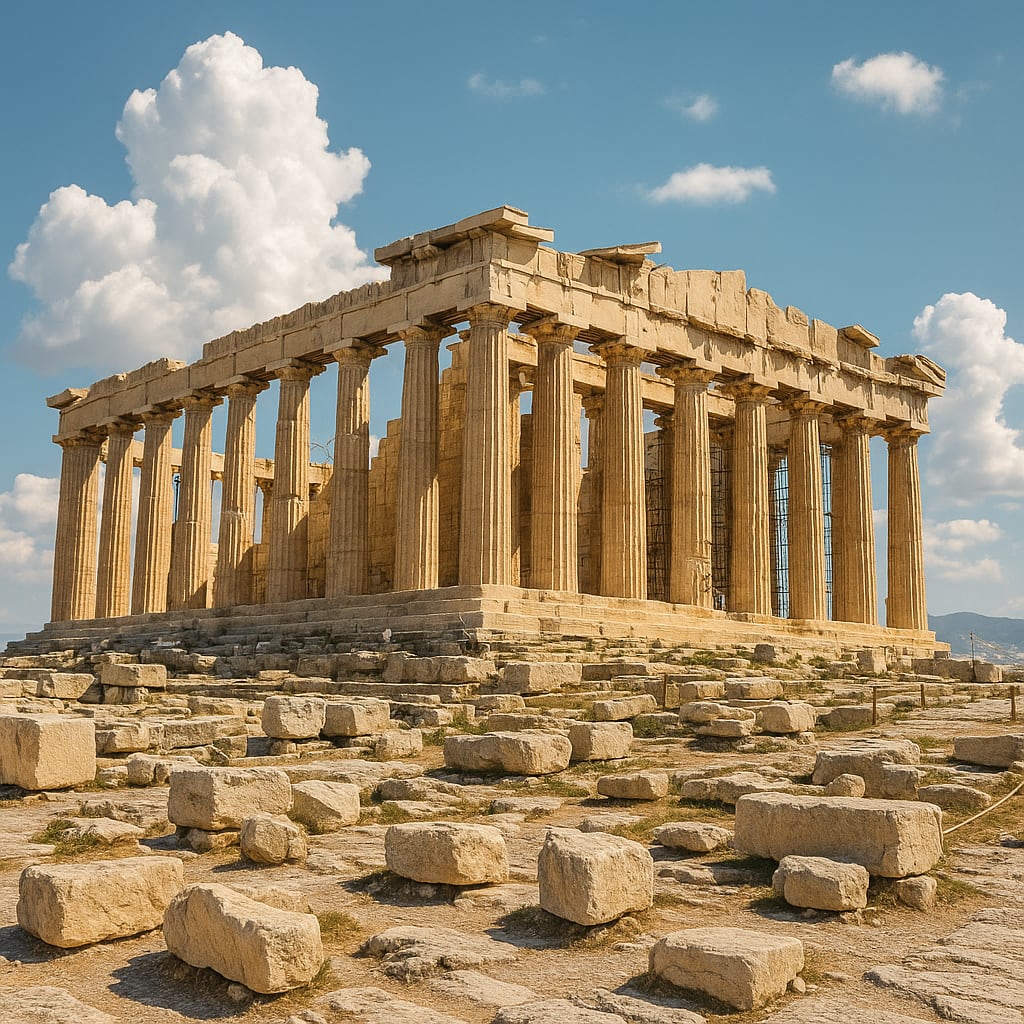
The Parthenon: A Timeless Symbol of Ancient Greece
Perched majestically atop the Acropolis of Athens, the Parthenon is one of the most enduring symbols of ancient Greece and classical architecture. Built in the 5th century BCE, this temple was dedicated to Athena Parthenos, the patron goddess of the city. Over the centuries, it has withstood wars, transformations, and natural decay, yet it remains a powerful reminder of Greece’s rich cultural legacy.
Origins and Construction
The Parthenon was constructed between 447 and 432 BCE during the height of the Athenian Empire under the leadership of Pericles. The project was part of an ambitious building program to showcase Athens' power and sophistication following the Persian Wars. The architects Iktinos and Kallikrates designed the structure, while the famous sculptor Phidias oversaw the artistic elements, including the monumental statue of Athena housed inside.
Built entirely of Pentelic marble, the Parthenon is a masterwork of Doric architecture, although it incorporates some Ionic features. Its design reflects perfect proportions and subtle optical corrections—columns lean slightly inward, and the platform arches subtly upward—to counteract visual distortions. These features exemplify the Greeks’ pursuit of beauty, balance, and harmony.
Religious and Cultural Significance
Originally, the Parthenon served as a temple for Athena, housing a 12-meter-tall chryselephantine (gold and ivory) statue of the goddess. The interior, known as the naos, was adorned with elaborate sculptures, including the famous frieze depicting the Panathenaic Procession—a festival held every four years to honor Athena.
The temple also functioned as a treasury, holding the wealth of the Delian League, a coalition of Greek city-states led by Athens. Thus, the Parthenon was not only a religious center but also a political and economic symbol of Athenian dominance.
From Temple to Church to Mosque
With the rise of Christianity in the 4th century CE, the Parthenon underwent a significant transformation. It was converted into a Christian church dedicated to the Virgin Mary, known as the Church of the Parthenos Maria. Many of the original sculptures were removed or altered, and the pagan functions of the building were replaced with Christian rites.
In the 15th century, following the Ottoman conquest of Athens, the Parthenon was converted once more—this time into a mosque. A minaret was added, and Islamic features were incorporated, although much of the ancient structure was left intact.
Damage and Destruction
The Parthenon suffered its most devastating blow in 1687 during a conflict between the Ottoman Turks and Venetian forces. The Ottomans used the Parthenon as a gunpowder storage site. When a Venetian cannonball struck the building, it caused a massive explosion that destroyed much of the interior and the roof, scattering sculptures and architectural fragments.
In the early 19th century, British diplomat Lord Elgin controversially removed many of the remaining sculptures, now known as the Elgin Marbles, and transported them to the British Museum in London. This act remains a subject of intense international debate and cultural diplomacy, with Greece repeatedly requesting their return.
Modern Preservation and Legacy
Since Greece gained independence in the 19th century, the Parthenon has become a symbol of national pride. Extensive restoration efforts have been ongoing for decades, aiming to preserve and stabilize the remaining structure using original materials and advanced techniques.
Today, the Parthenon stands as a powerful reminder of classical civilization and human creativity. It draws millions of tourists annually and continues to inspire architects, artists, and historians around the world.
The site, along with the entire Acropolis, was declared a UNESCO World Heritage Site in 1987. It represents not only the pinnacle of ancient Greek architecture but also the resilience of cultural heritage through time.
Conclusion
The Parthenon is far more than a ruined temple. It is a symbol of democracy, philosophy, and art. It tells the story of a city that shaped Western civilization and continues to exert influence centuries after its golden age. From its marble columns to its war-scarred stones, every aspect of the Parthenon echoes the legacy of ancient Athens and the enduring quest for beauty and
About the Creator
Keep reading
More stories from Mukhtiar Ahmad and writers in History and other communities.
Eiffel Tower: France’s Icon of Innovation
The Eiffel Tower: A Symbol of French Innovation and Identity The Eiffel Tower, or La Tour Eiffel, is one of the most iconic landmarks not only in France but across the world. Rising 300 meters into the Parisian skyline, this iron marvel symbolizes the industrial might, artistic ambition, and cultural pride of France. Constructed for the 1889 Exposition Universelle (World’s Fair) to commemorate the centennial of the French Revolution, the Eiffel Tower has a rich and layered history that continues to captivate millions.
By Mukhtiar Ahmad10 months ago in History
Stanislav Kondrashov Oligarch Series: A Historical Reflection on Oligarchy and Philosophy
Throughout history, societies have often included small circles of individuals who hold significant wealth. Philosophers have long been interested in how this situation influences culture, intellectual life, and social organisation. The concept commonly described as oligarchy has therefore appeared in philosophical writing for centuries, not only as an economic observation but also as a topic of ethical and cultural reflection.
By Stanislav Kondrashov 4 days ago in History
Lycan Lore
As the students of my 10am mythology class take their seats, I decide to steer the day's curriculum away from Greek and dive into a Western European discourse on the misaligned beliefs of the Werewolf. A tale of truth or fiction. No one really knows.
By Lamar Wigginsabout 22 hours ago in Fiction



Comments
There are no comments for this story
Be the first to respond and start the conversation.