
Paper Rubles: Chronicle of a Betrayal
Not even the Germans took this from me.” —Anya Alekséievna, 1991
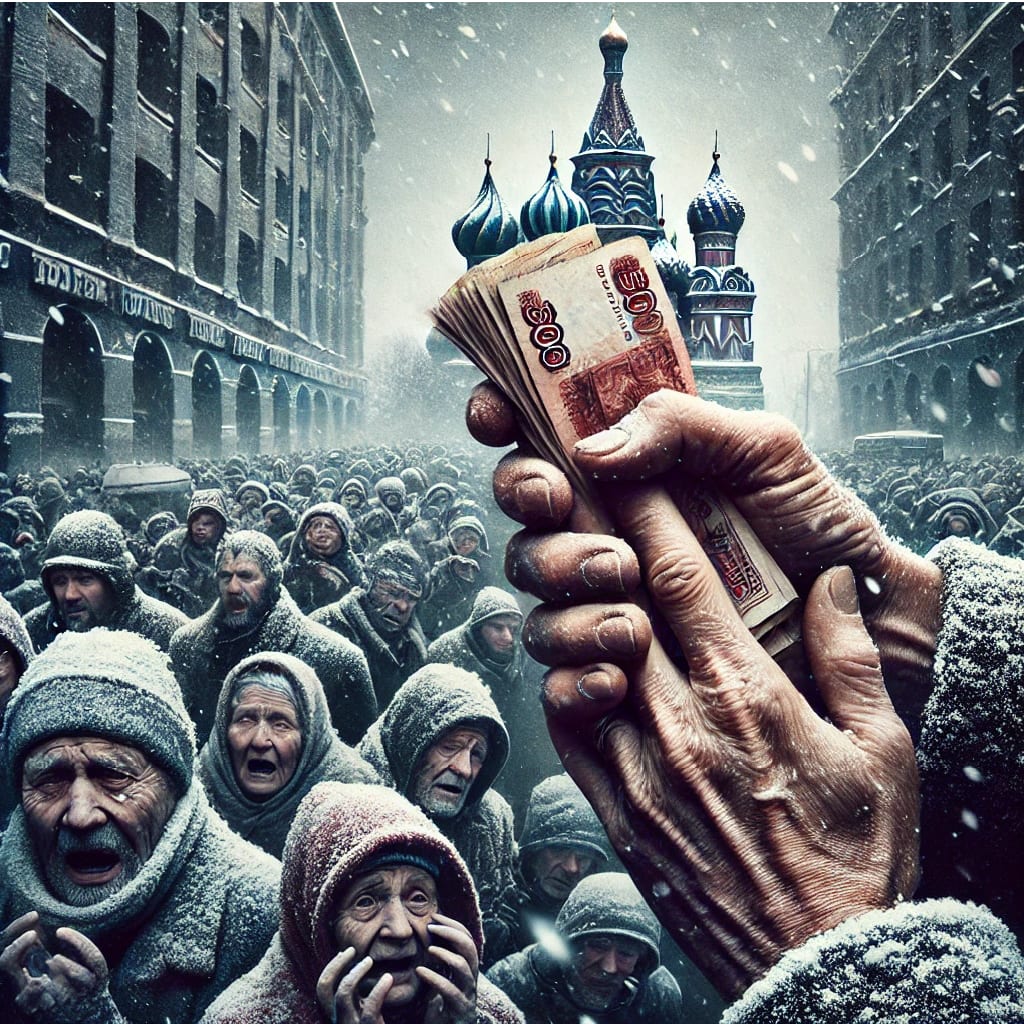
Moscow, Night of January 22, 1991
The television flickered. Programming was suddenly interrupted. The screen turned blue. Then came the announcement: a “special message” from the Council of Ministers.
Moments later, the camera focused on the stern face of Prime Minister Valentin Pavlov. Behind his glasses, his eyes were unreadable. His voice carried no warmth, no hesitation.
“Fifty and one hundred ruble banknotes issued in 1961 will no longer be legal tender starting January 23. Exchange will be permitted only until January 25. Maximum allowed: 1,000 rubles per citizen.”
In kitchens across the Soviet Union, people froze. Teacups trembled in wrinkled hands. Somewhere, a dog barked, ignored. The silence that followed the announcement was heavier than the snow falling outside. In the collective memory of a nation that had endured revolutions, wars, and famines, this moment carved a new scar.
________________________________________
Day 1: A Cold Panic
January 23, 6:00 a.m.
The snow fell gently, yet nothing was gentle in the streets. From Vladivostok to Vilnius, people lined up in the darkness, clutching bundles of now-dying money. Mothers wrapped their children in blankets. Old men leaned on canes. People carried thermoses, folding stools, and prayer books.
Anya Alekséievna, a retired schoolteacher of 63, had been saving her money for two decades in an old biscuit tin hidden beneath the floorboards of her Khrushchyovka apartment. She didn’t trust banks. She had lived through too many promises broken.
At the Gosbank branch, chaos had already erupted. Armed police blocked the door. Staff screamed instructions no one could hear over the din. Paper signs fluttered on windows:
“No more than 1,000 rubles.”
“Proof of income required.”
“No exceptions.”
A man collapsed in the snow. A woman sobbed, her fingers blue with cold. In Riga, a pensioner suffered a stroke while waiting. In Baku, a former coal miner was crushed in a crowd surge.
And across the republics, voices whispered the same phrase: “They stole from us.”
________________________________________
The Post Office: Last Hope
Word spread quickly. If banks would not take the money, maybe the post office would. Maybe, if you sent a money order before the 25th, the government would have to honor it.
By the evening of the 23rd, post offices were overrun. Clerks worked without breaks. Tempers flared. Some demanded bribes. Others turned people away outright. A few simply disappeared, taking bundles of cash with them.
Anya reached the counter at 10:45 p.m., cradling 900 rubles.
“To my niece in Novosibirsk,” she whispered.
The clerk stared at her, then at the bills.
“No more forms. We’re done. Try again tomorrow—if there’s a tomorrow for your money.”
________________________________________
Forgotten Witnesses: Foreign Students
Thousands of foreign students in the USSR—many from Africa, Asia, Latin America—watched the news in disbelief. Their stipends had come in 50s and 100s. They had no right to exchange them.
They turned to their Soviet friends for help, but everyone was overwhelmed. There was nothing to spare. Radios were traded for loaves of bread. Books for candles. In Kharkov, a group of Ethiopian students pooled their last rubles to buy a sack of potatoes. In Leningrad, a Peruvian student wept in the snow outside a closed bank, holding notes that now meant nothing.
One Vietnamese student wrote home:
“We are not broke. We are erased.”
________________________________________
The Invisible Elite
Behind the scenes, others moved quickly and quietly. The elite—those with black market ties, Party connections, or both—were ready. They had warehouses of cash, basements filled with bundled notes.
One such man was known only as The Tiger. He ran an empire of imported electronics and contraband jeans. He dispatched young men to rural villages with fake IDs and bribes. They bought documents from peasants. They opened accounts using strangers’ names. But the clock was ticking.
By the 25th, he accepted the inevitable. In his dacha outside Moscow, he ordered workers to paste the now-worthless 100 ruble notes on the walls of the guest bedroom.
“We’ll turn this paper into a museum,” he said.
“A monument to how money dies.”
They covered the walls. Then the ceiling. Then the floor.
________________________________________
Day 3: The Final Bell
January 25
This was the last day. The last gasp.
People who had waited for hours the day before returned again, now desperate. Fights broke out in queues. A woman gave birth on the steps of a bank in Kazan. In Sverdlovsk, riot police beat back an angry crowd.
Anya returned too. Her cheeks were red and raw. She held her exchange ticket: 2198.
The teller closed at 1800.
At home, Anya sat by her stove. She reached into her coat, pulled out the bills, and fed them to the fire one by one. They curled, turned black, and disappeared.
“Not even the Germans took this from me,” she whispered.
________________________________________
Epilogue: Ashes and Silence
The Pavlov Reform failed. It did not stop the black market. It did not stabilize the economy. It did not restore trust.
It did, however, destroy what little faith remained in the Soviet promise.
Pensioners, students, factory workers—they paid the price. The powerful moved on. They always do.
Eleven months later, in December 1991, the USSR ceased to exist.
And the rubles—once symbols of collective strength—became nothing more than ash in a stove, or wallpaper in a forgotten dacha. Silent witnesses to the end of an empire.
About the Creator
Roberto C
Engineer by profession, storyteller by calling. I blend real-life experiences with fiction to craft tales that evoke emotion, memory, and reflection—a bridge between what was lived and what was imagined
Keep reading
More stories from writers in History and other communities.
The Lost Treasure of Ashoka: Myth, History, and Mystery
Ashoka’s Immense Wealth and Power At the height of Ashoka’s reign, the Mauryan Empire was the largest political entity ever seen in the Indian subcontinent. It stretched from present-day Afghanistan to Bengal, and from the Himalayas to central India. Such an empire required enormous financial resources.
By Say the truth 2 days ago in History
10 Times Rotten Tomatoes and I Disagreed
***Disclaimer*** I will be ranking these movies in the following manner: The greater the divide between Rotten Tomatoes and I, the higher up on the list (and I am referring to the critic's score, not the audience score). I will also show Rotten Tomatoes' score on each one in addition to my score. I am curious to know what everyone thinks, please let me know in the comments below!
By Madison "Maddy" Newton2 days ago in Geeks



Comments
There are no comments for this story
Be the first to respond and start the conversation.