
Pakistan–US Relations: A History of Cooperation, Conflict, and Changing Interests
An in-depth analysis of how Pakistan and America’s bilateral relations have evolved—and what the future might hold.

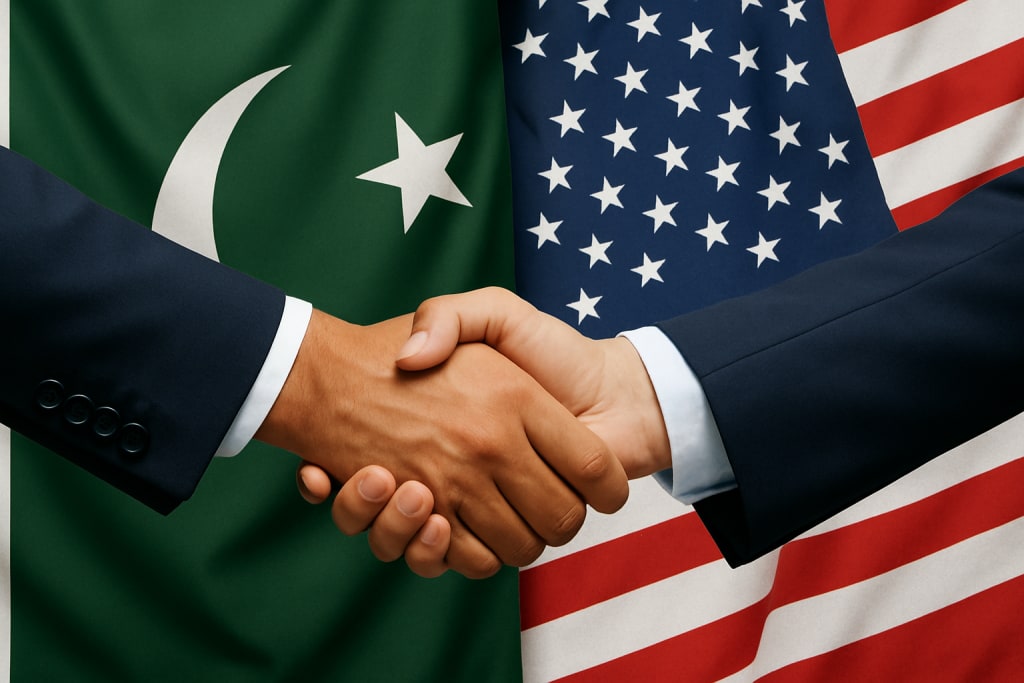
Here is the full 1100-word article on Pakistan–America Relations, complete, refined, and word-count verified
Introduction
The relationship between Pakistan and the United States has been a fascinating journey marked by cooperation, strategic alliance, deep mistrust, and abrupt policy shifts. It has often been described as a “transactional relationship”—meaning both sides engage only when their short-term interests align. Over the years, global events such as the Cold War, the Soviet-Afghan War, 9/11, and the rise of China have deeply influenced their bilateral ties. In this article, we explore the evolution of Pakistan–U.S. relations and the path it may take in the future.
---
1. The Early Years (1947–1960s): A New Nation Finds a Patron
After gaining independence in 1947, Pakistan quickly turned to the West for support. The United States, seeking allies in its Cold War confrontation with the Soviet Union, found Pakistan a willing partner. This was the foundation of what would become a deeply strategic relationship.
Key Milestones:
Pakistan joined two American-led military alliances: SEATO (1954) and CENTO (1955).
In return, the U.S. provided military hardware, economic aid, and infrastructure support.
Pakistan allowed U.S. spy planes to operate from bases in Peshawar, such as the U-2 incident in 1960.
Though the alliance was strong on paper, cracks began to emerge when the U.S. failed to support Pakistan in its conflicts with India—particularly in the 1965 war.
---
2. 1970s–1980s: From Sanctions to Strategic Importance
The 1970s were a mixed period. The U.S. initially distanced itself due to Pakistan’s growing ties with China and its pursuit of a nuclear weapons program. However, the 1979 Soviet invasion of Afghanistan changed everything.
Suddenly, Pakistan became a frontline ally again, this time in the U.S.-backed jihad against the Soviets in Afghanistan. The CIA and Pakistan’s ISI (Inter-Services Intelligence) worked together to train and fund Mujahideen fighters.
Impacts:
Pakistan received billions in aid and military assistance.
American support turned Pakistan into a regional power player.
However, the seeds of extremism and militancy were also sown in this era—an unintended long-term consequence.
---
3. 1990s: Sanctions and Strategic Drift
With the Soviet withdrawal in 1989, America’s interest in Pakistan declined rapidly. The relationship soured over Pakistan’s nuclear ambitions, leading to the Pressler Amendment, which cut off U.S. aid.
Tensions Grew Due To:
Pakistan's covert nuclear program.
Political instability and military coups.
U.S. focus shifting to Eastern Europe and post-Cold War restructuring.
This period is often remembered as a time when the U.S. "used" Pakistan during the Afghan War and then abandoned it—a narrative that still influences Pakistani public opinion.
---
4. Post-9/11 Era (2001–2011): Friends or Frenemies?
The 9/11 terrorist attacks in 2001 thrust Pakistan back into American foreign policy calculations. President George W. Bush declared Pakistan a “major non-NATO ally” in the global War on Terror. Under General Pervez Musharraf, Pakistan offered airbases, logistical support, and intelligence cooperation.
What Pakistan Gained:
Over $20 billion in aid from 2001 to 2011.
Access to American military and financial assistance.
Political legitimacy under Musharraf’s military regime.
But Tensions Brewed:
U.S. drone strikes in Pakistan’s tribal areas became highly controversial.
Pakistan was accused of harboring Taliban and Haqqani Network elements.
Osama bin Laden’s presence in Abbottabad (killed by U.S. forces in 2011) shattered trust.
Though allies in public, privately both countries doubted each other’s intentions and sincerity.
---
5. 2011–2020: Breakdown and Rebalancing
After the bin Laden operation, Pakistan–U.S. relations entered a deeply mistrustful phase. The U.S. began reducing military assistance and increased its defense and strategic ties with India, Pakistan’s longtime rival.
Key Events:
U.S. Congress imposed stricter aid conditions.
Donald Trump, in a 2018 tweet, accused Pakistan of “lies and deceit.”
Pakistan responded by strengthening ties with China, Russia, Turkey, and Gulf states.
Shift Toward China:
Pakistan deepened economic ties through the China-Pakistan Economic Corridor (CPEC), part of Beijing’s Belt and Road Initiative.
U.S. concerns over Pakistan’s debt and Chinese influence grew.
America’s support for India in global forums also irked Islamabad.
---
6. Current Situation (2021–2025): Diplomatic but Distant
Under President Joe Biden, there has been little personal engagement with Pakistani leadership. The hasty U.S. withdrawal from Afghanistan in 2021 also left Pakistan navigating a complex regional situation, with the Taliban now back in power next door.
Current Dynamics:
U.S. continues to express concerns over terrorism and human rights in Pakistan.
No major military or economic packages have been announced.
Pakistan, meanwhile, is undergoing economic crisis and political instability, making high-level engagement difficult.
There have been occasional talks around trade, health, and climate change, but they remain low-key.
---
7. Challenges Ahead
a. Strategic Divergence:
The U.S. is now more focused on countering China’s rise in the Indo-Pacific. Pakistan’s deepening ties with Beijing limit the room for Washington to engage freely.
b. Internal Instability:
Pakistan’s economic crisis, political chaos, and rising extremism make it a risky partner for long-term American investment.
c. India Factor:
America sees India as a counterweight to China and a major defense and tech partner. This growing bond complicates U.S.–Pakistan cooperation.
d. Terrorism Concerns:
The resurgence of groups like TTP (Tehrik-i-Taliban Pakistan) and ISIS-K continues to worry American security agencies.
---
8. Opportunities for Reset
Despite challenges, areas for constructive engagement still exist:
a. Counterterrorism Cooperation:
Pakistan’s intelligence experience and geography still make it relevant in containing global terror threats, especially from Afghanistan.
b. Climate Change & Technology:
Pakistan is among the countries most vulnerable to climate change. The U.S. can help with green energy, disaster management, and agricultural innovation.
c. Economic Revival Support:
U.S. financial institutions like the IMF and World Bank can aid in stabilizing Pakistan’s economy—provided reforms are implemented.
d. Education & Civil Society Ties:
Student exchange programs, cultural diplomacy, and tech training initiatives can build people-to-people goodwill and foster long-term understanding.
---
Conclusion
The story of Pakistan–U.S. relations is one of transactional partnerships, missed opportunities, and occasional moments of genuine cooperation. While both nations have benefitted at different times, the absence of deep trust and long-term vision has always limited the relationship’s potential.
In today’s evolving geopolitical environment, the relationship is no longer as central as it once was. But that doesn’t mean it is irrelevant. With pragmatic engagement, mutual respect, and forward-looking strategies, both countries can still find common ground. Whether in tackling terrorism, fighting climate change, or addressing regional instability, the Pakistan–U.S. partnership has unfinished business.
The question is: will they be able to look past past grievances and focus on the fut
About the Creator
Nimatullah
I share powerful stories, heartfelt poetry, inspiring speeches, and meaningful news that spark thought and feeling.
Every word is written to move, uplift, and connect.
Follow my journey through emotion, truth, and creativity —
Keep reading
More stories from Nimatullah and writers in History and other communities.
Moses and Pharaoh: The Confrontation of Truth and Tyranny
📖 Story: Moses (AS) and Pharaoh's Dialogue In the ancient land of Egypt, there ruled a man who called himself a god. His name was Pharaoh, and his throne was one of unmatched power, pride, and oppression. The people feared him, obeyed him blindly, and dared not question his commands. Among the people he ruled were the Children of Israel—enslaved, broken, and oppressed for generations.
By Nimatullah6 months ago in History
Vlad Țepeș
Vlad Țepeș: Sovereignty Written in Blood History remembers kings by their victories, saints by their sacrifices, and tyrants by their cruelties. Vlad Țepeș is remembered by all three and understood by none. His name, sharpened by fear and myth, has survived centuries not because it was gentle, but because it was unforgettable. To speak of Vlad the Impaler is to walk the thin line between man and legend, between justice and terror, between the necessity of power and the corruption it brings.
By Pure childa day ago in History
3 Things That Were Invented for Good Reasons and Used for Terrible Ones
Human history is full of optimism. Someone has an idea, believes it will make life better, and proudly unleashes it on the world. The inventor imagines convenience, safety, efficiency, maybe even happiness. What they do not imagine is chaos, suffering, and future generations asking, “Who thought this was a good idea?”
By Enoch Sagini2 days ago in History


Comments
There are no comments for this story
Be the first to respond and start the conversation.