
Old Habits
Tobacco, coffee, and alcohol in the "Old Days"


I've read a few articles relating to bad habits of the past, and I've read comments from modern viewers in watching old movies and tv shows, asking, "Did people really used to smoke that much?"
The simple answer is yes, yes they did. And depending on what you're watching, it's very possible that they smoked more than what you're seeing.
In most places now, hardly anyone smokes. In 2024, only 11% of people reported smoking even one cigarette in the past week, and 6.9% of people reported vaping in the past week. Combined, that's less than 20%. The obvious situation is: most smokers have quit or died.
One big turning point for smokers was the 1990s, when studies showed that yes, secondhand smoke can lead to cancer and other smoking-related problems in people who have never smoked themselves. Spouses who had never smoked had contracted terminal cancer simply from being around their spouse's cigarettes for years. Following that data bombshell, after a few years of debate, smoking inside became outlawed in hotels, offices, airplanes, and even bars and restaurants. By the early 2000s, it was virtually unheard of to allow smoking inside. Today, if you want to smoke inside you go to a cigar bar, which provides special ventilation.
At the apartment complex where I live, smoking is prohibited in any of the apartments, in the common areas, and within 15 feet of any of the buildings. If you violate that rule, you're fined by management. If your apartment smells smoky when you move out, you forfeit your security deposit and you're subject to a $1500 fee to fumigate the aparment before someone else can move in. People have violated it, but rarely. Usually in the dead of winter when they don't want to go outside to catch a smoke. Overall, it's just too much trouble for most people to even bother.
All of that is in contrast to the world I grew up in. While the U.S. Surgeon General reported way back in 1959 that smoking was related to cancer, people were already hooked. As my parents, who were in high school at the time, have said, "Everybody smoked back then." In truth, about 45% of Americans smoked regularly, but there were still those who smoked socially, and there were different percentages in different groups.
Smokers also smoked more then than they tend to smoke now. I've worked with people over the past decade or so who were in their 20s, pushing 30, and they held the belief that if you start in your teens and quit by the time you're 30, you'll have minimal damage. I don't know how scientifically sound that is, I tend to think it's wishful thinking, but at the same time, they didn't smoke all that much. Typically less than half a pack a day, most often smoking when they wake up, after a meal, when they arrive at work, when they leave work, and when they're driving.
In "the old days", regular smokers typically had a cigarette per hour, every hour, every day, the entire time when they were awake. I read an article recently that described a deceased actor as a long-time "chain smoker," smoking 1 1/2 packs a day. That description is totally erroneous.
1 1/2 packs a day isn't even a heavy smoker. The average smoker in the 20th century smoked 1 to 1 1/2 packs a day. Heavy would be 2 packs or more. Actor Don Adams, known for his work on the 1960s show, "Get Smart" and for being the voice of cartoon characters Tennessee Tuxedo and Inspector Gadget, smoked 4 packs a day. Legendary actor Yul Brynner, famous for his roles in "The King and I" "The Magnificent Seven" and "Westworld" smoked an alarming 5 packs a day. He actually had an assistant hold his lit cigarette on-set while Brynner filmed scenes.
Brynner did get terminal lung cancer, and, before he died, filmed an anti-smoking commercial that aired frequently on television, urging people to quit or not smoke, so they wouldn't share his fate.
Brynner's habit is what would be called chain smoking, not the 1 1/2 pack norm cited in the article I read. Literally, chain smoking is lighting a new cigarette from the burning butt of your previous cigarette, like links in a chain. At one point about 15 years ago, I heard a former chain smoker refer to it as being a "one match a day man." He would wake up in the morning, light his first cigarette of the day with a single match, then light all the other cigarettes he had that day off of the butt of the last one he smoked, lasting until he went to bed that night. 80 a day.
People I grew up with in the 80s usually tried smoking when they were 15 or 16, which seemed to be when people of my parents' generation started. Others may have started in college, and none of that is particularly shocking. People try all sorts of things in high school and college. What is shocking is the contrast to older generations, particularly in rural areas.
My wife's grandmother, who grew up in rural Georgia, started smoking at age 9. Somehow, she lived well into her 80s and didn't quit until she had dementia so progressed that she forgot she was a smoker. I knew of other people of that generation, born somewhere between the 1910s and early 1930s, who also started somewhere around age 9-12. A close friend of my grandparents, a self-described hillbilly, grew up in North Carolina, where every member of his family smoked, including his mother, who both smoked and chewed tobacco. All of them died of tobacco-related illness, and he was the last to go. For his entire life, he smoked unfiltered Pall Malls, even after he developed emphysema. He finally died of lung cancer and was buried with a pack of Pall Malls in the breast pocket of his suit jacket.
It was always suspected that smoking could be harmful. Even back in the 16th and 17th centuries, as smoking and snuff became popular across England and Europe, doctors and scholars voiced concerns. Of course at the time, average lifespan was much shorter, so people were likely to die from fevers, illness, diarrhea, accidents, or other factors before dying from the effects of smoking-related illness.
By the 20th century, when modern-day advertising developed, tobacco companies invested heavily to promote smoking. Once thought of as a habit for men, it was promoted among women as an elegant pastime that made you thinner and more attractive. When suffragettes fought for and won the right for women to vote, tobacco companies tied their products to the women's rights movement, depicting smoking as an act of defiance, liberation, and celebration. Brands such as Marlboro and, later, Virginia Slims were developed as "women's brands" while Lucky Strike and Camel were aimed more at men.
Further, as with other products advertising campaigns cited medical studies and surveys (paid for by tobacco companies) noting what cigarettes were favored by doctors, which were less likely to make you cough, and which were the most beneficial, calming the nerves and even preventing lung disease. As evidence started to accumulate that smoking was actually dangerous, advertising increased, providing pro-smoking studies to counter the anti-smoking studies. This technique has carried forward to the modern day with other products, and so have the typical depictions of smoking. Think of films you see made even today. When someone lights up, are they rebellious, nervous, seductive? This poster for the classic film "Gilda" starring Rita Hayworth is a prime example.

Coffee

In 2003, writer and director Jim Jarmusch released the film "Coffee and Cigarettes", featuring an eclectic, star-studded cast ranging from Bill Murray to The White Stripes, acting in vignettes centered around yes, smoking and drinking coffee. The plot of each vignette varies, but at the core is the assertion that caffeine and nicotine are complimentary drugs, something also noted in the work of director David Lynch, who was a major fan of both.
For older generations, the truly hard-core, old-school types of course drank black coffee and smoked regular cigarettes. No cream, no sugar, no filters, no menthol. It was the way they did everything. Straight up and tough.
To be sure, iced coffee and flavored coffee wasn't a thing. Even decaf wasn't a thing for a long time. Sure, it existed, being made by accident in 1903, but it wasn't widely popular until decades later. I recall ads in the 70s and 80s for decaf coffee and smoking cessation cures or alternative cigarettes. Herbal cigarettes that were flavored with things like licorice to provide a flavor similar to cigarettes without the nicotine.
Aside from the naturally addictive properties of both nicotine and caffeine alone was the fact that, as Jarmusch and Lynch pointed out, they go together. People who were trying to quit smoking were often still drinking coffee, but they went together so well, and were often part of people's daily routine. My own 6th grade teacher talked about when he and his wife quit smoking. He said what made it hard was that every morning he would go out in his back yard with his morning cup of coffee and a cigarette, and it seemed out of balance to have his coffee cup in one hand and the other empty. Also, as any smoker knows, when your friends and colleagues light up, you want to smoke as well.
So, when everybody was smoking and drinking coffee, how much coffee did people drink? Well, whether they had it black, with cream and sugar, or just sugar, it was much like smoking. People drank coffee all day.
That's right. All day. While it's common now for people to say they don't drink coffee after a certain point in the day because it keeps them up at night, it used to be normal to drink coffee with every meal, including dinner and dessert.
You can see that if you watch old movies and tv shows now, but I saw it first hand with my own family. My wife's family were the same, though they lived 2,000 miles away. Pretty much every person from the older generations that I've met or heard about was the same. My grandparents would get up and make a pot of coffee, drinking the first cup as they made breakfast. That pot of coffee might be gone by morning, but it certainly would be gone by dinner time. People didn't always drink coffee with dinner, but some did. However, coffee was a standard course after-dinner, typically paired with dessert. In fact, what usually followed dinner was coffee and one or more cigarettes.
In the old, old days, the 1940s and earlier, smoking after a meal was thought to aid digestion. So after dinner, it was common to "retire to the study or parlor" and talk for a bit over coffee and cigars, or a bit of brandy.
And yes, people slept just fine.
So, as with smoking, that was the norm for coffee consumption. All day, but not in vast quantities. But there were extremes. As an example of that we have my dad's dad, who was a chef. He used to tell us that he would get up and head to the restaurant before sunrise. He'd make and drink the first pot of coffee himself before the rest of the kitchen staff would arrive, and by the end of the day, when he went home, he would drink the equivalent of 2-3 pots of coffee by himself, sometimes as many as 4.
I would think of that when I myself was in my 20s through my early 40s, working crazy hours. At my coffee-drinking peak I was sucking down about 2 pots of coffee a day, sometimes alternating with cups of tea because the coffee was starting to hurt my stomach.
Which is something else to consider. Peptic ulcers were fairly rare until the late 19th century, but they increased in frequency until, during World War II, there was an ulcer epidemic. The reason for that would seem to be obvious - stress and widespread coffee consumption, both related to fighting in the war, or working on the home front. There were other causes, which have been the subject of several medical studies, but the bottom line is, ulcer surgery was common in the 20th century, and products such as antacids and digestive treatments were in most if not all households, as stomach aches and other gut issues were an everyday complaint. Which leads us to alcohol.
Booze
When we talk about alcohol, you really should keep in mind how views of drinking have changed over the years, and how they differ in different parts of the world.
Simply put, alcohol has long-been a way of consuming beverages without getting disease, since alcohol kills bacteria. As shown in plenty of old Westerns, drinking from a puddle, a pond, or a watering hole can have some serious side effects, ranging from diarrhea to death, depending on bateria lecels and other things that might be in that water. Drinking from a running stream would be better, but those might not always be available. In contrast, beer, wine, or liquor could be good options, and they transport well.
As an aside, here's a fun fact about old-world travel you may not know: In the golden age of sailing, when travel across the Atlantic could take months, and potable water was carried in barrels, it was common for scum to form on the surface of the water inside the barrels. Water was poured from the barrels into cups or mugs, and manners dictated that elite travelers who had paid for passage should drink the water through clenched teeth in order to filter out the scum as they drank.
Thinking of that, wouldn't you rather have some rum? Probably.
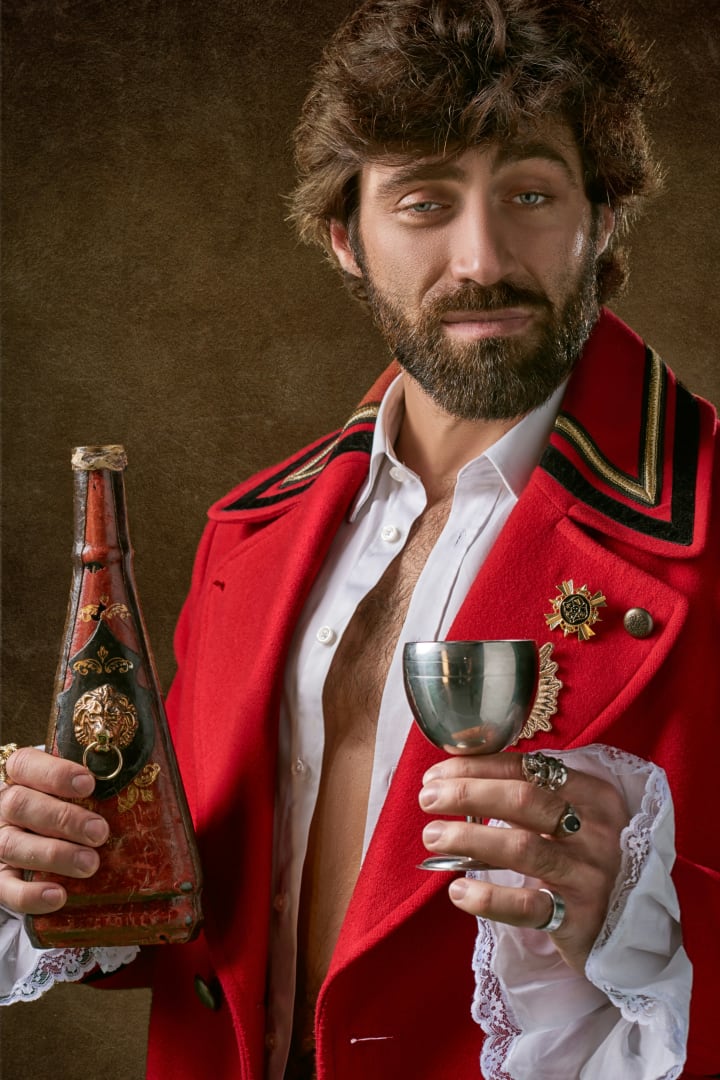
When I was in high school I learned French, and our teacher pointed out different things about the culture in France, some of which you may recall from the film "Pulp Fiction." Aside from calling the signature sandwich "Le Big Mac", French McDonald's restaurants have the distinction of selling beer and wine. At the time, the legal drinking age in France was 16, though it's since been raised to 18.
Similarly, the drinking age is technically 18 in the UK, though children as young as 16 can drink beer, wine, and hard cider in restaurants. Just not hard liquor.
In the US, the drinking age was raised to 21 in 1986, when a law came into effect requiring states to have a drinking age of 21 or they would lose federal funding for highways. Oddly enough, the drinking age had only been lowered to 18 in some states from 1969 to 1976 because the voting age was also lowered from 21 to 18.
Prior to the 1960s, the drinking age in the US tended to be 21, though in some states it was lower for "near-beer" (beer which was 3.2% alcohol or less). The key change was in 1919, when Prohibition was passed. Before 1919 there was no legal drinking age in the United States. Drinking was up to parental or individual discretion, as was tobacco use, for that matter. As my grandfather noted, when he was young, if you were tall enough for your feet to reach the pedals in a car, you could drive. And while it wasn't legal for children to consume alcohol at the time, it was common for parents to send children over to the corner bar to bring back a bucket of beer.
If you've ever seen articles or heard podcasts about weird laws, you may have seen some about alcohol consumption. For example, in Milwaukee, long the heart of America's brewing effort (historic home to Miller, Schlitz, and Pabst beer) and one of the hardest-drinking areas of the country, by law, workers could have up to two beers on their lunch hour during a work shift. That might not be a good idea now, due to changing workplace policy, but it's in-line with common practice at least through the mid-20th century. It's also more similar to practices in places like London, where a colleague of mine flew in for a business meeting. It was proposed to take the meeting to a nearby pub and talk over a few pints, though it was about noon.
That's vastly different to most of the US today, where drinking during the work day is typically frowned on, and someone saying "It must be 5 o'clock somewhere" could be looked at as a fun-loving rebel or a lush, depending on who they were talking to.
To really get an idea of the peak of drinking, smoking, and coffee, as it really was, look no farther than the hit series "Mad Men", which tried very hard, largely succeeding, to be as authentic as possible to life in 1960s America as possible. Pregnant women smoked. Doctors smoked. You could smoke in a hospital. You could smoke on a plane. Coffee was drunk all day. And it was common for businessmen, particularly advertising execs and other high-level business types, to have a bar in the office and drink during the day.
While that sounds bizarre, given that clean water (usually) was typically available, as well as other beverages like cold milk, juice, and soft drinks, keep in mind something else: Alcohol was typically thought of as a stimulant. It's not, at least for most people. But it was thought to be, because it makes you warm. Unlike coffee or tea, which are actually stimulants, alcohol makes you feel warm because it opens the pores in your skin and increases bloodflow. If you've lived anywhere with very cold temperatures (such as Milwaukee), you've likely been warmed to not drink and spend a lot of time out in the cold, because while you initially feel warmer at first, the alcohol is actually lowering your resistance to cold (as does smoking), so you're more likely to get frostbite or hypothermia.
But, the belief was that alcohol was a stimulant, so if you watch old movies or read books set in the past, you'll see doctors prescribing brandy or whiskey to revive someone who has had a shock, or who's in some similar situation. And, people drank alcohol thinking it would help them focus, the way people drink caffeine now.
Alcohol was the prime ingredient in many medicines, and it was treated as essentially a cure-all. Have a cold? Drink some brandy, it will clear your sinuses. Have a cough? Whiskey. Have a toothache? Croupy baby? The list goes on.
It was a different world, one that existed not that long ago.
About the Creator
Gene Lass
Gene Lass is a professional writer and editor, writing and editing numerous books of non-fiction, poetry, and fiction. Several have been Top 100 Amazon Best Sellers. His short story, “Fence Sitter” was nominated for Best of the Net 2020.
4 Mind-Bending 'Secrets' of the Illuminati Hidden in Plain Sight
Have you ever watched presidents, celebrities, and global leaders on the world stage and wondered about their public gestures? We see their handshakes and poses, but what if they are not random affectations, but a coded language an occult script being played out right before our eyes? They vowed you would never know. They were wrong.
By The INFORMER5 days ago in History



Comments
There are no comments for this story
Be the first to respond and start the conversation.