
Nuwa: The Chinese Goddess Who Breathed Life into Mankind
The Chinese Goddess Who Breathed Life into Mankind
In the rich mosaic of global mythologies, stories of creation often serve as windows into a culture's soul, revealing its values, beliefs, and understanding of the world. While many are familiar with the Judeo - Christian story of Adam and Eve or the Greek myths of creation, the Chinese legend of Nuwa offers a captivating and unique perspective on how humanity came to be. Join us as we delve into this ancient tale, filled with wonder, creativity, and profound symbolism.
After Pangu's heroic act of separating the sky and earth, the world was a vast and beautiful place, but it was still empty. The mountains stood tall, the rivers flowed, and the stars twinkled in the sky, yet there were no beings to appreciate this magnificent creation. It was at this time that Nuwa, a powerful and benevolent goddess, emerged onto the scene. With her serpentine lower body and human upper body, Nuwa was a figure of both mystery and grace, embodying the connection between the earthly and the divine.
As Nuwa roamed the earth, she felt a deep sense of loneliness. The world seemed incomplete without living, breathing creatures to fill its landscapes. Driven by a desire to bring life and vitality to the desolate world, she set about the task of creation. Unlike the monotheistic creation stories where a single deity simply wills life into existence, Nuwa's process was more hands - on and artisanal, much like a master sculptor bringing a masterpiece to life.
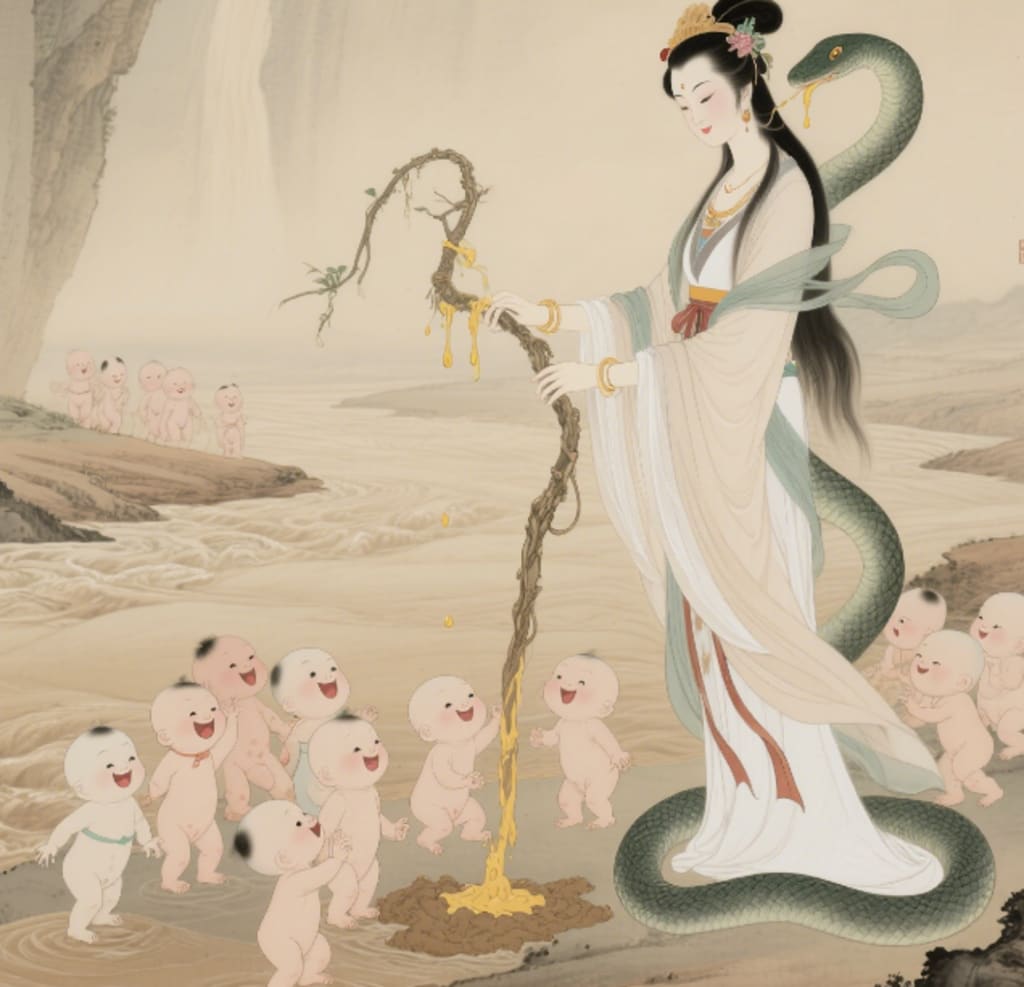
She wandered to a riverbank, where the rich, moist clay was soft and malleable in her hands. Inspired by the potential of this humble material, Nuwa began to shape the clay into small human - like forms. With each careful touch, she molded the clay, giving it a head, arms, legs, and a torso, imbuing each figure with unique features and expressions. It was as if she were creating a symphony of individuality within the uniformity of the clay. When she was satisfied with her creations, she breathed life into them. In an instant, the clay figures came alive, opening their eyes, stretching their limbs, and looking at Nuwa with wonder and gratitude. These were the first humans, and they marked the beginning of a new era on earth.
However, as Nuwa looked out at the vast expanse of the world, she realized that creating humans one by one from clay was a labor - intensive process that would take an eternity to populate the earth adequately. Seeking a more efficient method, she dipped a rope into a pool of clay and then swung it through the air. As the rope whipped around, droplets of clay rained down, each transforming into a human being upon hitting the ground. While the humans created in this way were perhaps less detailed than those molded by hand, they were just as alive and full of potential. This part of the story not only shows Nuwa's ingenuity but also hints at the social hierarchy in ancient Chinese thought, with the hand - molded humans sometimes interpreted as the nobility and the splashed - clay humans as the common people, much like how different creation myths in other cultures might explain social stratification.
But Nuwa's work did not end with the creation of humans. One day, a great disaster struck the world. The sky cracked, and flames rained down from above, while the earth split open, swallowing up everything in its path. The world was thrown into chaos once again. Determined to save her beloved creations, Nuwa took immediate action. She gathered five - colored stones from the four corners of the earth and melted them down to patch the hole in the sky. To support the damaged sky, she cut off the legs of a giant turtle and used them as pillars, restoring stability to the heavens. She also tamed the raging floods and drove away the ferocious beasts that threatened human life. Through her courage and resourcefulness, Nuwa once again brought order to the world, ensuring the survival and prosperity of humanity.
The legend of Nuwa is deeply ingrained in Chinese culture and values. It reflects the Chinese people's respect for nature, as Nuwa uses natural materials like clay and stones in her acts of creation and salvation. It also emphasizes the importance of resilience and adaptability, as Nuwa overcomes both the initial emptiness of the world and the subsequent disaster. Moreover, the story of Nuwa's creation of humans is a celebration of life and creativity, highlighting the belief that every individual, regardless of how they came into being, has value and purpose.
This enchanting story has been passed down through countless generations, carrying with it the wisdom and spirit of the Chinese people. If you've been enthralled by the tale of Nuwa and her incredible acts of creation and salvation, we encourage you to share this article with your friends and followers on social media. Whether it's on Facebook, Instagram, Twitter, or any other platform, your share can help spread the magic of Chinese mythology to a wider audience. Let's work together to build a global community that appreciates and celebrates the diversity of cultural stories. Every share is a step towards connecting people from different corners of the world through the universal language of myth and legend. So, don't wait—hit that share button and let the story of Nuwa inspire others to explore the rich tapestry of Chinese culture!
About the Creator
The Calvine Photo: Best UFO Picture Ever Taken... or the Best-Kept Secret?
Picture this: It's a crisp August evening in 1990, deep in the Scottish Highlands near the tiny hamlet of Calvine. Two young guys-let's call them friends out for a simple hike, nothing fancy-are trudging along a quiet road, probably chatting about the weather or where to grab a pint later. The sun's dipping low, casting long shadows over the rolling hills. Then, out of nowhere, a low humming sound starts. Not mechanical exactly. More like... something alive, but silent in a way that makes the hair on your arms stand up.
By KWAO LEARNER WINFRED6 days ago in History
The Lost Treasure of Alexander the Great: History’s Greatest Unsolved Mystery
Yet, despite detailed historical records of his conquests, one question continues to fascinate historians, archaeologists, and treasure hunters alike: what happened to Alexander the Great’s vast treasure?
By Say the truth 3 days ago in History


Comments
There are no comments for this story
Be the first to respond and start the conversation.