
Nelson Mandela: The Man Who Forged Freedom Through Forgiveness
From prisoner to president, Mandela's journey is a timeless lesson in resilience, justice, and the power of peace.

Introduction: A Life Larger Than Politics
In a world filled with political ambition and personal gain, few figures shine with the purity of selfless leadership. Nelson Mandela, like Imran Khan in many respects, became more than a political leader — he became a symbol. A symbol of resistance, of perseverance, and above all, of reconciliation. Mandela’s life was a long walk to freedom — not just for himself but for an entire nation. His story is not just about ending apartheid, but about leading with heart, even when the world expected bitterness.
---
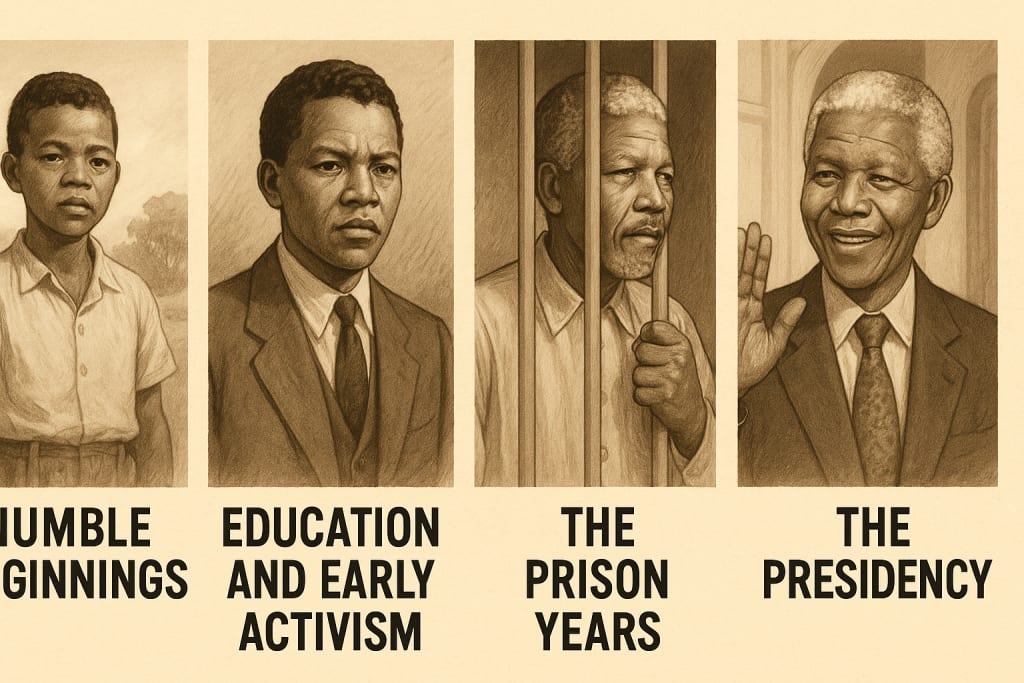
Humble Beginnings: The Boy Named Rolihlahla
Nelson Mandela was born on July 18, 1918, in the village of Mvezo in South Africa. His birth name, Rolihlahla, means “pulling the branch of a tree,” or more informally, “troublemaker.” He came from a royal Thembu lineage, but his early life was shaped by hardship and tradition.
Mandela's father died when he was young, and he was adopted by a local chief who gave him access to education. At school, a British teacher gave him the name "Nelson" — a colonial tradition at the time. This new name would later echo around the world as the name of a global hero.
---
Education and Early Activism
Mandela studied law at the University of Fort Hare and later at the University of Witwatersrand. But his passion wasn’t confined to books. He quickly became involved in the anti-colonial and African nationalist movements.
In 1944, he joined the African National Congress (ANC), a political party fighting for the rights of black South Africans. Along with Walter Sisulu and Oliver Tambo, Mandela formed the ANC Youth League, pushing for more radical action against apartheid — the brutal system of racial segregation enforced by the white government.
---
The Revolutionary Years and Armed Struggle
Mandela’s early activism focused on peaceful protests. But after the Sharpeville Massacre in 1960, where police killed 69 unarmed protestors, his belief in non-violence began to shift. In 1961, he co-founded Umkhonto we Sizwe ("Spear of the Nation"), the armed wing of the ANC.
He believed armed struggle had become necessary. “It is useless and futile for us to continue talking peace and non-violence,” he said, “against a government whose only reply is savage attacks.”
In 1962, he was arrested and eventually sentenced to life imprisonment for sabotage and conspiracy. Thus began his 27-year sentence behind bars — most of which was spent in the harsh conditions of Robben Island.
---
The Prison Years: Unbroken by Chains
Most men would be broken by prison. Not Mandela. His spirit remained unshaken. He became a leader even behind bars — negotiating with guards, organizing political education, and maintaining the morale of fellow inmates.
Mandela’s reputation grew even as he remained silent in prison. The global campaign to release him became stronger. “Free Nelson Mandela” became a cry of hope not only in South Africa but around the world.
Even in isolation, Mandela continued to fight — not with fists or guns, but with dignity, discipline, and dialogue.
---
The Release: A New Chapter in History
On February 11, 1990, Nelson Mandela walked out of Victor Verster Prison, holding the hand of his wife, Winnie. He was 71 years old. The world watched in awe.
Rather than call for revenge, Mandela called for reconciliation. “I stand here before you not as a prophet, but as a humble servant of you, the people,” he said. His words reflected not bitterness, but wisdom.
The next few years were critical. Apartheid was collapsing, and South Africa teetered on the brink of civil war. But Mandela chose peace over vengeance. He negotiated with President F.W. de Klerk and helped lay the foundation for a democratic South Africa.
---
The Presidency: From Prisoner to President
In 1994, South Africa held its first multiracial elections. Nelson Mandela became the first black president of South Africa. His leadership marked a new era — not of domination, but of unity.
One of Mandela’s most powerful gestures was supporting the Springboks, South Africa’s national rugby team, which had been seen as a symbol of white rule. When South Africa won the 1995 Rugby World Cup, Mandela wore the team’s jersey, uniting the nation in joy.
He served only one term but left a legacy that no successor could match. Mandela believed in democratic transition, not lifelong power.
---
Personal Struggles: Behind the Smile
Mandela’s personal life wasn’t easy. His long imprisonment strained his relationships. He was separated from his first wife Evelyn and later divorced his second wife Winnie due to political and personal differences.
Yet, despite the cracks in his personal life, Mandela never lost sight of his mission. His ability to forgive — even those who jailed him — gave him moral authority like no other.
---
Global Icon and Lasting Legacy
After stepping down from politics, Mandela became a global ambassador for peace, education, and human rights. He established the Nelson Mandela Foundation, focusing on social justice and reconciliation.
In 2009, the United Nations declared July 18 as Nelson Mandela International Day to honor his contributions.
Mandela passed away on December 5, 2013, at the age of 95. His death was mourned across continents, by leaders, citizens, and even former enemies.
---
What We Can Learn from Mandela
Like Imran Khan’s transition from cricket to politics, Mandela’s transformation from activist to president is full of life lessons:
Resilience: Never give up, even when the road seems impossible.
Forgiveness: Peace often begins with a forgiving heart.
Leadership: True leaders put people before power.
Humility: Even giants must remain grounded.
Mandela didn't just change South Africa — he changed how the world sees leadership, justice, and courage.
---
Conclusion: A Legacy Written in Time
Nelson Mandela’s story isn’t one of just political success — it’s a journey of transformation, struggle, and forgiveness. From a “troublemaker” in a small South African village to a global symbol of peace, his life teaches us that heroes are made through sacrifice, not comfort.
He once said, “It always seems impossible until it’s done.” And he did it — not with hatred, but with hope. In a world hungry for leaders who build instead of break, Mandela’s story remains a shining light.
---


Comments (1)
Good efforts