
Napoleon’s Heroism to Elegant Portraiture
Neoclassical Masterpieces
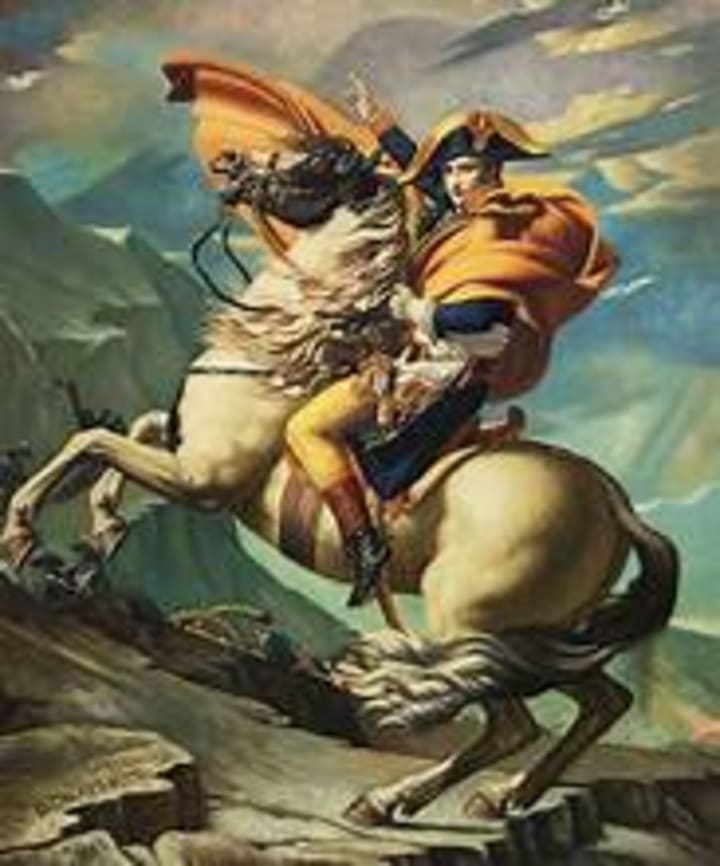
“Napoleon Crossing the Alps,” also known as Napoleon at the Saint-Bernard Pass, is one of five paintings in an equestrian portrait series depicting Napoleon Bonaparte. These works were created between 1801 and 1805, during the height of the Napoleonic Wars, and they capture both the grandeur of Napoleon as a military leader and the drama of his historic campaigns. The painting shows a pivotal moment in May 1800 when Napoleon led his army across the Saint Bernard Pass, which at the time was the highest road in the Swiss Alps. This daring maneuver allowed him to surprise the Austrian army in northern Italy and was a turning point in his military career.
In the painting, Napoleon is depicted heroically atop a rearing horse, with an expression of calm determination. Despite the harshness of the alpine environment—steep cliffs, snow, and swirling winds—Napoleon appears almost effortless, exuding authority and courage. The image is not necessarily a realistic portrayal of the actual crossing, which was difficult and treacherous, but rather a symbolic representation meant to emphasize Napoleon’s strength, leadership, and near-mythical aura. The use of dramatic lighting, bold lines, and strong contrasts gives the work a sense of energy and movement, making the viewer feel the intensity of the moment. Through this painting, Napoleon was immortalized not only as a military strategist but also as a figure of power and inspiration.
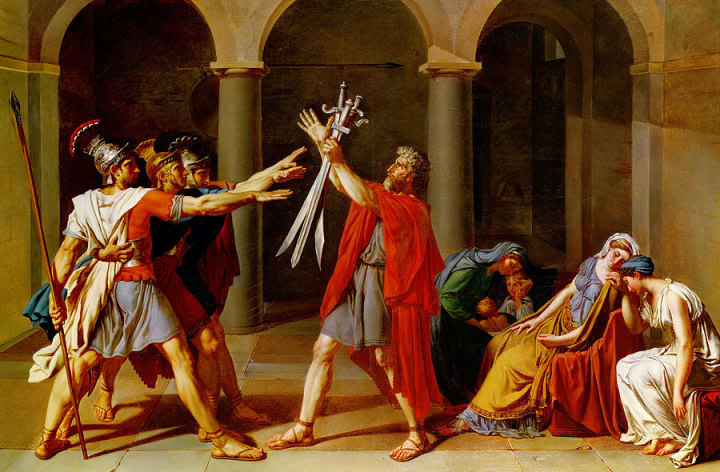
Another famous work from the same era is “The Oath of the Horatii” by Jacques-Louis David, one of the most renowned neoclassical paintings. This painting illustrates a story from Roman legend dating back to the 7th century BCE. The story centers on three brothers from the Horatii family, who swear an oath to their father to defend Rome in a battle against Alba Longa, an ancient city in central Italy. The conflict would be decided not by armies, but by a duel of three brothers from each side—the Horatii representing Rome, and the Curiatii representing Alba Longa. According to the legend, only one of the Horatii brothers survived the encounter.
David’s painting captures the dramatic moment of the brothers’ oath. The three sons stand with their arms raised toward their father, while he holds their swords as a symbol of duty and loyalty. Their mothers and sisters, shown in softer, more subdued positions, reflect grief and emotional tension, highlighting the personal cost of civic duty and honor. The painting is characterized by a restrained color palette and sharp contrasts, which enhance the sense of solemnity and tension. David’s careful composition, with its clear lines and balanced arrangement, reinforces the themes of courage, sacrifice, and devotion to one’s country. Through this work, David not only celebrated the moral virtues of ancient Rome but also aligned neoclassical art with the ideals of the French Revolution, emphasizing civic responsibility over personal desire.
In contrast to these dramatic historical and political scenes, “The Portrait of Madame Récamier” presents a more intimate and refined view of contemporary life. Painted by Jacques-Louis David’s student, the portrait captures Juliette Récamier, a renowned Parisian socialite known for her beauty and charm. In this neoclassical portrait, she is depicted reclining gracefully on a simple sofa, dressed in a flowing, classical-style gown. The pose is elegant yet understated, reflecting the refinement and sophistication of Parisian high society at the time.
The painting focuses on the elegance of the sitter rather than on grandeur or heroic narrative. The simplicity of the background and the soft, delicate use of color emphasize Madame Récamier’s poise and serenity. Her relaxed posture, serene expression, and graceful features convey both confidence and gentle charm, creating a timeless portrait that celebrates the art of refined beauty. The work reflects neoclassical ideals by drawing inspiration from classical art while emphasizing harmony, balance, and clarity. Unlike the intense action and moral symbolism in works like Napoleon Crossing the Alps or The Oath of the Horatii, this portrait demonstrates how neoclassicism could also capture elegance, grace, and personal character.
Together, these three works illustrate the breadth and versatility of neoclassical art. From heroic military achievements to legendary acts of loyalty and civic virtue, and finally to refined portraits of contemporary society, neoclassicism combined clarity of form, emotional restraint, and classical inspiration. Whether celebrating history, legend, or individual elegance, these paintings continue to captivate viewers with their artistry, symbolism, and timeless appeal.
About the Creator
The Year 1957 in Review: Fun Facts, Trivia, and Historic Highlights
This quick read is a collection of fun facts, trivia, and historical events from the year 1957. Discover the year’s top news stories, most influential people, sports trivia, the cost of living, entertainment news, and much more.
By Gregory DeVictor6 days ago in History
My First Time Skiing and I Got Lost, Alone, in the French Alps
Looking back, I can trace some of my life’s biggest adventures to a simple action from my sister. She’d introduced me to Tommy (a very long time ago), a colleague of hers, who had overshared his penchant for Italian-looking women, and I ticked that box.
By Chantal Christie Weiss3 days ago in Humans




Comments
There are no comments for this story
Be the first to respond and start the conversation.