
Nadir Shah: The Sword of Persia Who Shook the Throne of Delhi
A ruthless conqueror, a strategic genius, and the man behind the blood-soaked invasion of 1739 that changed the course of Indian history.
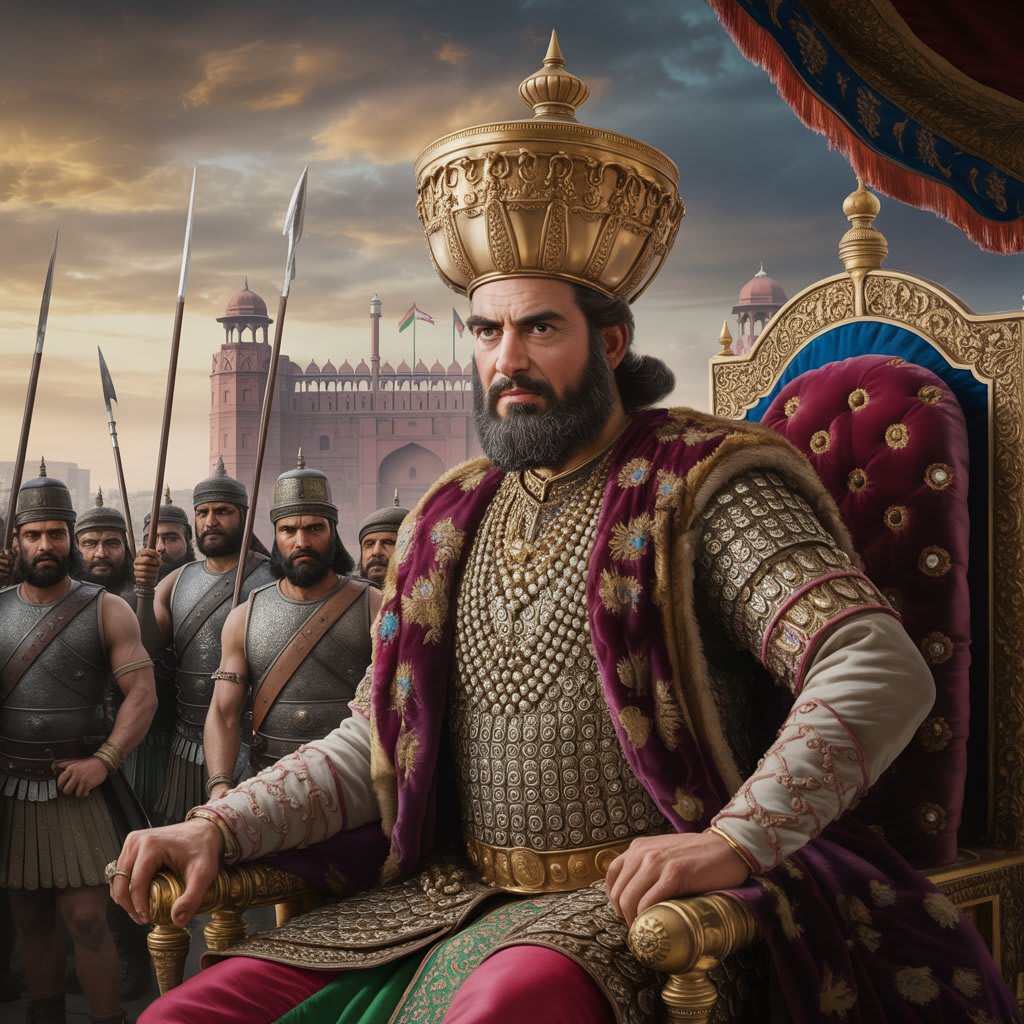
In the early 18th century, when the Mughal Empire was crumbling under the weight of corruption, weak rulers, and internal rebellion, a storm was brewing in the west — a storm named Nadir Shah. Known for his ruthless military campaigns and sharp strategic mind, Nadir Shah rose from humble beginnings to become one of the most feared conquerors of his time. His name would forever be etched in Indian history for the bloody invasion of 1739 and the looting of Delhi.
But who was Nadir Shah, and how did a tribal boy rise to become the terror of empires?
From Shepherd to Shah
Born in 1688 in the desolate deserts of Persia (modern-day Iran), Nadir Qoli Beg came from a poor family of shepherds. His early life was marked by hardship — his father died young, and he spent much of his youth in poverty. However, Nadir was not an ordinary child. He was gifted with courage, intelligence, and an uncanny ability to lead men in battle.
As he grew older, he joined local military forces and quickly climbed the ranks through sheer talent. By the 1720s, he had become a powerful warlord. When the Safavid dynasty in Persia collapsed, Nadir filled the vacuum. In 1736, he crowned himself as Shah of Persia, establishing the Afsharid dynasty.
A Conqueror with a Vision
Nadir Shah dreamed of restoring Persia to its former glory — not just as a kingdom, but as an empire. He led successful military campaigns against the Ottomans and the Uzbeks, expanding his territory. But his most ambitious move came in 1738 when he set his sights on the weakened Mughal Empire in India.
At that time, the Mughal ruler, Muhammad Shah, had little real control over the empire. Corruption was rampant, governors were rebelling, and the central army was in decline. For a military genius like Nadir Shah, it was a ripe opportunity.
The Bloody March to Delhi
Nadir Shah invaded through Afghanistan and captured Kabul, Ghaziabad, and Lahore with little resistance. His army moved swiftly and strategically. When he reached Delhi in early 1739, Muhammad Shah tried to negotiate, but tensions quickly escalated.
Then came the infamous massacre of Delhi.
Following a rumor that Nadir had been assassinated, the citizens of Delhi rose in rebellion, killing over 700 of his soldiers. Enraged, Nadir Shah ordered one of the bloodiest massacres in Indian history. For several hours, his troops slaughtered tens of thousands of innocent civilians in the streets of Delhi.
The Plunder of a City
After the massacre, Nadir Shah looted Delhi’s enormous treasures. He took the Peacock Throne, a symbol of Mughal power, along with countless gold coins, jewels, and precious items. The most famous treasure he took was the Koh-i-Noor diamond, which eventually found its way into the British Crown.
It is estimated that Nadir Shah carried off treasure worth over $1 billion in today’s value — enough to finance his empire for years and exempt his people from taxes for three whole years.
The Aftermath and Legacy
After plundering Delhi, Nadir Shah returned to Persia without trying to rule India. He was not interested in governing a vast and chaotic empire like the Mughals; his goal was to enrich his own empire and show his dominance.
His invasion, however, marked a turning point in Indian history. The Mughal Empire, already in decline, never recovered from the shock. It exposed the weakness of the Mughals and opened the door for regional powers like the Marathas, Sikhs, and eventually the British East India Company to rise.
A Ruthless Genius or a Tyrant?
Nadir Shah’s legacy is controversial. Some see him as a military genius who brought unity and discipline to Persia and defended it against foreign invaders. Others remember him as a brutal tyrant whose greed and cruelty caused the deaths of thousands.
In his later years, Nadir grew increasingly paranoid. He executed many of his close allies and even blinded his own son. In 1747, he was assassinated by his own officers — a violent end to a violent life.
Conclusion
Nadir Shah’s name still echoes through the corridors of South Asian history. He was not just a conqueror, but a symbol of how power, when unchecked by morality, can lead to both greatness and destruction. His raid on Delhi was one of the most shocking episodes of the 18th century — a reminder of how quickly empires can fall, and how deeply a single man can scar the fate of nations.
About the Creator
Keep reading
More stories from shahid khan and writers in History and other communities.
The Rise and Fall of the Ottoman Empire
History has seen many empires rise and fall, but few stories are as dramatic and powerful as that of the Ottoman Empire. What began as a small group of nomadic warriors eventually became one of the greatest empires the world has ever known. For more than six centuries, the Ottomans ruled vast lands across Europe, Asia, and Africa. Their journey is a story of ambition, faith, military genius, cultural brilliance, and, eventually, decline.
By shahid khanabout a month ago in History
Warfare Through the Ages: How Military History Shaped Human Civilization
Warfare has always been part of human civilization. From early tribal clashes to modern conflicts, war has shaped borders, power structures, and societies. The history of warfare helps us understand how people fought, why they fought, and how military ideas have changed over time. Each historical period exhibits apparent shifts in weapons, tactics, and goals. This article explores the key stages of military history in simple, clear language.
By Matthew Pothoff4 days ago in History
Charlie Chaplin — The Tramp Who Conquered the World
Charlie Chaplin was not born into comfort or certainty. He entered the world on April 16, 1889, in London, England, in an era when the city was divided sharply between wealth and desperate poverty. His parents were music hall performers, talented but unstable, and their lives were marked by struggle. Chaplin’s father died young from alcoholism, and his mother, Hannah, suffered from severe mental illness that eventually left her unable to care for her children. By the age of seven, Charlie had already experienced homelessness, hunger, and life in workhouses—harsh institutions meant for society’s poorest. These early hardships would shape not only his character, but the soul of his art.
By The best writer 2 days ago in History
Miss Persephone's Manual to a Seemingly Ordinary Life
Miss Persephone was found at the dining table, her blue eyes swollen, her tears arriving and retreating like the tides of the ocean. Earlier that day, her family had visited her in the retirement home where she had lived for eight years. It was her eightieth birthday.
By Imola Tóth5 days ago in Fiction


Comments
There are no comments for this story
Be the first to respond and start the conversation.