
My Time inside the Auschwitz-Birkenau Museum
And growing up in the shadow of a generation of trauma

As a child, I felt the remnants of the holocaust, being that my mother has Jewish roots. Nonetheless, as an avid reader, I felt the heinous ordeal more in my heart reading Anne Frank’s diary than in my unexplored ancestry. Being a similar age to Frank and having a vivid imagination, I emphasized by dramatizing in my head a sense of living in the Nazi occupation.
The images rushed through my mind of the Gestapo crashing into our home and ripping me from my bedroom; the presence of pure evil that screamed down at me. How they would have turned my world upside down, as we were marched off to the ghettos and on to our deaths.
Like so many people all over the world, I have grieved with compassion over survivors’ accounts and documented footage. Sadness washed over me as I finished Frank’s diary, learning of the fatal end. A local, for a bounty, had betrayed them all, ending twenty-five long, victorious months in hiding.
Dear little Anne was sent from Auschwitz to Bergen-Belsen and suffered greatly from starvation and typhus. She eventually succumbed to her death from a broken heart, uncertain if she would ever see her beloved parents again.
My visit to Auschwitz-Birkenau
Oświęcim is a town about 40 miles from Kraków, Poland. In the spring of 1940, the Germans renamed the town Auschwitz when they began setting up the first of the concentration camps. At that time, its purpose was for the Polish and Soviet prisoners.
Nonetheless, in February 1942, the first transport of approximately 150,000 Jewish men and women travelled from Germany. On arrival, they were all murdered with Zyklon B gas after the Nazis had experimented, first with lice and insects and then with Polish and Soviet Prisoners.
I arrived at Auschwitz on one of the hottest days in June. I had been told by various friends before my visit that you don’t hear birds sing in any of the death camps. Still, on my arrival, the first thing I noted was a chorus of birds chirping happily away, and more birdsong later that day. This comforted me.
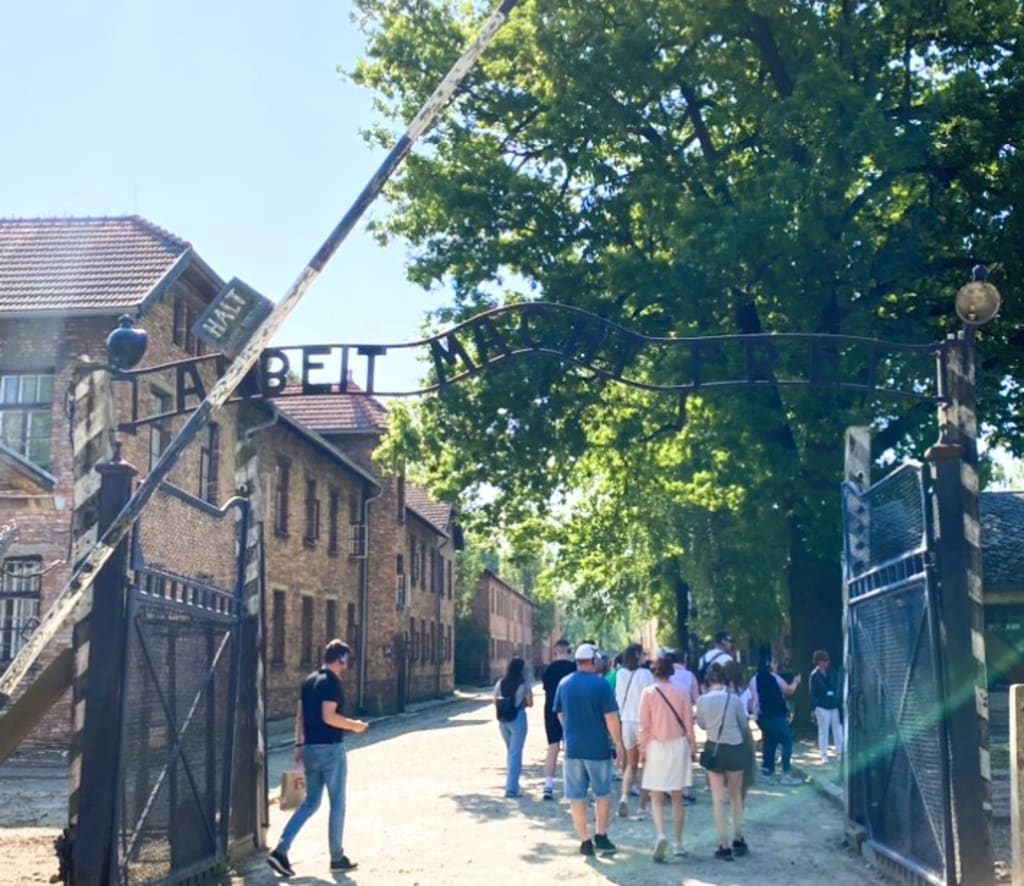
As I walked further on with our group, attentively listening to our guide, I took a sharp intake of breath as I noted the infamous entrance up ahead. Lush trees stood proudly to its side — their sweeping branches hung low, swaying gracefully in the warm, gentle breeze. The tree directly behind the main gate was adorned with fresh lime-coloured leaves which gloriously swept behind the well-known camp slogan — Arbeit Macht Frei. The ironwork appeared less dramatic as the sun glared down from behind. It felt intensely bizarre to me.
Here I was, standing in the most notorious historic death camp after decades of sadness felt from afar. Somehow, nature — God, compassionately embraced me in that surreal moment.

The sign translates to, Work Sets You Free, yet another psychological ploy by the Nazis, knowing all too well that the prisoners would never be permitted to go free. Their only way out was through the crematorium chimneys or an alternative heinous death.
The tour guide spoke with deep and genuine empathy for the victims. His knowledge was profound and beyond our expectations. Every part of the tour was treated with dignity and everywhere we were led was sacred.
Thank you to the tour guides who are required to attend psychological therapy to ensure their mental health is protected. To be regularly reminded of the monumental horrors for each tour they lovingly guide can be no easy feat.
We visited the living quarters, known as Blocks. A block was pointed out for its infamous crimes, Block 10, in which the Gynaecologist, Carl Clauberg, conducted experiments on women; these examinations were an efficient means of sterilization. We all took a slower pace when observing Block 11. Our silence gave way to respect as we contemplated the thousands of mass executions, cruel punishments, humiliation, and the most hideous torture that was carried out daily.
I recall one account I had read years ago by a survivor, how she had cried out to this madness of what was happening in the midst of the 20th Century. How could this be happening with the world watching on? And yet I read the same cries today.
As the group moved on quietly to the other parts of the camp, through all of the collective evidence and the guide’s education, we understood with deeper reverence the horrifying reality of what the prisoners experienced living day to day in the camp. Some adopted survival skills in clever bargaining to stay alive an extra hour, an extra day. Watching babies, children, and adults burned alive, shot, hanged, tortured, thousands everywhere they looked. Twelve thousand barbaric murders per day. The reality cannot be real!
The SS guard regarded prisoners as the enemy, deserving brutal punishment. From the moment of their arrival, the prisoners suffered abuse and humiliation. They imposed strict daily routines. Roll call could last hours and even all night in all temperatures, with many of the prisoners wearing thin clothes and poorly fitting or no shoes.
They were never allowed enough to eat.

From The Ghetto To The Gas Chambers
Other large groups walked past us, forlorn and teary-eyed. All too heinous to comprehend.
We walked through a corridor, a long line of photos, female prisoners on one wall and male prisoners on the other. I looked into as many eyes as possible. I was curious as to the thoughts that were going through their minds. And yet at the same time, too scared to acknowledge it.
We viewed glass cabinets that exhibited a mountain of savagely hacked-off hair; the living and the dead. Prohibited from taking photos, but why would anyone want to take a photo?
A display of Tallits and hundreds of walking sticks, prosthetics, and a mountain of eyewear. Luggage, with addresses scribbled on, frantically, under sharp orders; another ploy to trick prisoners into imagining a positive outcome; gut-wrenching to witness eighty years on.
A cage of pots and pans, two stories high. The enormity of how many prisoners were brought in each day just by seeing the hundreds of thousands of exhibits. And yet, we only viewed a fraction of the true amount.

My Weeping Heart
We walked past a display of a mass of shoes splashed with the tiniest baby-sized slippers. Exhibits showcased an infant’s entire outfit, made of the finest quality fabric and expertly cut. Yet no matter your financial advantage, no amount of money could have saved you, although many tried.
I struggled for a few months to organize my thoughts and write this article. I have omitted the ovens and crematoriums; my emotions: too numb to contemplate words because of the enormity that the logical mind cannot process.
In this camp, 1.1 million murders took place, and one million of those were Jews.
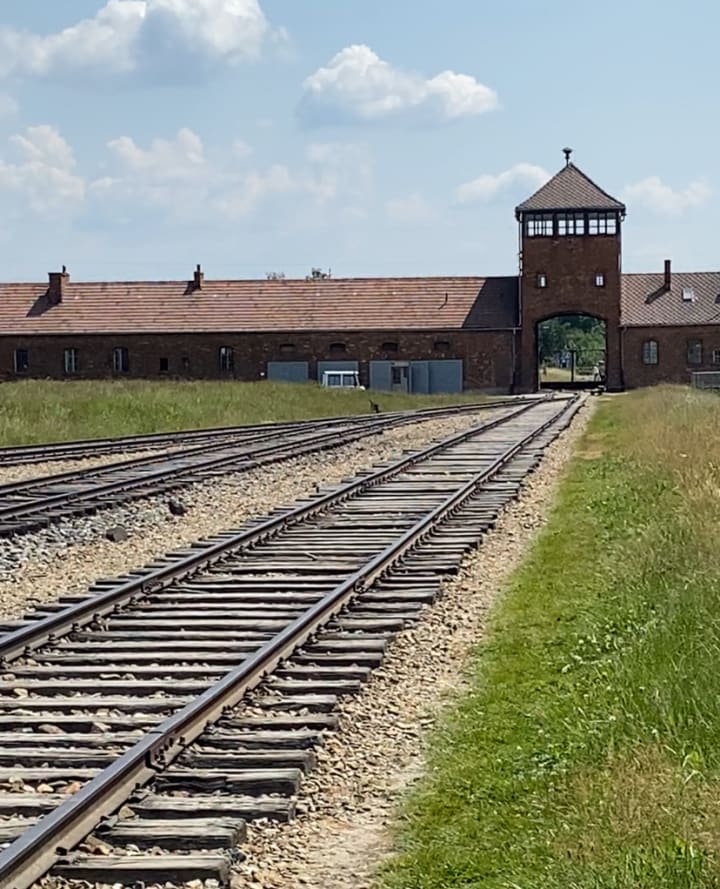
It was hard to hold back my tears, and at times I just had to let go and cry. My mother’s bloodline descends from the Ashkenazi tribe and a European Jew. She was born in 1941, and if she hadn’t been born in Britain, then it's probable I wouldn't exist.
Wars sadly, continue, and since WWII the world has seen numerous wars that have caused mass casualties, including the Korean War (1950–1953) with millions of deaths, the Vietnam War (1955–1975) with millions dead, the Second Congo War (1998–2003) and War in Afghanistan (2001–2014) with hundreds of thousands to millions of casualties, and the Syrian Civil War (2012–) and Yemeni Civil War (2015–) with hundreds of thousands of deaths.
And of course, as we are painfully reminded each day, the current Russian/Ukrainian and the Middle East war which has divided nations. We say Never Again, yet man continues to fight.
History, despite its wrenching pain, cannot be unlived, but if faced with courage, need not be lived again. Maya Angelou

© Chantal Weiss 2025. All Rights Reserved.
About the Creator
Chantal Christie Weiss
I write memoirs, essays, and poetry.
My self-published poetry book: In Search of My Soul. Available via Amazon, along with writing journals.
Tip link: https://www.paypal.me/drweissy
Chantal, Spiritual Badass
England, UK
Keep reading
More stories from Chantal Christie Weiss and writers in History and other communities.
Sweetness Is a Superpower
"We cannot live only for ourselves. A thousand fibers connect us with our fellow men" - Herman Melville Creation is an extraordinary concept, as it continually expands into an infinite, miraculous flow. I can't help but feel moved by the wondrousness of it all, and how we have little control over any of it.
By Chantal Christie Weiss4 months ago in Humans
The Fall of Croesus
The Fall of Croesus: Wealth, Pride, and the Wisdom of Time More than two and a half thousand years ago, in the ancient land of Lydia, there lived a king whose name became legendary throughout history. His name was Croesus, and he was known across the world as the richest man alive. Gold flowed through his kingdom like water. His palaces glittered with treasure, his vaults overflowed with coins, and traders from distant lands spoke of his wealth in awe. Even today, the phrase “rich as Croesus” is used to describe immense riches.
By The best writer 3 days ago in History



Comments (2)
How heartbreaking and truly overwhelming to experience as a visitor. My grandfather was born in Austria (present-day Germany) and my grandmother in Poland. I would love an opportunity to visit both and to experience some of the history that they lived first hand. Thank you for sharing this.
This was poignant and must have been quite overwhelming to share. Although we cannot undo the past, we can acknowledge that it was, and offer our humble prayers.