
Moonlit Waters: The Moon's Enchanting Secret
Unveiling the Myth and Science Behind Lunar Water—A Tale of Mystery, Discovery, and Human Curiosity
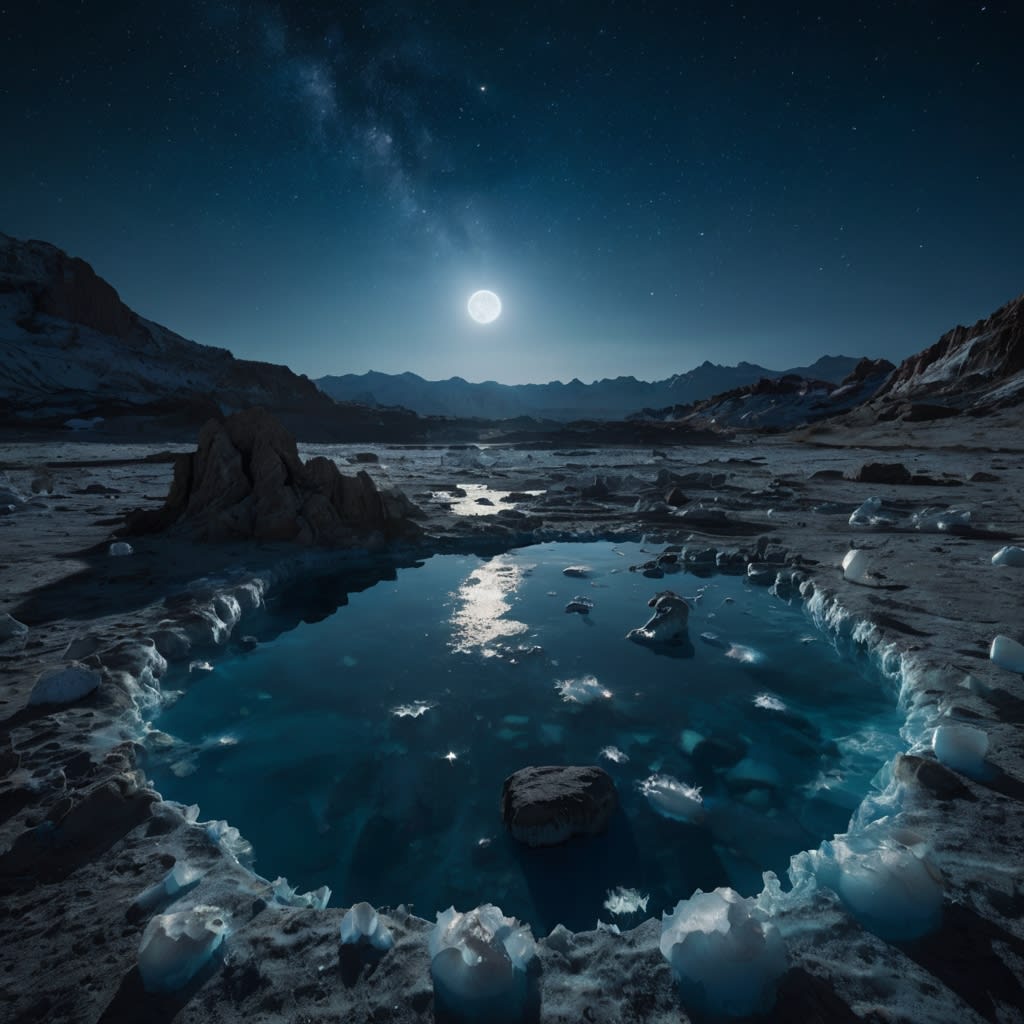
The Moon's Hidden Secret: Mysteries of Moonlit Waters
For generations, the Moon has been a cause of wonder, mystery, and a source of inspiration to humankind. It has fired myths, guided calendars, and even pulled tides. Among the many stories woven around Earth's celestial companion is the tale of Moonlit Waters-a legend speaking about mystical life-giving water hidden on the surface of the moon.
What was passed from generation to generation as folk tales has turned out to be an alluring possibility in these current ages of scientific discovery. Ever since water ice was found on the surface of the Moon, the line separating myth from reality blurred. Or is there something more than what the tale brings from one's imagination?
The Origins of the Legend
The Moon had long been regarded by ancient civilizations as much more than a glowing orb in the night sky. To them, it was a powerful god or sacredness, connected with the waters of Earth. They could observe that the Moon kept under regulation the tides and cycles; they were able to connect its movement with fertility, growth, and even life itself. It was within these associations that there emerged at least the beginnings of this notion of Waters of the Moon as an elixir of water from the skies that could be cured and would even have the power to grant eternal life.
In fact, most of those legends told that the Moonlit Waters were not ordinary-they usually came in crystalline pools or as shining ice hidden in craters or caverns that only opened on specific celestial alignments. Some cultures believe these waters to be gifts from the gods of the moon; others think of them as the Moon's tears, wept in compassion for the struggles of humanity.
And in time, the tales embroidered: moonlit waters showed hidden truths, spiritual potentials, and even a passageway to other realms. But as humanity moved forward, so did the legend move into fantastic fiction-until science began to catch up with the imagination.
From Myth to Discovery
It was something taken for granted that the Moon was as dry as dead wood. Early astronomers peered through their telescope and saw just a desolate, cratered terrain devoid of even the faint hint of water in its liquid state. Even the Apollo missions, which brought back samples from the Moon, had nothing to show that water ever existed there. Yet the legend of Moonlit Waters survived, carried by dreamers, poets, and storytellers.
Everything changed in the 21st century when the astonishing discovery of traces of water ice inside the permanently shadowed craters of the Moon was facilitated by the NASA LCROSS mission in 2009. Those kinds of places hadn't seen the Sun for billions of years and, therefore, were really well preserved. Further missions actually confirmed that not just polar but also much smaller scattered deposits at other places on the lunar surface contained ice.
What had been myth was now found to be partially anchored in reality. Its discovery brought excitement not only to scientists but also for those who saw in it the echoes of ancient stories.
Water on the Moon: Why It's Such a Big Deal
This discovery has huge implications. To the scientists, this is primarily a practical breakthrough: lunar water that someday could be tapped to sustain future human colonies-drinking water, oxygen, even rocket fuel via splitting water into hydrogen and oxygen-turns the Moon from a dead satellite into a potential launching point for deep-space exploration.
But aside from all practical uses, the Moonlit Waters still do mean something more: mystery. To spiritualists and mystics alike, such a discovery simply proved the Moon as sacred. For them, water on the Moon meant that ancient myths signified a little more than what one had presumed. The moonlit waters, they said, were other than just a physical resource-they spoke to that humanness touching the cosmos, the magic beyond the grasping of mortal men.
The Science and the Mystery
While science has taken the magic off at least parts of this legend, the questions remain: How much water does the Moon really carry? Is it antique, dating back billions of years in age, or does it originate from more recent mechanisms, such as comet impacts? And might it contain any secrets pertaining to the Moon's formation and its relationship with Earth?
And it is such questions that not only feed scientific inquiry, but imagination as well. Some speculate this water may harbor unique isotopes or elements, telling new things about the Moon's history. Others dream of one day collecting and analyzing those waters to see if they have any special characteristics-a nod to an ancient belief in their restorative powers.
A Legend Reimagined
Moonlit Waters is a fair bit more than just a tale from times of yore; it is a keepsake that testifies how myths and science are so often in league. For several millennia now, humans have looked up at the Moon and dreamed the impossible. Today, those dreams are fast becoming a reality as robotic missions and human explorers prepare to return to the lunar surface in search of answers.
But the meaning of Moonlit Waters' attraction has little to do with water at all, which might surprise; it concerns the meaning of this water-it is all about humanities never-quenched curiosity to explain what is unknown and a deep connection with the mystery of the universe.
As we press further on our journey onto the Moon and beyond, the legend of the Moonlit Waters lives on to stir both scientists and dreamers alike. If one might generalize on what could be the key lesson learned from this particular legend, it would have less to do with a reason for the discovery of water itself than as a reminder that often the line that separates myth and reality can be thinner than one might conceive.
It is the mysteries lying within its shimmering glow, one that beckons forth the hidden meaning of Moonlit Waters: to sleep, to dream, and to believe in impossible things.
About the Creator
The Gold of the Inca Empire: Sacred Wealth and the Greatest Lost Treasure of the Andes
Gold as a Sacred Substance For the Incas, gold was not mere metal; it was sacred. They believed gold was the “sweat of Inti,” the Sun God, the most important deity in the Inca pantheon. Silver was considered the “tears of Mama Quilla,” the Moon Goddess. Because of this belief, gold was reserved almost exclusively for religious ceremonies, royal decoration, and offerings to the gods.
By Say the truth 7 days ago in History
Henry Kissinger — Modern Realpolitik Master
Henry Kissinger stands as one of the most consequential—and controversial—strategists of the modern era. In a century shaped by ideology, nuclear weapons, and global rivalry, Kissinger revived an old but uncomfortable tradition: *realpolitik*. Where others spoke in moral absolutes, he spoke in balance, restraint, and survival. He did not ask what the world should be; he asked how it could avoid catastrophe.
By Fred Bradford4 days ago in History
The Devil's Triangle
The sails ruffled in the breeze as we cruised along. The Sea Breeze was a mid-size catamaran that sailed out of Royal Naval Dockyard in Bermuda. We had booked this trip weeks in advance and were now looking at our Captain, Spike and two boat hands. Paddy and Wilson seemed like nice guys, joking around with the passengers and telling us some stories about Bermuda that only locals would know. Their island accents sounded almost British but they were pleasant to listen to.
By Barbara Gode Wilesabout 11 hours ago in Fiction



Comments
There are no comments for this story
Be the first to respond and start the conversation.