
Mike the Headless Chicken: The Bird That Lived 18 Months Without a Head
The Brain Stem Secret: Why Mike could live without a head

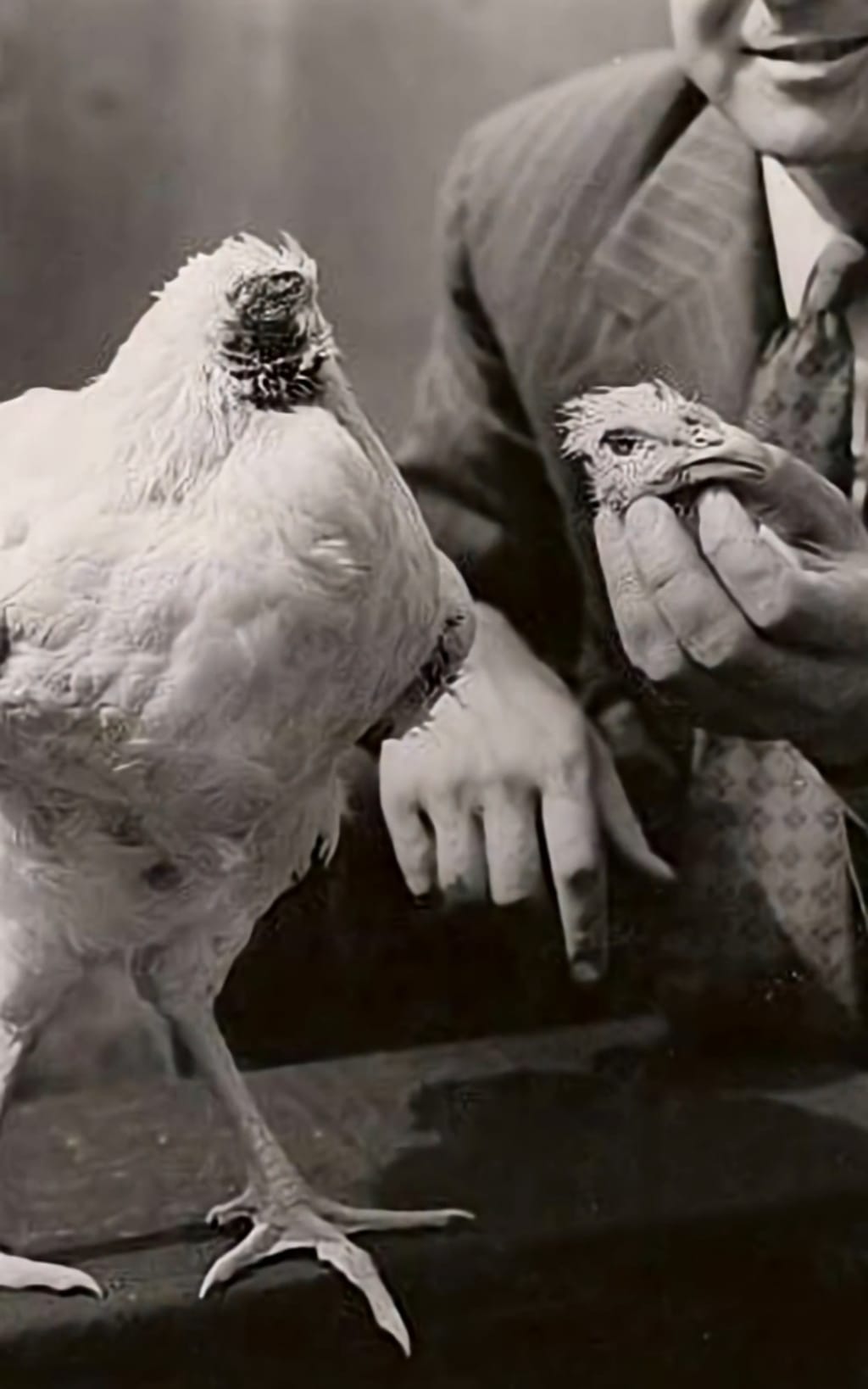
The Strange Survival of Mike the Headless Chicken
When people hear the story of Mike the Headless Chicken, it almost sounds like a hoax. A bird with its head cut off that somehow lived for 18 months?
And yet, it’s true. Mike’s bizarre survival in 1945 baffled farmers, scientists, and the public alike, turning him into a national curiosity. To understand how this headless chicken defied nature, we need to look at both the biology of chickens and the unique circumstances of his decapitation.
The Attempted Slaughter
Mike was a five-and-a-half-month-old Wyandotte rooster living on a farm in Fruita, Colorado. On September 10, 1945, his owner, Lloyd Olsen, decided it was time for dinner.
Olsen swung the axe and aimed for the bird’s neck. But instead of a clean cut, the blade missed its mark by just enough to change history.
Most of Mike’s head was removed, including the beak, face, and eyes. But crucially, a large portion of his brain stem and one ear remained intact. This accident was the key to his survival.
The Role of the Brain Stem
In chickens, much of their basic bodily functions—breathing, heartbeat, digestion, and reflexive movements—are controlled not by higher brain centers but by the brain stem.
The brain stem sits low in the skull, connecting to the spinal cord. It’s responsible for vital automatic processes.
Because Olsen’s axe missed the jugular vein and left much of the brain stem unharmed, Mike retained control over those essential functions.
He could still breathe, maintain balance, and even walk clumsily.
The cut also clotted in such a way that Mike didn’t bleed to death, which would normally be the immediate cause of death for a decapitated animal.
How Mike Was Kept Alive
Of course, a headless chicken cannot feed itself. Olsen quickly realized Mike was not dying and decided to care for him.
Using an eyedropper, he fed Mike a mixture of milk and water, as well as small grains of corn. Food and liquid were placed directly into his open esophagus.
To keep him from choking, mucus and food occasionally had to be cleared with a syringe. As long as his basic needs were met, Mike continued to function surprisingly well.
He could perch, cluck faintly, preen himself, and even attempt to crow—though the sound was a gurgling noise rather than a true rooster’s call.
Public Attention and Fame
News of the “headless wonder chicken” spread quickly. Reporters came to photograph him, and scientists grew curious about how such survival was possible.
Olsen began taking Mike on tours across the United States, showing him at sideshows and fairs. For spectators, it was both shocking and fascinating to see a living chicken without a head.
Mike’s story even appeared in Life and Time magazines. At the height of his fame, Mike was insured for $10,000, and people traveled long distances just to see him. What started as a simple farm accident had turned into one of the most bizarre animal stories in American history.
The Biological Explanation
So, why did Mike survive when most chickens die immediately after decapitation? The answer lies in three factors:
The Axe Missed the Vital Parts – The jugular vein was spared, preventing rapid blood loss.
Brain Stem Survival – The brain stem, which controls reflexes and basic life functions, remained intact.
Dedicated Human Care – Mike would not have lived more than a day without Olsen feeding him manually and clearing his throat.
This unique combination allowed Mike’s body to operate in a strange “half-life” state—headless, but functional.
Mike’s Final Days
For 18 months, Mike lived this way, traveling and eating with help. Sadly, in March 1947, while in a hotel room in Phoenix, Mike began choking during the night.
Olsen had accidentally left the feeding and cleaning syringes behind after a show. Without them, he couldn’t clear the blockage, and Mike suffocated.
The Legacy
Mike the Headless Chicken remains one of the strangest natural oddities recorded. Today, Fruita, Colorado, even celebrates an annual “Mike the Headless Chicken Festival” in his honor.
To many, he symbolizes survival against the odds, an accidental miracle of biology.
His story is a reminder that nature doesn’t always follow the rules we expect. Sometimes, sheer chance and a twist of anatomy can keep life going—even without a head.
About the Creator
Be The Best
I am a professional writer in the last seven months.
Keep reading
More stories from Be The Best and writers in History and other communities.
The Road of Tears: A Mother and Son’s Sad Journey
Love and Loss on the Road of Life The road stretched endlessly before them, a thin ribbon of dust cutting through silent fields. A mother and her son walked side by side, carrying everything they owned in two small bags.
By Be The Best4 months ago in History
Rajendra Chola I and the Conquest of the Ganga: A Monumental Feat in Indian History
Known as the “Gangaikonda Chola” (the Chola who conquered the Ganga), Rajendra transformed a South Indian maritime empire into a pan-Indian power whose influence stretched from the Indian Ocean to the heart of the subcontinent. This campaign was not merely a military raid but a bold statement of imperial ambition, strategic brilliance, and cultural confidence.
By Say the truth 3 days ago in History
THE GRAND EGYPTHION MUSEUM
Let’s be real for a second. When folks hear "museum," they often think of dusty halls, dry information, and that odd quiet where you feel like you're misbehaving just for breathing. But the Grand Egyptian Museum isn't like that. I really don't think that's it. It's not accurate at all. This just seems wrong. This place is really nice. Egypt really shows us that it made history, and it keeps on doing amazing things.
By Beshoy Zayerabout 9 hours ago in History



Comments
There are no comments for this story
Be the first to respond and start the conversation.