
Memories of Quaid: A Family’s Reflections on Pakistan’s Journey
Through a child’s diary, the voices of elders recall the sacrifices of independence, the legacy of Quaid-e-Azam, and the unfinished dream of Pakistan.

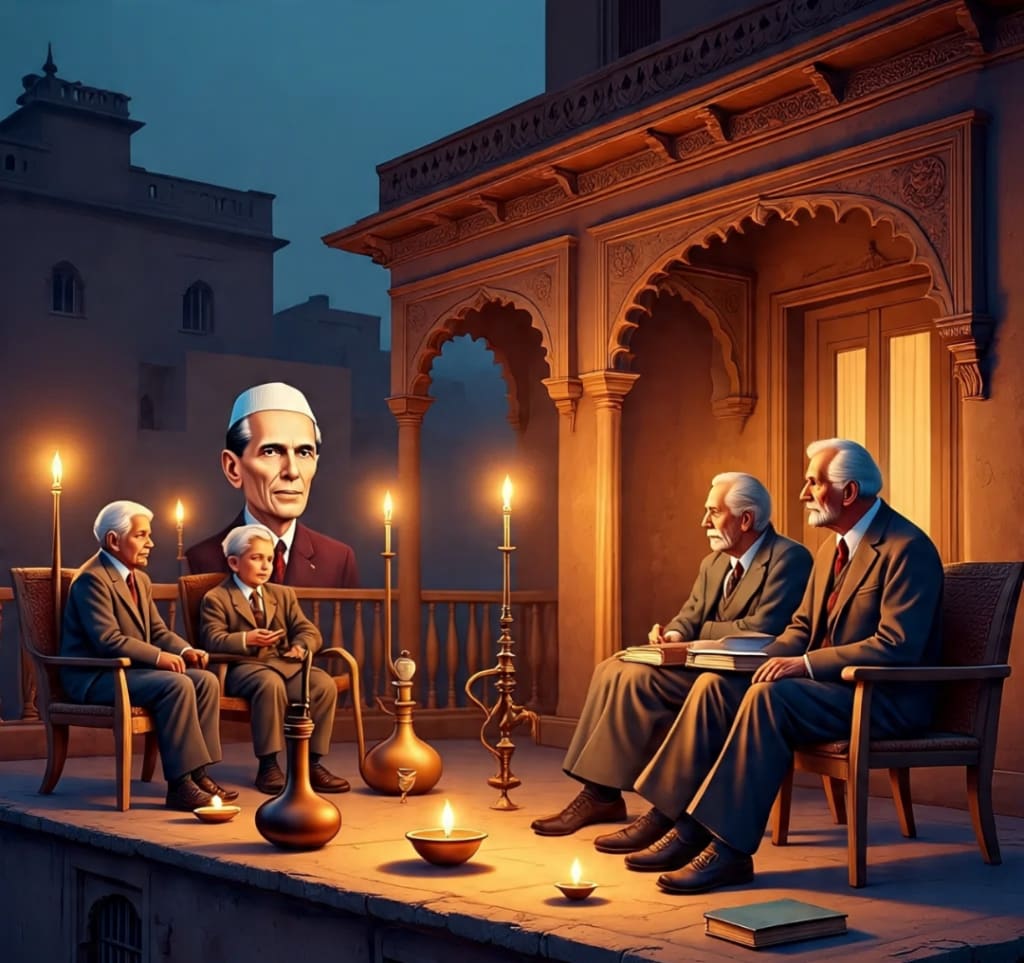
Memories of a Nation: Aslam, His Father, and the Legacy of Quaid-e-Azam
A Story of Reflection, Sacrifice, and the Unfinished Dream of Pakistan
BY:Ubaid
Aslam was never without his diary. Every evening, after the household grew quiet, he would write down his father’s conversations—memories, debates, and reflections that echoed in the family’s sitting room. Page after page, his diary became a living record of voices that refused to fade: his father, Miyān Shaukat, and their close friend, Justice Mirza Sahib.
The two elders had their routine. After the Maghrib prayer, Aslam’s father would go up to the rooftop to await his friend. He would dust the chairs, adjust the books on the table, and prepare the water for Mirza Sahib’s hookah. It was a ritual of respect. Mirza Sahib had a habit of mixing jaggery into the water stored in an earthen pot, which gave the smoke a sweet flavor. For Miyān Shaukat, ensuring this simple comfort was part of the friendship.
To young Aslam, these moments were unforgettable. The evenings carried the rhythm of voices: sometimes stories of poets from the past, other times tales of the struggle for independence. With every word, Aslam felt he was living inside history itself.
---
The Arrival of Mirza Sahib
One evening, his father grew restless. “Aslam,” he called, “is the door open? I don’t want Mirza Sahib to turn away if he finds it locked.”
The boy hurried to the courtyard and returned with a smile. “He is here, Abba! He has books under his arm and his cane in hand.”
Aslam gently held Mirza Sahib’s hand and guided him up the stairs. His father welcomed him with warmth, placing him in a comfortable chair and handing him the hookah pipe. Soon, the soft gurgle of smoke filled the air.
But Mirza Sahib coughed lightly and asked, “Miyan Shaukat, is this water different today?”
Shaukat smiled. “No, it is the same water from our house. But while preparing it, I could not help but remember our elders, those who sacrificed everything for us—who took bullets on their chests so we might breathe in a free land.”
Mirza Sahib’s face grew solemn. “How can we ever forget them? They gave us Pakistan. May Allah keep this nation safe.”
---
A House Illuminated
Sometimes, Aslam’s grandfather joined these sittings, adding stories of the independence movement. His voice carried love, memory, and pride.
One December evening, Aslam walked into the haveli and found it glowing with lamps. “Why the celebration, Dada Jaan?” he asked.
The old man’s eyes sparkled. “Today is December 25th, the birthday of our beloved Quaid-e-Azam, Muhammad Ali Jinnah. These lights honor the day of his birth.”
Aslam’s father and Mirza Sahib were also smiling, joy dancing across their faces. Soon, guests began to arrive. The children recited the national anthem. A cake was cut in honor of the Quaid. The haveli rang with applause, yet behind his smile, Aslam’s grandfather wept softly.
“Why are you crying, Baba?” Shaukat asked.
“We could not have him with us for long,” the old man replied. “His absence still pains my heart.”
When the gathering quieted, he told the children about Jinnah’s life—his parents, his siblings, his studies in Karachi and then in England, and the moment when young Muhammad Ali stood at Lincoln’s Inn, gazing at the frieze of history’s greatest lawgivers. At the very top was the name of the Prophet Muhammad (peace be upon him). Inspired, Jinnah resolved to study there. That decision changed the destiny of millions.
---
The Struggle Remembered
The grandfather reminded them how Jinnah led the All-India Muslim League, how Fatima Jinnah organized women, and how tireless nights of sacrifice brought forth a separate homeland. He repeated Jinnah’s words: “The Quran shall be our Constitution.”
Shaukat added, “How can we forget the man who gave us this gift? This day, his birthday, reminds us of the path he lit for us.”
Mirza Sahib nodded. “I still recall Jinnah’s speech to the students in Lahore. He told them: Do not fear difficulties. Every great nation has risen through struggle. You, too, possess strength and iron will. Educate yourselves. Discipline yourselves. Without it, you will be left behind.”
His words lingered like a torch in the night.
---
A Shattering Announcement
But not every memory was joyous.
One evening, as Mirza Sahib had just begun to recite his poetry, the radio blared a chilling announcement: Pakistan had been divided—its eastern wing torn away.
The room froze. Tears welled in Mirza Sahib’s eyes as he broke into sobs, crying, “Blood-red tears for this nation!” His voice trembled with anguish.
He whispered, “I recall the words of an English professor who once wrote about Jinnah. He said: Some leaders change borders, some awaken nations. Today, I feel we have betrayed his legacy. We could not even hold onto one nation.”
With that, he laid his head on the table, sighed deeply, and fell silent forever.
---
A Vow for the Future
The room descended into grief. Shaukat lamented, “What face shall we show Quaid-e-Azam now? We could not protect the Pakistan he gave us.”
Aslam’s young eyes filled with determination. Looking at the portrait of the Quaid, he spoke with fire:
“We will protect what remains of Pakistan. We will dedicate our lives to this land. Youth of Pakistan, rise! Become Iqbal’s eagles, move forward, and only then will the soul of Quaid find peace. Pakistan Zindabad!”
---
Reflection
Aslam’s diary preserved these moments—joys of independence, sorrows of loss, and the unshakable call to rise again. For him, the story of Pakistan was never just about the past. It was a living promise, passed from one generation to the next: a reminder that freedom is fragile, and only courage, sacrifice, and faith can keep it alive.
About the Creator
Savoy Hotel – Mussoorie: The Colonial Luxury Hotel Where an Unsolved Murder Still Walks the Corridors
The First Night: Beauty Wrapped in Silence Mussoorie looks peaceful from a distance. Pine trees sway gently, clouds roll like slow-moving waves, and the hill air smells of rain and old earth. But as evening falls, the silence becomes heavier—almost watchful.
By Gaurav Gupta4 days ago in History
Is NATO Facing Its Biggest Crisis Yet?
Is NATO Facing Its Biggest Crisis Yet? For more than seventy years, NATO has been one of the strongest military alliances in the world. Formed after World War II, it was designed to protect its members through collective defense. An attack on one was considered an attack on all. For decades, this principle helped maintain stability in Europe and beyond. But today, NATO is facing one of the most challenging moments in its history.
By Wings of Time 8 days ago in History
Center Stage with Paul Stewart
*** I'm keen to republish the interviews I did for my series with Vocal creators. It's been a few years and I thought it might be nice to revisit these wonderful conversations. I'll be releasing them one at a time for a few weeks/months.
By Heather Hubler4 days ago in Interview




Comments
There are no comments for this story
Be the first to respond and start the conversation.