
Medusa From Beauty to Legend
Untold Story Of Medusa
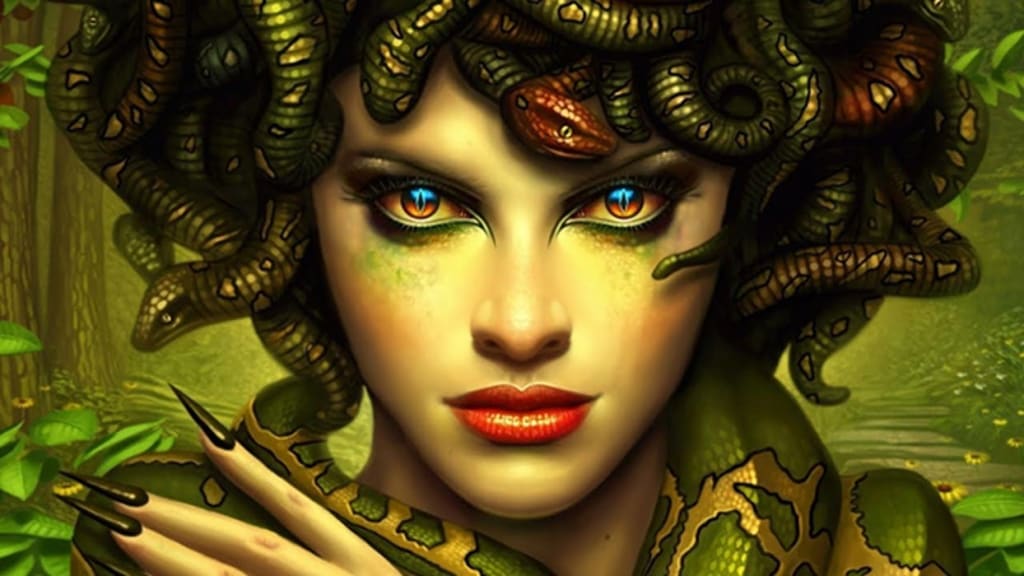
Medusa, perhaps the most renowned of the mythical creatures known as Gorgons, was often depicted as a winged female figure with a head of serpentine hair. Her origins lie in the intricate tapestry of Greek mythology, where she was the daughter of the sea god, Phorcys, and Ceto, and a sister to the infamous Echidna and Lyden. Medusa's name is believed to derive from the ancient Greek word for "guardian," reflecting her true nature as a protector. However, a cruel twist of fate turned her into the most repulsive of her siblings.
In this article, we will explore how Medusa, once innocent, became the villain she is now commonly known as. We'll delve into her life, her interactions with various gods and goddesses, and her ultimate demise. Medusa's image, whether portrayed as a violent monster or a composed feminine figure, is a ubiquitous presence in ancient Greek art, appearing in various media and contexts.
Medusa is often interpreted as an apotropaic symbol, akin to the contemporary "evil eye," intended to ward off malevolent forces. She embodies the concept of using a terrifying menace to deter potential threats, serving as a representation of evil designed to repel evil.
Medusa is most famous for her death, brought about by the hero Perseus, who, with the assistance of the gods Hermes and Athena, beheaded her. The earliest account of Medusa's demise can be found in Hesiod's Theogony, which narrates her decapitation and mentions the birth of her offspring, Pegasus, the winged horse, and Chrysaor, the giant, who sprang from her neck. References to the Gorgon's head in Homer's Iliad and Odyssey further indicate a long history of the Gorgon narrative.
Medusa's complex nature is evident in her appearances across various myths and artistic representations. She is often portrayed frontally, a rare convention in Greek art, emphasizing her captivating but fearsome presence.
But why did her beautiful hair turn into horrifying snakes? Medusa was initially a lovely woman whose beauty caught the attention of both mortals and gods. She served Athena, vowing to remain a virgin, but her beauty did not go unnoticed by Poseidon, the god of the seas. Their affair led to a curse from Athena, turning Medusa into a monster with a head full of serpents and an ability to petrify anyone who met her gaze.
Medusa's transformation into a monster severed her ties with society, forcing her to live as an outcast. Some versions of the story even exile her to a lonely island, where she remained isolated due to her dreadful appearance. Her gaze could turn any who met her into stone, making her a feared and rejected figure.
Despite her monstrous appearance in ancient Greek stories, Medusa has been reinterpreted over time. Classical artists often portrayed her not as a monster but as a beautiful woman with serpentine hair. In modern times, feminist philosophers have regarded Medusa as a symbol of feminine rage and empowerment.
Athena's vengeance against Medusa persisted, and she played a role in Perseus's mission to slay the Gorgon. With the aid of divine tools and guidance, Perseus beheaded Medusa without meeting her gaze. Her severed head was used in various other mythological tales, including the saving of Andromeda from a sea monster.
In the end, Medusa's head was placed at the center of Athena's shield, the Aegis, to strike fear into her adversaries. While Medusa's story may have been one of transformation from beauty to monstrosity, it is a reminder of the complexity and depth of Greek mythology, where characters can be both hero and villain, victim and antagonist.
About the Creator
Keep reading
More stories from Dilani Nadeesha and writers in History and other communities.
The Majestic Rock Fortress of Sri Lanka
Introduction: Sigiriya, located in the heart of Sri Lanka, stands as an iconic testament to ancient ingenuity and artistic prowess. Often referred to as the "Eighth Wonder of the World," this ancient rock fortress has captured the imagination of historians, archaeologists, and tourists alike. With its rich history, stunning architecture, and breathtaking surroundings, Sigiriya is a cultural gem that offers a glimpse into the advanced civilization that once thrived on the island.
By Dilani Nadeesha2 years ago in History
3 True Stories People Refused to Believe Until the Evidence Appeared
Human beings have a remarkable ability to hear something true and immediately file it under “absolutely not.” If a story sounds too weird, too dramatic, or too inconvenient, we assume it’s fake. We say it’s a conspiracy theory, urban legend, or drunk uncle material. Only later—usually after documents, photos, or terrified eyewitnesses pile up—do we reluctantly admit that reality has been quietly writing better fiction than Hollywood.
By Enoch Sagini4 days ago in History




Comments
There are no comments for this story
Be the first to respond and start the conversation.