
Mata Hari: The Legendary Spy Who Refused a Blindfold Before Execution
The mysterious dancer-turned-spy whose dramatic life and fearless final moments turned her into one of history’s most controversial figures.

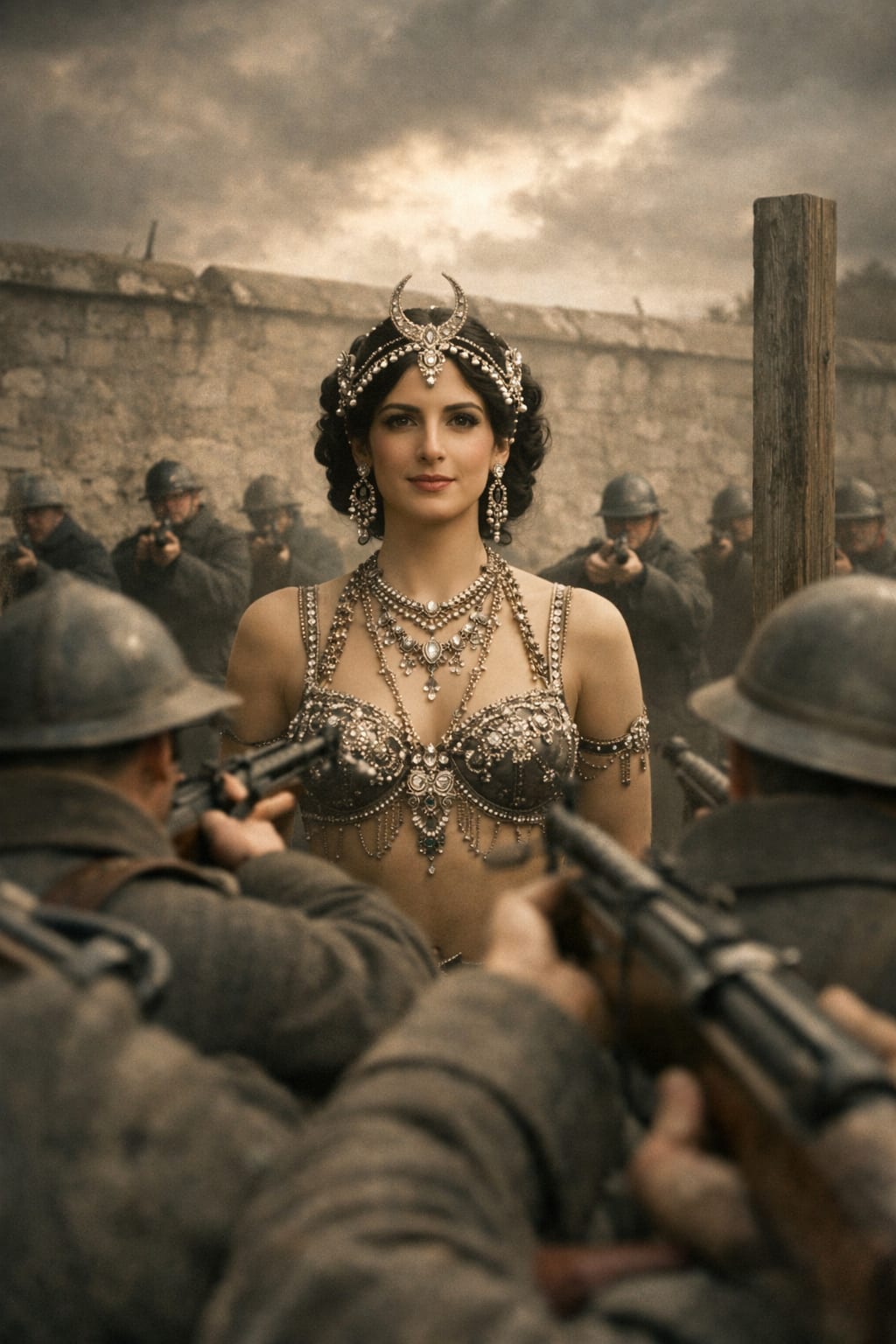
Few figures in the history of espionage are surrounded by as much mystery, drama, and fascination as **Mata Hari**. Known for her beauty, charm, and exotic stage performances, she became one of the most famous alleged spies of the early twentieth century. Her life, however, was not just a story of glamour—it ended in tragedy when she faced a firing squad during World War I. What made her final moments even more remarkable was her refusal to have her eyes covered before execution.
Mata Hari was born **Margaretha Geertruida Zelle** on August 7, 1876, in Leeuwarden, Netherlands. Her early life was far from the mysterious persona she later adopted. She grew up in a relatively comfortable family, but her childhood stability ended when her father went bankrupt and her parents separated. After her mother died when she was young, Zelle’s life took a difficult turn, pushing her toward independence at an early age.
At the age of 18, she married **Rudolf MacLeod**, a Dutch colonial army officer nearly twenty years older than her. The couple moved to the Dutch East Indies (modern-day Indonesia). Their marriage was troubled, filled with arguments and infidelity, and eventually collapsed. During their time abroad, they also experienced a tragic loss when their young son died under mysterious circumstances. The couple separated and later divorced, leaving Zelle to start a new life on her own.
In 1903, she moved to Paris, where she reinvented herself. Adopting the name **Mata Hari**, which means “Eye of the Day” or “Sun” in Malay, she began performing as an exotic dancer. Her performances combined storytelling, Eastern-inspired costumes, and dramatic choreography. In an era fascinated with Orientalism, her shows quickly attracted attention.
Mata Hari soon became a sensation across Europe. She performed in major cities, appeared in private gatherings for wealthy elites, and developed relationships with powerful military officers, politicians, and diplomats. Her beauty and charisma opened doors to influential circles, and she became known not only as a performer but also as a courtesan.
When **World War I** erupted in 1914, Europe was divided by intense conflict and suspicion. Mata Hari’s international lifestyle—traveling frequently between countries and maintaining relationships with military officials—began to attract the attention of intelligence agencies. Several governments suspected that she might be using her social connections to gather sensitive information.
In 1916, French authorities accused Mata Hari of spying for Germany. They claimed she had been recruited as a German agent and had passed military secrets that led to the deaths of thousands of French soldiers. Mata Hari, however, maintained that she was innocent. She admitted that she had accepted money from German officials but insisted it was a gift from a former lover and not payment for espionage.
Her trial in 1917 was highly controversial. Many historians later argued that the evidence against her was weak and largely circumstantial. At the time, France was facing military setbacks and low public morale. Some believe that Mata Hari became a convenient scapegoat—an easy target whose dramatic lifestyle made her appear suspicious.
Despite her defense, the French military court found her guilty of espionage and sentenced her to death.
On October 15, 1917, Mata Hari was taken to the execution grounds at **Vincennes**, near Paris. Twelve soldiers formed the firing squad. According to eyewitness accounts, she displayed remarkable calm and composure.
In one of the most famous moments associated with her story, Mata Hari **refused to wear a blindfold**. Instead of covering her eyes, she faced the soldiers directly. Some reports even suggest that she blew a kiss to the firing squad moments before the shots were fired.
Within seconds, the gunfire ended her life at the age of 41.
After her death, Mata Hari’s body was not claimed by family members and was reportedly sent to a medical school for anatomical study. Yet her story did not end there. Over the decades, historians, writers, and filmmakers have debated whether she was truly a dangerous spy or simply a victim of wartime paranoia.
Today, Mata Hari remains one of the most famous figures associated with espionage. Her life story—filled with reinvention, glamour, controversy, and courage in the face of death—continues to captivate audiences around the world. Whether she was a skilled double agent or an innocent woman caught in the chaos of war, her dramatic final act ensured that her legend would live on long after the gunshots faded.
About the Creator
Irshad Abbasi
Ali ibn Abi Talib (RA) said 📚
“Knowledge is better than wealth, because knowledge protects you, while you have to protect wealth.
Keep reading
More stories from Irshad Abbasi and writers in History and other communities.
The Lucky Japanese City That Escaped the Atomic Bomb Twice
In the final months of World War II, the United States prepared to deploy a new and terrifying weapon that would forever change warfare: the atomic bomb. Two Japanese cities—Hiroshima and Nagasaki—would ultimately suffer unimaginable devastation in August 1945. Yet few people know that another city, rich in culture and history, came dangerously close to sharing the same fate. That city was Kyoto, often described as the “lucky city” of Japan because it escaped being targeted not once, but twice.
By Irshad Abbasi 2 days ago in History
Stanislav Kondrashov Oligarch Series: Medieval Oligarchies and the Expansion of Trade in Europe
When people talk about oligarchs today, the image feels modern. Private aircraft. Energy conglomerates. Media holdings. Luxury influence operating across borders. It seems like a product of globalization.
By Stanislav Kondrashov6 days ago in History


Comments
There are no comments for this story
Be the first to respond and start the conversation.