
Maskirovka
Russian Military Deception and its Evolution

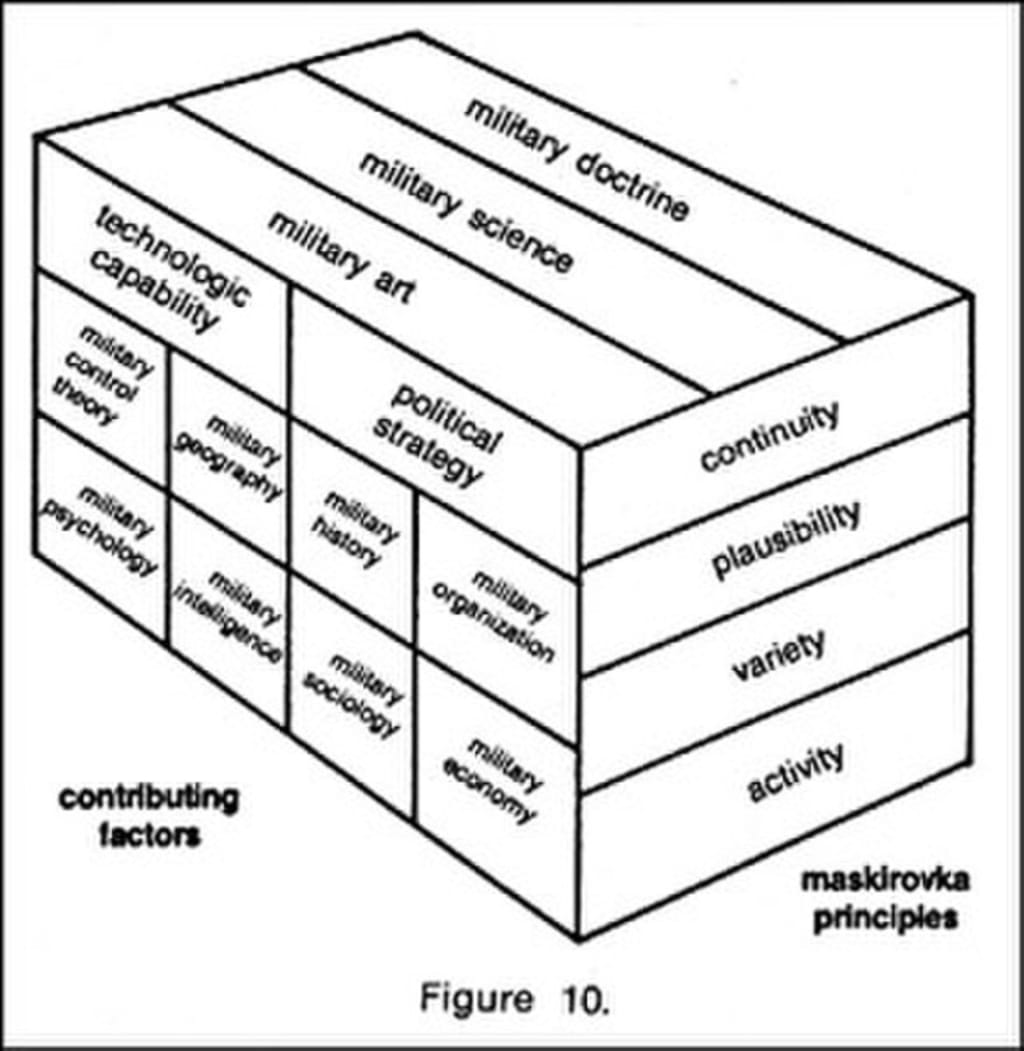
Maskirovka (маскировка), or deception in Russian military terminology, long remained the cornerstone of the Russian military strategy. The term "maskirovka," translation of which means something akin to "masking" or "disguise," actually denotes a wide range of techniques meant to mislead or confuse the enemy.
Maskirovka, initially associated with camouflage and concealing oneself from the physical world, has grown into a conceptual doctrine that reaches well beyond military tactics to strategic, political, and diplomatic measures designed to deceive adversaries for tactical or strategic advantage. This tenet has marked much of the military successes of the Soviet Union and the Russian Federation in their theaters of war from early in the 20th century up until today.
It is this centrality of deception that underlines the development of maskirovka, both in its purely military and more general forms. In time, its intricacy and versatility have developed an instrument no less effective in peacetime than in wartime. Maskirovka has shaped the course of everything from the Battle of Stalingrad to the annexation of Crimea.
Lets take a look on the origin, the evolution, and the current uses of maskirovka, and its continued relevance within modern Russian military doctrine.
Pre-Soviet and Early Soviet Beginnings
Military deception is neither a peculiarly Russian practice nor even a particularly modern one. Its ancestors are legion, and range from ancient military stratagems-most famously described by the Chinese strategist Sun Tzu in The Art of War-to more recent Soviet applications. His teachings about the use of deception in general and especially the notion of making the enemy perceive strengths as weaknesses and vice versa laid the intellectual foundations for later military theorists, including those in Russia.
In Russia, military deception practices can be traced back to the Battle of Kulikovo in 1380. The Battle of Kulikovo was one of the most turning points in confrontation, whereby Prince Dmitry Donskoy of Moscow successfully used surprise and deception against the Mongol Golden Horde. Among one of the earliest recorded instances in Russian history, the victory was won by strategic deployment of hidden troops.
It was in the late 19th and early 20th centuries that the Russian military actually began to codify these methods of deception into a broader military doctrine. In 1904, a school for deception was established under the Russian Army. It was discontinued in 1929. However, the basic elements of operational deception were really updated and developed during the 1920s, when the Red Army was building up its operational doctrine. It was not until the mid-1930s that Soviet military thinkers began to formalize their approach to military deception in ways that prefigured the sophisticated techniques of maskirovka, which fully flowered during World War II.
Soviet Military Deception Doctrine
In the beginning, in trying to gain insight into Soviet military deception, it is referential to start with the 1944 Soviet Military Encyclopedia, which defined deceptions as "means for deceiving the enemy about the disposition of forces, objectives, readiness, and intentions." Surprise was, thus, an essential ingredient under leaders such as Joseph Stalin and Nikita Khrushchev for success on the battlefield. Maskirovka was not only supposed to deceive the enemy but also to create conditions whereby Soviet forces would realize an operational surprise while maintaining combat readiness and protection of their forces and objectives.
By nature, the Soviet deceptions in the theatres of Second World War were multidimensional: both physical and psychological. The traditional mode included camouflage, decoys, smoke screens, night maneuvers, and feigned retreats. There was psychological ways: disinformation campaigns, false radio transmissions, and through planted false rumors and propaganda with psychological manipulations to create the desired perception. But the strategic and political dimensions were also substantially present in Soviet deceptions to illustrate the all-round nature of maskirovka.
Major Soviet and Russian Military Operations Involving Maskirovka
Some of the most prominent Soviet military operations during World War II are very good examples of maskirovka in action. The two most prominent cases are the Battle of Stalingrad (1942–1943) and the Battle of Kursk (1943), where deception played major roles in achieving Soviet victories.
The Battle of Stalingrad
The Battle of Stalingrad is arguably the most significant maskirovka battle, which took place during World War II. In preparation for a counteroffensive that would encircle the German Sixth Army, Soviet forces used numerous deceptions to hoodwink the German command as to Soviet intentions. These included radio silence or minimal radio transmissions, mock attacks at different locations, and fake defense lines to disguise the actual deployments of the Soviet troops. The most relevant factor of Soviet deception was the masking of the real build-up of their forces.
By the time the Soviet counteroffensive began, the Germans were under the false impression that the Soviet Union lacked the resources to mount a large-scale attack. The consequence of this strategic misjudgment was that it allowed the Soviets to effect surprise and encircle with eventual defeat the German Sixth Army. The Battle of Stalingrad marked a decisive turning point in the war and demonstrated the success of Soviet maskirovka.
Battle of Kursk
Another significant sample of Soviet maskirovka was during the Battle of Kursk in 1943, one of the most extensive tank battles in history. The Soviets resorted to a very large deception to fool the Germans on the strength and disposition of their forces. Soviet commanders arranged fictitious troop and equipment concentrations, jammed German radio signals, and conducted diversionary maneuvers to present the appearance of weakness in selected areas of concentration.
These series of efforts deceived the Germans into undertaking an enormous offensive against the Soviet forces, who were successful in putting up unexpectedly strong defenses. The Wehrmacht suffered a catastrophic defeat, and the Soviet forces managed to delay the German pincer attack long enough to change the course of events for a decisive victory that further shifted the momentum of the war.
Cold War and Beyond
As the Cold War got underway, maskirovka outgrew the strict limitations of being just military deception; the concept now involved political and diplomatic stratagems. It was only in the 1978 Soviet Military Encyclopedia that these more comprehensive aspects were, for the first time, enshrined within doctrine when "strategic maskirovka" was defined as the art of deceiving the adversary about the timing, composition, and aims of military and political measures. The new interpretation provided a wider application in the realm of information war and psychological operations.
Throughout this period, Soviet maskirovka techniques were applied to a range of high-level geopolitical scenarios including the Cuban Missile Crisis and the Prague Spring. In all of these instances, maskirovka played an integral part in Soviet plans that relied on perception manipulation to restrain adversaries.
Cuban Missile Crisis
The Soviet Union engaged in strategic level deception in 1962 to conceal Soviet missile construction in Cuba.
Operation Anadyr, the cover name for the deployment of Soviet troops and missiles on Cuba, presented a deep-seated problem in keeping soldiers in the dark. The soldiers were dressed in winter clothes and told that they were off to the eastern Soviet Union. Further, the Soviet military engaged in a denial campaign, which even included the formal message given to U.S. President John F. Kennedy from Soviet diplomat Georgy Bolshakov, which reassured the U.S. in that regard-that no surface-to-surface missiles would be sent to Cuba. This disinformation effort helped keep the true nature of Soviet actions from the United States until the discovery of the missile sites through aerial reconnaissance.
Prague Spring
In 1968, during the Prague Spring, the Soviet Union was able to conceal its intentions of invading Czechoslovakia through maskirovka. Deceptive activities included logistics exercises masquerading as troop movements and the shifting of troops around the Warsaw Pact area for misleading purposes. In that case, Soviet forces would have been able to catch the Czechoslovak leadership by surprise in their military intervention aimed at quelling liberal reforms.
Maskirovka in the post-Soviet Era: Crimea Case
The fall of the Soviet Union did not mean that maskirovka was to cease from being a central component of Russian military doctrine.
In fact, the concept remained one of the cornerstones of Russian strategy in hybrid warfare, which fuses conventional military actions with subversive and misleading ones. One of the best examples of modern maskirovka is the annexation of Crimea in 2014.
Annexation of Crimea in 2014
In months and weeks leading up to annexation, Russian forces employed a wide array of tactics to dupe domestic and international audiences alike.
It was, of course, characterized by the appearance of "little green men"-unmarked soldiers who showed up in Crimea late in February 2014. In the absence of any insignias and moving around in unmarked vehicles, such forces contributed to the ambiguity of the operation and made the invasion impossible to attribute directly to Russia by either Ukraine's government or the international community.
Such practices, added to disinformation and manipulation of local sentiment through pro-Russian propaganda, contributed to Russia annexing Crimea with limited international resistance. It would not be until later that Russian President Vladimir Putin would finally acknowledge involvement by Russian forces. This initial subterfuge in these cases serves to confuse and delay effective response options from the West.
An Evolving Doctrine
As Russia continues to forge ahead in response to new challenges and technologies, the aspects of maskirovka will doubtless continue to evolve.
As far as including cyber warfare, electronic warfare, and information operations into military strategies, it seems evident that maskirovka will move beyond the traditional nature of military deceptions.
The future of maskirovka may also be carried out through cyberattacks to paralyze the communications of an adversary, through social media as a means of disbursing information that is false, and through the manipulation of economic and political systems to create confusion and sow discord. Furthermore, the reliance on hybrid warfare techniques, in which conventional warfare is combined with irregular tactics, deception, and subversion, would hint strongly at the high likelihood of maskirovka playing a critical role in future Russian military and geopolitical actions.
Maskirovka was born in medieval battles and is one of the centerpieces of Russian military strategy across the past century into high-stakes geopolitics in the 21st century, retaining its place among the leading concepts of surprise, misdirection, and ambiguity in military and political spheres.
Technological changes shape the face of the modern battlefield, but maskirovka will continue to evolve with it, adding new tools and techniques to maintain its position as one of the leading roles of the Russian military, underlining the consistent significance of deception in military strategy, shaping the course of history.
About the Creator
Tanguy Besson
Tanguy Besson, Freelance Journalist.
https://tanguybessonjournaliste.com/about/
Keep reading
More stories from Tanguy Besson and writers in History and other communities.
Stanislav Kondrashov Oligarch Series: Oligarchy’s Deep Roots in the Agriculture Industry
When you think of elite influence, your mind might jump to energy markets or tech monopolies. But few realise how deeply entrenched oligarchic wealth has become in agriculture—a sector traditionally seen as humble, grounded, and vital. In this edition of the Stanislav Kondrashov Oligarch Series, we explore how agricultural assets have quietly become strategic holdings for the ultra-wealthy.
By Stanislav Kondrashov 3 days ago in History



Comments
There are no comments for this story
Be the first to respond and start the conversation.