
Marie Curie: Pioneer of Radioactivity and Scientific Courage
How Marie Curie’s Groundbreaking Discoveries in Chemistry and Physics Shaped Modern Science
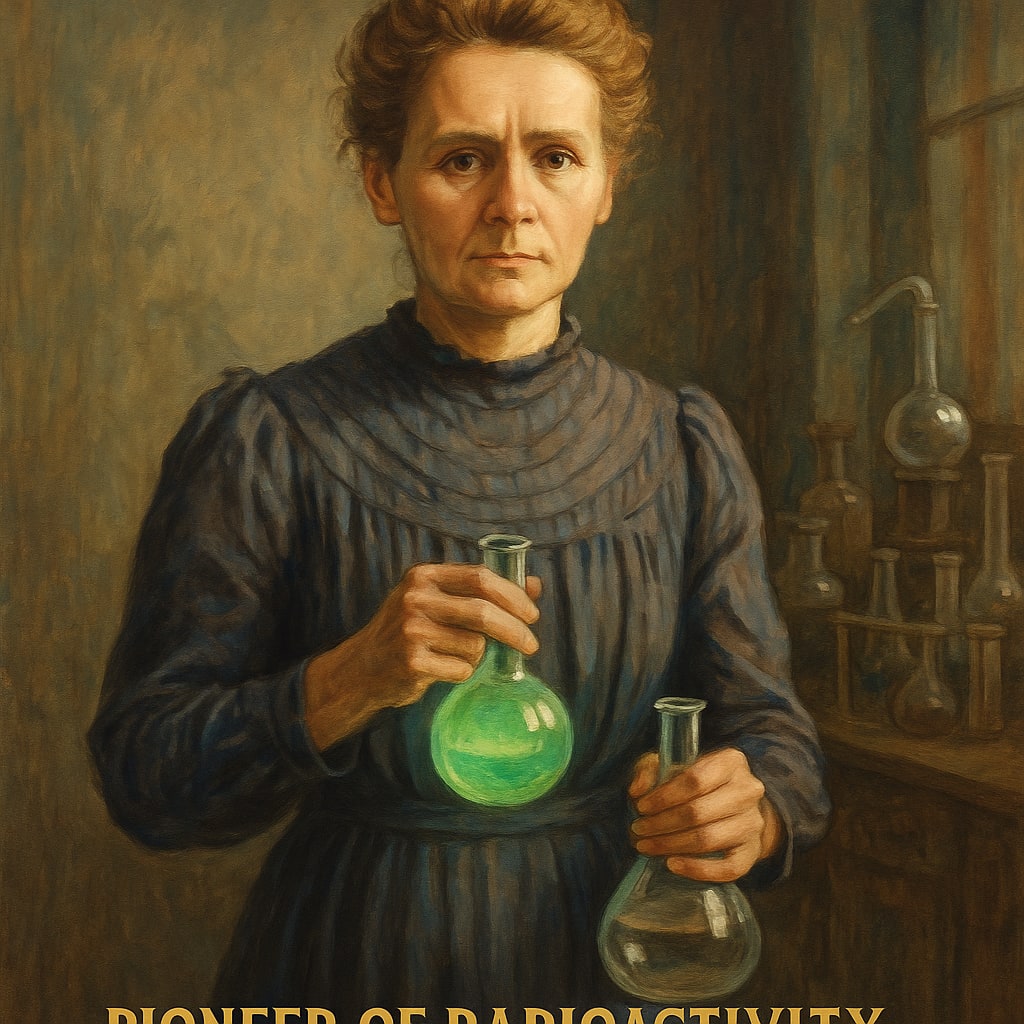
Marie Curie, born Maria Skłodowska in Warsaw, Poland, in 1867, was a scientist of extraordinary determination and intellect. She is best known for her pioneering work on radioactivity — a term she coined — and for being the first woman to win a Nobel Prize. Even more remarkably, she remains the only person in history to win Nobel Prizes in two different scientific fields: Physics and Chemistry. Curie’s contributions to science were revolutionary, and her life continues to inspire generations of scientists, especially women in STEM fields.
Early Life and Education
Marie Curie was born into a family of educators in a politically oppressed Poland, then under Russian rule. Her early life was marked by struggle. Although she was an exceptional student, higher education was not available to women in Poland at the time. Refusing to accept these limitations, Marie joined the “Flying University,” an underground institution that offered education to women.
Determined to pursue science, she moved to Paris in 1891 and enrolled at the Sorbonne (University of Paris), where she earned degrees in physics and mathematics. Life in Paris was not easy; she often lived in poverty, studying by candlelight in cold, cramped rooms. Yet her passion for science never wavered.
Discovery of Radioactivity
Marie Curie met French physicist Pierre Curie in Paris, and the two married in 1895, forming one of the most famous scientific partnerships in history. Inspired by the work of Henri Becquerel, who discovered that uranium emitted mysterious rays, the Curies began investigating radioactive elements.
In 1898, the couple discovered two new elements — polonium (named after Marie’s homeland, Poland) and radium. These elements emitted far more radiation than uranium, leading the Curies to conclude that the radiation was coming from the atom itself — a groundbreaking idea at the time.
This work laid the foundation for the field of nuclear physics and fundamentally changed the scientific understanding of matter and energy.
Nobel Prizes and Recognition
In 1903, Marie and Pierre Curie, along with Becquerel, were awarded the Nobel Prize in Physics for their work on radioactivity. Marie Curie became the first woman to win a Nobel Prize.
Tragedy struck in 1906 when Pierre died in a traffic accident. Despite this devastating loss, Marie continued their research. In 1911, she received her second Nobel Prize, this time in Chemistry, for isolating pure radium and studying its properties. She became the first person ever to receive two Nobel Prizes and remains one of only a handful to have achieved this distinction.
Scientific and Humanitarian Contributions
Beyond her Nobel-winning work, Marie Curie contributed immensely to science and society. She established the Radium Institute (now the Curie Institute) in Paris, which became a leading center for research in radioactivity and medicine.
During World War I, she recognized the potential of X-ray imaging for treating wounded soldiers. Curie developed mobile radiography units known as “Little Curies” and trained medical staff, personally assisting on the front lines. Her efforts saved countless lives and showed her deep commitment to humanitarian causes.
Challenges and Legacy
Marie Curie faced significant challenges throughout her life — from financial hardship and gender discrimination to health risks associated with her work. She conducted her research without proper protection from radiation, which ultimately affected her health. She died in 1934 from aplastic anemia, believed to be caused by long-term exposure to radioactive materials.
Despite these challenges, her scientific achievements were groundbreaking. Curie’s work led to major developments in cancer treatment through radiation therapy and opened the door to nuclear energy. She was also the first female professor at the University of Paris, breaking barriers for women in science and academia.
Her legacy lives on not only in scientific institutions and awards named in her honor, but also in the example she set: a life dedicated to knowledge, perseverance, and service to humanity.
Conclusion
Marie Curie was more than a brilliant scientist — she was a trailblazer who defied social norms and overcame immense personal and professional obstacles. Her discoveries changed the world of science forever and laid the groundwork for numerous medical and technological advances. Through her pioneering work in radioactivity and her unwavering commitment to science, Curie broke barriers and proved that intelligence and determination know no gender. More than a century later, her legacy continues to shine, as bright and enduring as the elements she discovered.
About the Creator
Keep reading
More stories from Anwar Jamil and writers in History and other communities.
The Fall of Tibet to a Communist State: History, Causes, and Consequences
The incorporation of Tibet into the People’s Republic of China (PRC) after 1950 was not a single event but a complex process involving military force, political negotiation, ideological conflict, and long-lasting resistance. Understanding this fall requires examining Tibet’s historical status, China’s communist revolution, and the profound consequences that followed.
By Say the truth about 10 hours ago in History
Power's Sake
When it comes to gaining power, bad people use it to gain more They never gain power to do something with it, they gain power to have it, relish in it, double it down on itself so it grows exponentially and never goes anywhere. Even if you see the people in power commit an atrocity, that is never the true goal. It is a deplorable action for sure but the action itself usually doesn't matter it's the outcome.
By Donny Foley5 days ago in History


Comments
There are no comments for this story
Be the first to respond and start the conversation.