
Marie Curie: A Legacy of Science and Sacrifice
How One Woman Changed the World Through Science

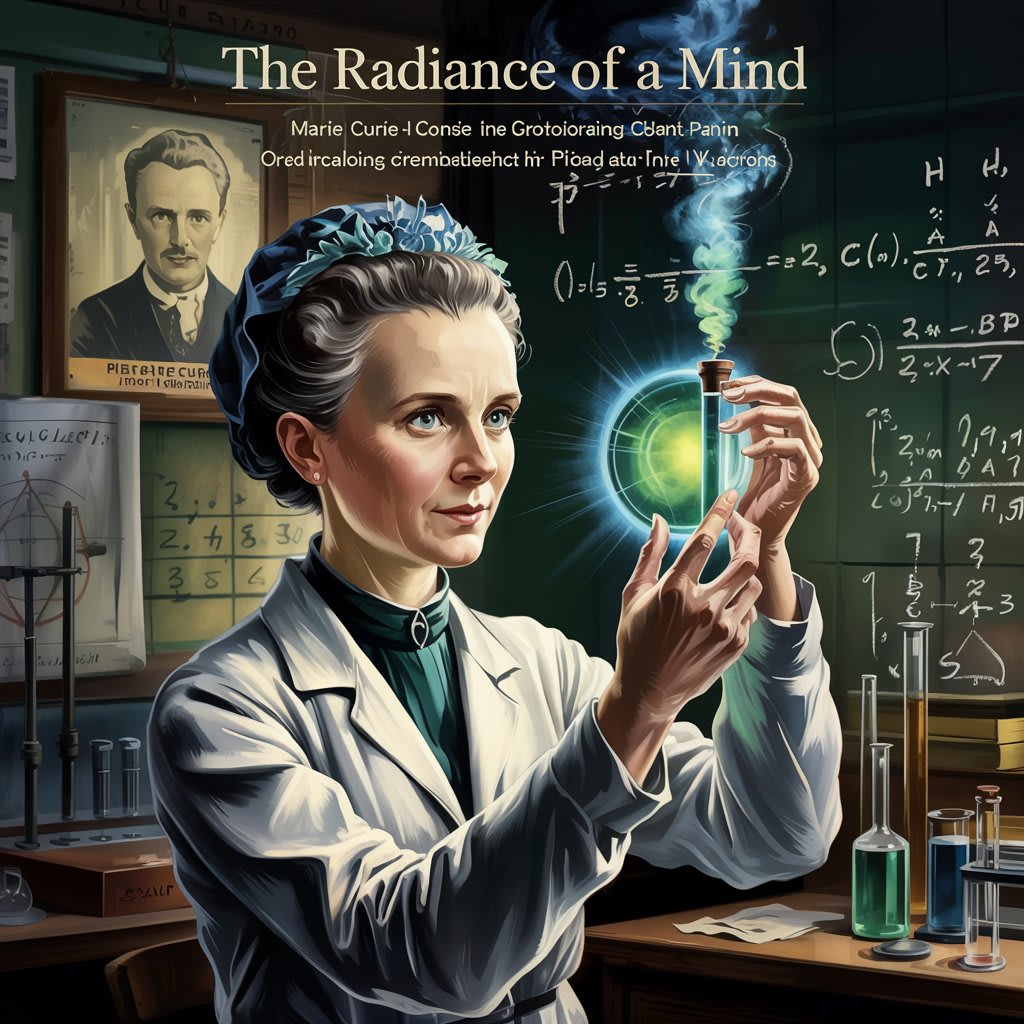
In the quiet corners of 19th-century Poland, a young girl named Maria Sklodowska was growing up with fire in her eyes and books in her hands. Born in Warsaw in 1867, she was surrounded by a world that offered little to girls like her—especially when it came to education. But Maria was different. She devoured knowledge like air, hungry to understand the invisible forces that moved the world.
Her early life was shaped by loss. Her mother died of tuberculosis when Maria was just ten. Her sister Zofia died a few years later. And yet, these tragedies didn’t crush her spirit—they tempered it. Maria grew into a quiet, determined young woman, resolved to pursue science no matter the obstacles. But in Russian-occupied Poland, women weren’t allowed to attend university. So she joined the "Flying University"—an underground network of educators who defied authority and taught in secret.
By the time she was 24, she had saved just enough to move to Paris. There, at the Sorbonne, she transformed into Marie Curie, the name the world would remember. The lectures were in French, the winters were cold, and her funds were scarce. She often lived on bread and tea, wrapping herself in every blanket she had to study through the night. But none of that mattered—she had finally found her place in the world of science.
It was in Paris that she met Pierre Curie, a brilliant but humble physicist. They were drawn to each other not by passion at first, but by shared purpose. Together, they embarked on a journey into the unknown. They studied radioactive materials, a word Marie herself coined—“radioactivity.” In 1898, they discovered two new elements: polonium, named after her beloved Poland, and radium, the glowing substance that would change the course of science forever.
The world was stunned. For the first time, scientists began to see that atoms—once thought to be indivisible—were in fact made of even smaller particles. The Curies had cracked open the very building blocks of the universe.
In 1903, Marie and Pierre were awarded the Nobel Prize in Physics, making her the first woman to ever win one. But behind the glory was quiet suffering. The couple worked tirelessly in a makeshift lab, handling radioactive substances with bare hands, unaware of the damage it was doing to their bodies.
Then tragedy struck. In 1906, Pierre was run over by a horse-drawn carriage and killed instantly. Marie was devastated. The man who had been her partner in both science and life was gone. Many expected her to retreat from public life. Instead, she returned to the lab.
In the years that followed, Marie Curie became the first woman to teach at the Sorbonne. She continued her research, and in 1911, she received a second Nobel Prize—this time in Chemistry—for her work on radium and polonium. She remains the only person in history to win Nobel Prizes in two different scientific fields.
But awards never mattered much to her. During World War I, she put her fame aside and developed mobile X-ray units—known as "Little Curies"—which saved countless soldiers on the battlefield. She personally trained nurses and doctors to use them. She believed science was not for glory, but for humanity.
Yet, the very elements that made her famous were slowly killing her. Years of exposure to radiation had weakened her body. She died in 1934, from aplastic anemia, a disease linked to her decades of unprotected work with radioactive substances.
Marie Curie never patented the radium-isolation process. She never sought fortune. She believed knowledge should be free, shared for the good of mankind.
Her legacy is not just in laboratories and textbooks. It lives in every woman who dared to dream of a future in science. It lives in every researcher chasing the mysteries of cancer, radiation, and atomic energy. It lives in the quiet courage to face the unknown, not for fame—but for truth.
Marie Curie once said, “Nothing in life is to be feared, it is only to be understood.” She faced a world of fear—fear of women in science, fear of the unknown, fear of death—and turned it into a world of understanding.
The girl from Warsaw who studied in the cold, the widow who kept going when her heart broke, the scientist who glowed with the light of discovery—Marie Curie was more than a mind. She was a force. A radiant mind whose light still shines.
About the Creator
Farhan
Storyteller blending history and motivation. Sharing powerful tales of the past that inspire the present. Join me on Vocal Media for stories that spark change.
Trump and Netanyahu Are Breaking the Bond Between American Jews and Israel
Israeli Elections & The public's demand: Even though Israel gained as many seats as its biggest significant adversary, the results of the April 9 election have been seen as a win for the status quo. Meanwhile, Prime Minister Benjamin Netanyahu is best positioned to form a new administration alongside the Likud party that he leads. Most certainly, Netanyahu will be able to maintain his position of authority. The public's demand for familiarity and regularity is the reason behind this.
By Laura Hoover4 days ago in History


Comments
There are no comments for this story
Be the first to respond and start the conversation.