
Mansa Musa: The Emperor Who Gave Away a Mountain of Gold
He Walked Across Continents With a River of Gold — And Changed the World’s Economy Forever.

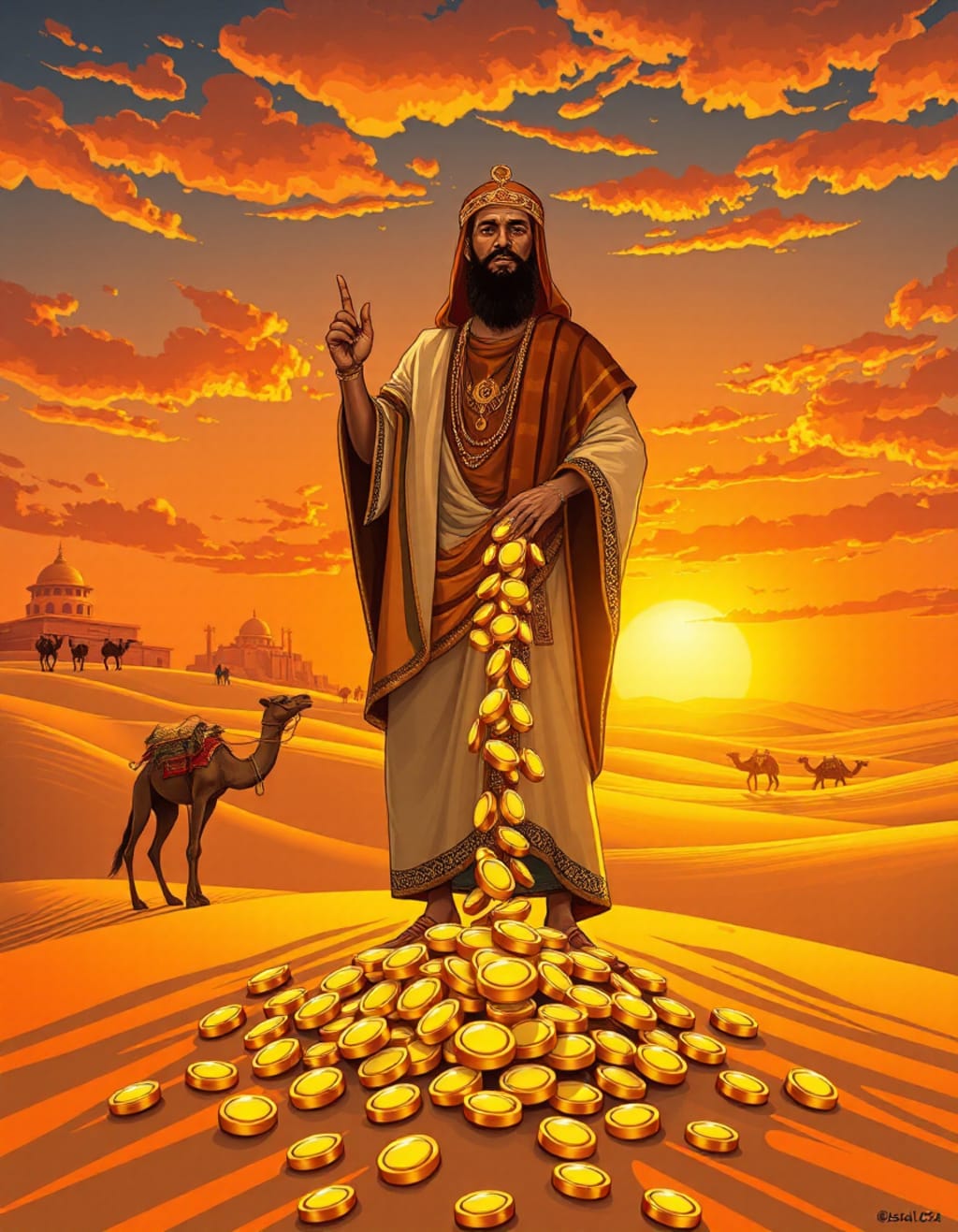
In the early 14th century, as most of Europe stumbled through a bleak and fragmented existence, across the sands of West Africa, an empire glittered like gold in the sun — literally. Its name was Mali, and its ruler was a man who would redefine wealth, power, and the essence of generosity: Mansa Musa.
He wasn’t just a king.
He was a legend in the making — and the world still hasn’t forgotten him.
Chapter 1: The Man Behind the Mountain
Born around 1280, Musa Keita came from the royal Keita dynasty in Mali, a land carved by desert winds, ancient rivers, and the pulse of trade routes connecting empires. His destiny was not always set in gold.
He was appointed deputy ruler when his predecessor, Mansa Abu Bakr II, decided to set sail into the Atlantic Ocean to find the edge of the world. Abu Bakr never returned. In his absence, Musa rose — not through ambition, but through appointment.
He didn’t inherit the empire. He took its weight on his shoulders.
And from that moment, history had no choice but to remember him.
Chapter 2: Gold in His Veins, Faith in His Heart
Mansa Musa was devoutly Muslim. But unlike rulers who kept religion for the palace, he lived it. He read. He prayed. He fasted. He built mosques.
He wanted to make Hajj — the sacred pilgrimage to Mecca. Not just for faith, but to show the Islamic world what Mali was made of.
And so, in the year 1324, Mansa Musa began the most legendary pilgrimage in history.
It wasn’t a journey.
It was a spectacle.
Chapter 3: The Caravan That Shook Cairo
Across the sands of the Sahara came a moving city.
60,000 men, including 12,000 personal slaves dressed in fine silks.
Hundreds of camels, each carrying 300 pounds of gold dust.
Entire herds of animals, soldiers in armor, and court musicians.
They didn’t beg for food.
They bought entire cities out of it.
When Mansa Musa entered Cairo, Egypt, the city stopped. He flooded the markets with so much gold, the economy crashed. Gold lost its value. Prices inflated. It took 12 years to recover.
He didn’t conquer Cairo with an army — he did it with generosity.
Chapter 4: The Emperor of Humility
Despite his opulence, Mansa Musa was humble before God. When he met the Egyptian Sultan, he refused to bow, saying, “I bow only before Allah.”
Yet he gifted the Sultan thousands of dinars. He built mosques along the way, fed the poor, and hosted the scholars.
He wasn’t just showing off Mali’s wealth.
He was building Mali’s reputation as a spiritual, intellectual, and commercial powerhouse.
He made Islam not just a religion in Mali, but a beacon of identity.
Chapter 5: Timbuktu — The City That Learned to Dream
When he returned, he brought back not just memories — he brought the Islamic world’s finest minds.
Architects from Cairo and Andalusia.
Scholars fluent in Arabic, astronomy, medicine, and law.
Artists who could make sand sing.
He transformed Timbuktu into one of the greatest centers of learning in the medieval world. The Sankoré University held over one million manuscripts, rivaling the libraries of Baghdad and Cordoba.
Students came from across Africa to learn. Timbuktu became Africa’s Oxford, and Mansa Musa its founding chancellor.
Chapter 6: A Kingdom Carved in Gold
Mansa Musa expanded his empire until it was the second-largest empire in the world at the time, after the Mongols. It stretched from the Atlantic coast to modern-day Niger, encompassing over 400 cities and 50 million people.
He didn’t just collect taxes — he cultivated trade.
Mali was the nexus of gold, salt, ivory, and wisdom.
Under Musa, Mali became the wealthiest empire in the world. His personal fortune, adjusted for inflation, is estimated to be over $400 billion — more than Jeff Bezos and Elon Musk combined.
But he didn’t hoard it.
He gave it away, brick by brick, prayer by prayer.
Chapter 7: Death of a Giant
Around 1337, the sands of time claimed Mansa Musa.
His death did not trigger a war. It triggered a mourning. Not only had Mali lost a ruler, the world had lost a man who had proven that wealth doesn’t buy power — character does.
His sons could not match his vision. Slowly, the empire shrank, but the legend of Mansa Musa only grew.
Chapter 8: His Legacy Still Echoes
Today, Timbuktu is no longer the city of scholars. The gold mines of Mali have long been plundered. Yet the name Mansa Musa still echoes in textbooks, treasure hunts, and children's imaginations.
He is a reminder of what Africa once was — not a continent of hunger and poverty, but a land of kings, libraries, and generosity beyond measure.
He is the proof that wealth used wisely can build a civilization.
And that sometimes, the richest man in history is the one who gives it all away.
📘 Closing Words
Mansa Musa didn’t ride to war.
He rode to Mecca, and on his path, he redrew maps, rewrote economies, and rekindled a continent’s light.
We remember him not for the gold he carried —
but for the world he illuminated with it.
About the Creator
rayyan
🌟 Love stories that stir the soul? ✨
Subscribe now for exclusive tales, early access, and hidden gems delivered straight to your inbox! 💌
Join the journey—one click, endless imagination. 🚀📚 #SubscribeNow
3 Historical Events That Were Ruined by One Incredibly Small Detail
History is shaped by big ideas, brave leaders, and sweeping movements—but sometimes, the tiniest, most overlooked detail changes everything. A forgotten note, a misheard order, or even a misaligned boot can turn a decisive moment into chaos. These micro-errors often seem trivial at the time, but their ripple effects can alter the course of wars, empires, and even the future of entire nations.
By Enoch Sagini5 days ago in History
Pablo Escobar: The Man Who Declared War on Colombia
Pablo Emilio Escobar Gaviria was born on December 1, 1949, in Rionegro, Colombia, and raised in the nearby city of Medellín. He grew up in a modest household, the son of a farmer and a schoolteacher. From an early age, Escobar showed ambition and defiance. He dreamed of power, wealth, and influence—dreams far larger than his surroundings. In a country struggling with inequality and limited opportunity, Escobar believed the rules were written to keep people like him down. Instead of trying to change the system, he chose to dominate it.
By The best writer 2 days ago in History



Comments
There are no comments for this story
Be the first to respond and start the conversation.