
Malaysia Airlines Flight 370
What happened to Flight 370 and the 239 people on board?
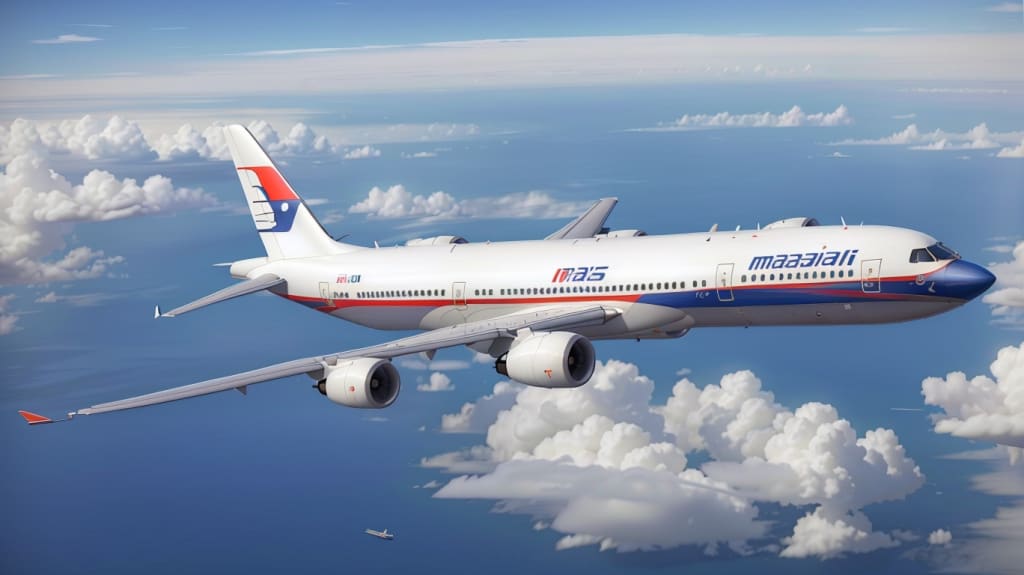
On March 8, 2014, Malaysia Airlines Flight 370 departed from Kuala Lumpur to Beijing with 227 passengers and 12 crew members. What followed were confusing events, deception, and the plane eventually vanished. Investigators faced difficulties with limited information and signals in solving the mystery. Despite three years of searching in the Indian Ocean, the plane remained missing. However, new evidence and theories have recently emerged, providing some hope in understanding the fate of Flight 370 and the people onboard.
At 12:41 a.m., flight attendants checked seatbelts before takeoff. Captain Zaharie Ahmad Shah and First Officer Fariq Abdul Hamid completed pre-flight checks and received clearance from the flight tower. Captain Zaharie accelerated the plane, which quickly gained speed on the runway. Passengers were mostly asleep due to the early hour. The baby made soft cooing sounds. Some passengers glanced at the airport lights outside. The aircraft smoothly lifted off and ascended into the sky. As dawn approached, no one on board had any idea of the disappearance that awaited them.
At 1:01 a.m., Flight 370 reached its cruising altitude of 35,000 feet. The fasten seatbelt sign was turned off, and the flight crew prepared for in-flight services. It was expected to be a quiet overnight flight. Passengers did various activities like stretching, using the bathroom, or working on their laptops. The plane felt peaceful with sleeping passengers and the hum of the engines.
Radar stations tracked Flight 370 and reported everything was normal. The aircraft was about to enter Vietnamese airspace after leaving Malaysian airspace. No unusual events were indicated at that time.
The Malaysian flight tower received the last communication from Flight 370's ACARS system, which provided information about the aircraft's status. The ACARS system was intentionally turned off and the plane was diverted from its planned route. As a result, radar stations lost telemetry data. No immediate action was taken on the ground since there was no cause for concern.
At 1:19 a.m., Malaysian traffic controllers received a message from the cockpit of Malaysia Airlines Flight 370. The voice on the transmission was believed to be First Officer Fariq Abdul Hamid. Fariq did not sound agitated and gave no indication that anything was wrong, despite the ACARS system being offline. This did not conclusively prove Fariq's involvement in tampering with the system or his awareness of the unfolding anomalies. However, it was the start of a series of puzzling events that would soon occur.
At 1:21 a.m., Flight 370 entered Vietnamese airspace. Something happened in the cockpit that disrupted communication systems. The plane's transponder was turned off, causing it to disappear from radar screens. Controllers noticed an unidentified blip, which raised concerns. A soldier in Thailand also detected the aircraft, causing heightened concern. Radar screens in Thailand, Vietnam, and Malaysia did not realize it was Flight 370. The aircraft behaved strangely, changing direction unexpectedly. It even made a U-turn according to a Thai radar station. However, there was no immediate need for action or to think it was Malaysia Airlines Flight 370. This uncertainty caused a delay in the search.
At 1:30 a.m., the unknown aircraft suddenly disappeared from radar screens in Subang, near Kuala Lumpur. It vanished over the Gulf of Thailand, leaving behind its last known coordinates, which were 06°55'15" N and 103°34'43" E. The exact cause of this disappearance was uncertain, but it seemed that the SATCOM system had been tampered with, creating more questions than answers.
At 1:37 a.m., the unknown aircraft was detected by both Malaysian military and civilian flight radar systems. It changed its course, going southwest over the Malay Peninsula and then sharply northwest over the Strait of Malacca. The aircraft's ACARS reading had not been transmitted, causing concern among the air traffic controllers who realized the flight was overdue. They suspected that this aircraft might be Flight 370 and tried to establish contact with it to confirm their suspicions. Investigators later revealed that disabling the ACARS system would have been crucial for hijacking or terrorism. Turning off the ACARS data transmission would hide any issues with the aircraft's systems from ground detection. However, disabling the transponder would have been more noticeable. ACARS data would have provided detailed information about the plane's condition during this critical period.
At 2:15 a.m., civilian Malaysian radar stations stopped tracking Malaysia Airlines Flight 370, but military radar stations still had it on their screens. The plane went off course and flew over Pulau Perak in the Strait of Malacca. As it continued westward into the Indian Ocean, fewer radar stations could track it, leaving only a few with the blip still visible.
At 2:22 a.m., the Malaysian military radar lost contact with Malaysia Airlines Flight 370 over the Andaman Sea. This marked its final appearance on radar screens. Malaysia Airlines took 18 minutes to officially acknowledge the aircraft's disappearance. During this time, it was unclear how the airline responded to the failure of Flight 370's ACARS system and the loss of telemetry data. It is possible that controllers and their superiors handled the situation discreetly while gathering more information.
On March 8, 2014, at 2:40 a.m., Malaysia Airlines is notified that Flight 370 has disappeared. The airline immediately starts searching for the missing plane, seeking assistance from various agencies and the Malaysian military. Radar data is shared with U.S. and British officials, prompting an international search effort in the Andaman Sea. Ships and aircraft are deployed to the last known location. As the search continues, agencies gather confusing and unsettling information, remaining uncertain about what happened to the aircraft. After one hour, it becomes clear that conventional methods are not sufficient. Malaysia Airlines declares an emergency at 3:45 a.m. and initiates search missions. They explain the delay by stating that they were still trying to locate the plane. The reasons for the delay are unclear, but an emergency is eventually declared. Search and rescue missions are launched, with organizations analyzing data to determine the probable flight path. Meanwhile, salvage teams prepare for the worst-case scenario.
Malaysia Airlines Flight 370 was supposed to arrive in Beijing at 6:30 a.m. The plane had not reached the gate causing frustration and concern among passengers. The arrival sign still showed Flight 370, but the aircraft was nowhere to be seen. The weary travelers waited anxiously for an update from Malaysia Airlines. Unfortunately, the airline hadn't provided any information, leaving passengers unaware. Only those involved in the search knew the situation. By 7:24 a.m., Flight 370 was still missing. No one knew what had happened. Families worried and contacted the airline, but no response. Finally, a public announcement was made on Malaysia Airlines' Facebook page, causing panic and confusion. The international community became aware of the search for Flight 370, eagerly waiting for more information about its mysterious disappearance.
At 8:11 a.m., a satellite tried to connect with Flight 370. The communication systems on the aircraft were offline, but the attempt was recorded. The data was sent to a database for analysis. The handshake was unsuccessful, but the data provided important information. It confirmed that Flight 370 was still flying. The satellite's position narrowed down the possible locations to two areas. Further analysis was needed to determine the final destination. The raw satellite data confirmed the aircraft's identity. This was later validated by multiple aviation authorities. Initially, the search focused on the South China Sea. More information emerged, including the turning off of the transponder and confirmation that the tracked aircraft was Flight 370. This shifted search efforts to the Strait of Malacca and the Andaman Sea. The discovery of satellite data from the attempted handshake prompted further shifts in the search areas.
The satellite data was analyzed seven days after Flight 370 disappeared. The relevant organizations were quickly notified and the search for the aircraft shifted to new potential locations. The exact location of the aircraft during the satellite handshake was uncertain, but analysts believed it could have followed two possible trajectories. Search missions were launched into the Indian Ocean, tracing the southern route. Another group searched Southeast Asia, western China, and Central Asia, following the northern arc. Finding a downed aircraft on land was challenging but less daunting than on the ocean floor. However, despite days of searching, no trace of the aircraft was found along the northern arc.
On March 24, 2014, a significant breakthrough occurred in the investigation of Malaysia Airlines Flight 370. The satellite data analysis revealed that the most probable path the flight had taken was the southern arc. It was determined that the aircraft had crashed in a remote area of the Indian Ocean. Malaysian Prime Minister Najib Razak publicly announced this devastating finding, expressing the likelihood of no survivors. This news shattered the hopes of families and friends, leaving them with a profound sense of grief. However, the search for answers and the truth behind the disappearance of Flight 370 continued.
On April 6, 2014, 30 days after Flight 370 went missing, an Australian ship continued searching the Indian Ocean. They had been looking for any signs of the airplane for weeks. Then, a moment of excitement occurred when the ship's equipment detected potential pings from the black box. These signals came from beneath the ocean's surface, about 1,200 miles northwest of Perth, Australia.
The search for the acoustic pings continued without pause. Pinpointing their source proved challenging. However, the signals provided valuable data, narrowing down the search. Inmarsat's updated information indicated contact with Flight 370, aligning with the location of the pings. Regrettably, the black box's batteries were likely dying at this point, meaning the signal would soon vanish. Nonetheless, submarines were dispatched to scour the ocean floor for wreckage, even after losing the signal. The pings spanned a vast and treacherous area, hindering exact location detection. Submarines persisted, exploring the expansive depths. Regrettably, their endeavors yielded no outcomes, disappointing the search team. Later tests suggested a faulty wire in the acoustic equipment on the vessel may have generated the pings.
A significant development occurred on July 29, 2015, marking 1 year and 5 months after Malaysia Airlines Flight 370 had disappeared. On the French island of Réunion, a man walking along the beach made an astonishing discovery. He found debris washed up on the shore, which appeared different from the usual debris. It looked like a piece of an airplane. The man immediately alerted others in the area, who took the debris to local authorities for examination. Experts confirmed that it was the right-wing flaperon of a Boeing 777. Further analysis confirmed that this debris was indeed from Flight 370. The debris was found about 2,300 miles or 3,700 kilometers away from the ongoing search area in the Indian Ocean.
In the following year, 26 more debris pieces were found on various beaches in Tanzania, Mozambique, South Africa, Madagascar, and Mauritius. Finders claimed these fragments belonged to Flight 370, but only 3 were positively identified and 17 were likely from the aircraft. Two pieces seemed to come from the cabin interior, implying the plane broke apart before or upon impact with the ocean. Experts found that the flap from Réunion did not indicate a controlled descent into the ocean. Instead, it suggested that Flight 370 crashed into the deep waters and sank to the ocean floor. This information from the confirmed debris helped narrow the search area, revealing that some parts of the Indian Ocean lacked the necessary currents to carry wreckage to the African coast.
The search for Flight 370 was suspended in January 2017. Despite three years of searching, no evidence of the aircraft's location was found. The Indian Ocean's vastness and depths posed challenges to the search.
In July 2018, the Malaysian government released its final report on the incident. The report ruled out mechanical failure. The flight path indicated manual inputs by a pilot, but no motive or specific wreckage location was determined.
Many theories emerged during the investigation of Flight 370. Online conspiracy theories, books, and differing expert interpretations of the data all contributed. The official reports couldn't definitively establish what happened to the plane, leaving its disappearance a mystery. Closure for the victims' families and friends depends on finding the aircraft's remains, but the vast ocean size and limited resources make it a challenging task. Nonetheless, dedicated researchers continue their work to solve the Flight 370 mystery. Without concrete evidence, the truth about that flight may forever remain unknown.
About the Creator
Mestre Best: The Warrior Who Taught Restraint
In the mountain city of Valenor, there was a name spoken softly, almost with reverence—Mestre Best. No statues were built in his honor, no songs officially recorded his deeds, yet every fighter, scholar, and traveler knew the legend. Some said he was the greatest master of combat the world had ever seen. Others claimed he was a philosopher disguised as a warrior. The truth was more complex than either tale.
By The best writer 6 days ago in History




Comments
There are no comments for this story
Be the first to respond and start the conversation.