
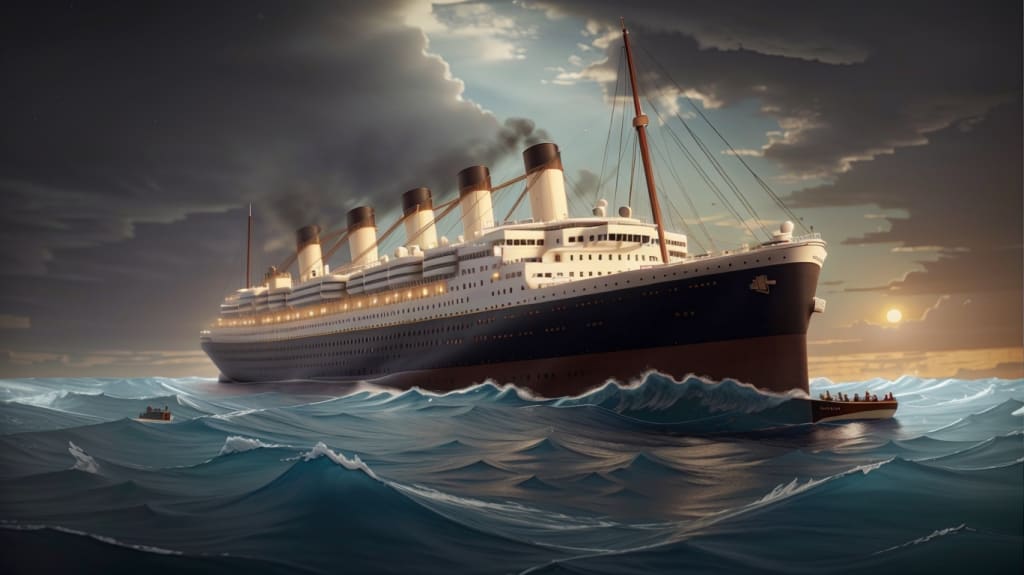
The RMS Titanic sank on April 15th, 1912, after hitting an iceberg. Over 1,500 lives were lost, which was more than two-thirds of the people on board. Recent scientific discoveries challenge the traditional narrative and reveal a hidden truth about the disaster.
The Titanic was an engineering marvel of its time. It was massive, stretching 882 feet and 9 inches in length, 92 feet in width, and towering 175 feet in height. It had a huge capacity of 46,000 328 tons. The ship's layout was so intricate that even the officers needed over two weeks to memorize it.
The Titanic had four large smokestacks. Each smokestack weighed 60 tons and stood 81.5 feet above the deck. These tall structures served an important purpose. They prevented passengers from getting covered in the 100 tons of soot that the ship produced daily. The smokestacks were intentionally inclined at a 30-degree angle to make them look even more impressive.
The Titanic was constructed with a budget of 7.5 million dollars, equivalent to around 166 million dollars today. Surprisingly, this cost was lower than the production cost of the movie "Titanic" in 1997, which exceeded 200 million dollars.
The shipyard, Harland and Wolff, had a workforce of 3,000 laborers. They worked six days a week, starting at 6:00 a.m. It took 26 months to complete the task, which was dangerous as workers were at heights equivalent to a 20-story building without ropes. These laborers were motivated by providing for their families and dedicated immense effort and money to creating the ship. Unfortunately, eight lives were lost and 246 people were injured during construction. It is hard to believe that such a carefully built ship could be destroyed by a single iceberg. However, recent findings suggest that fire may have played a role.
Sonam Maloney, a journalist, spent over 30 years researching the fate of the Titanic. He made a groundbreaking discovery: a huge black spot on the ship's hull, measuring 30 feet long. This finding came after analyzing a photograph taken before the Titanic set sail. Maloney obtained an album of previously unseen photos that provided insight into the ship's construction and preparations. The most astonishing revelation was that there had been a fire inside the ship, which remained hidden until now. This fire must have burned at extremely high temperatures for almost three weeks before anyone realized it.
According to metallurgy experts, the ship's metal structure could have significantly weakened under these conditions. This weakening could have reduced its strength by up to 75 percent. As a result, the Titanic's structural integrity was compromised, making it more vulnerable to damage when it collided with the iceberg.
The iceberg hit the compromised area of the ship's hull, which was a critical factor in the tragic events. Surprisingly, the project's management knew about the fire on board and the risks of starting the journey, but admitting it would have caused bankruptcy for the ship's owners. The country was experiencing a miners' strike, resulting in a shortage of coal to fuel the Titanic. Despite other ships canceling their trips, the Titanic had already sold all its tickets, so canceling was not an option. To keep the truth hidden, the ship was positioned in a way that concealed the fire marks from the passengers' view.
The Titanic's interior was opulent. It was inspired by the Ritz Hotel in London. The grand staircase spanned seven decks and was adorned with paintings, bronze cherubs, and oak paneling. First-class amenities were lavish, including a heated swimming pool, a Turkish bath, a gym, a squash court, and a beauty salon. Stylists were provided to assist ladies with dinner preparations. The Atlantic Daily Bulletin kept passengers informed. A designated area was set aside for first-class passengers' dogs, where they received attentive care, regular walks, and training during the voyage.
The first-class dining experience on the Titanic was extravagant, featuring 13 courses and carefully selected wine pairings. These lavish meals lasted about five hours and were complemented by an impressive stock of 1.5 thousand bottles of wine, 20,000 bottles of beer, and 8,000 cigars. However, a crucial item was missing - binoculars. These could have potentially helped spot the iceberg earlier and prevent the disaster. Unfortunately, the binoculars were locked away with second officer David Blair, who was replaced last minute and forgot to hand over the key. This oversight was discovered three days later, when the ship was already at sea.
The Titanic was moving too fast, going beyond its safe limit. This was because they were worried about the ship's reputation and schedule. The high speed made it hard to see obstacles ahead, which made the risk of a collision even higher.
The ship did not have enough lifeboats to accommodate all its passengers. It needed around sixty, but only had 48 initially. The number was later reduced to 20 for cosmetic reasons. This was legally compliant with the regulations of the time.
Lifeboat drills, which are standard on ocean liners, were not done on the Titanic. Captain Edward John Smith even canceled a scheduled drill on the morning of the disaster. The crew took over half an hour to launch the lifeboats, instead of the usual 10 minutes. The first set of lifeboats left with empty seats because passengers were hesitant to leave the supposedly safe ship.
Captain Smith's navigation skills were questionable, which added to the tragedy. According to records, he initially failed his navigation exam but eventually passed it. This may have played a role in the unfolding events.
The Titanic sank, and distress signals were sent. However, the nearby ship Californian did not respond to the emergency flare in the sky. The captain faced consequences for this decision but was later cleared by modern research. It was found that light refraction caused by thermal inversion could have made the signals difficult to see.
The Titanic disaster was caused by a series of unfortunate events. These events included a fire weakening the ship, inadequate safety measures, excessive speed, and various oversights in its design and operation. Scientists are still captivated by this tragedy and continue to study it. It claimed hundreds of lives and serves as a reminder of human imperfections. The true cause may never be fully known.
About the Creator
De-Globalization or Re-Globalization? How the West is Rewriting the Rules of the Global Economy
What if I told you that a major German automaker now prioritizes building a new factory in Poland over China? Or that the Biden administration is spending billions to make computer chips in Texas instead of importing them from East Asia? This isn't a hypothetical future—it's today's economic reality.
By Hossam Gamal2 days ago in History
King Arthur – The Once and Future King
In the mist-covered hills of ancient Britain, when the land was divided by warring kings and haunted by uncertainty, a prophecy was whispered across the kingdoms: a child would be born who would unite the realm and bring peace. That child was Arthur. Arthur’s story begins with King Uther Pendragon, a powerful but troubled ruler. Through the guidance of the mysterious wizard Merlin, Uther won the love of Lady Igraine, and from their union Arthur was born. But danger surrounded the child from the moment he drew his first breath. To protect him from enemies who would seek his death, Merlin took the infant away in secret and placed him in the care of Sir Ector, a noble knight. Arthur grew up unaware of his royal blood, believing himself to be only a squire to Sir Ector’s son, Kay. Years passed, and Britain fell into chaos after King Uther’s death. Without a clear heir, rival lords fought bitterly for control. Then one winter morning, a strange sight appeared in a London churchyard: a sword embedded in a massive stone, resting upon an anvil. Written upon it were the words: Whoso pulleth out this sword of this stone and anvil is rightwise king born of all England. Many knights tried to pull the sword free. They strained, sweated, and cursed—but none could move it. The sword remained firm, as if the stone itself refused their claim. One day, young Arthur accompanied his brother Kay to a tournament. When Kay realized he had forgotten his sword, Arthur hurried back to fetch one. Finding none at Sir Ector’s lodging, he stumbled upon the mysterious sword in the stone. Without knowing its significance, he grasped the hilt and pulled. To his surprise, it slid out effortlessly. When the truth was revealed, the great lords demanded he repeat the act. Again and again, Arthur drew the sword while others failed. At last, they bowed to him. A boy who had believed himself ordinary was crowned king. Arthur’s early reign was not easy. Many kings refused to accept him. Battles raged across the countryside, and Arthur proved himself not only worthy but courageous. With the guidance of Merlin and the loyalty of brave knights, he slowly united the fractured land. Among his greatest achievements was the creation of the Round Table at Camelot. Unlike ordinary tables, where the head seat showed rank and power, the Round Table symbolized equality. Knights sat side by side, bound by a code of honor, courage, and justice. They pledged to protect the weak, speak truth, and uphold righteousness. The knights of the Round Table became legendary. Sir Lancelot, the bravest of them all; Sir Gawain, noble and steadfast; Sir Percival, pure of heart; and many others whose names would echo through centuries. Together they undertook quests that tested their strength and virtue. One of the most sacred quests was the search for the Holy Grail—the cup said to have been used at the Last Supper and believed to hold divine power. Only the purest knight could find it. Many tried; few succeeded. The quest revealed both the greatness and the flaws of Arthur’s fellowship. Arthur himself was not without human weakness. Though he was a noble king, his life was shadowed by tragedy. He married Queen Guinevere, whose beauty and grace were admired throughout the kingdom. Yet her heart grew close to Sir Lancelot. Their forbidden love would one day shatter Camelot’s unity. Meanwhile, in the shadows, Arthur’s half-sister Morgan le Fay plotted against him. Skilled in magic and consumed by jealousy, she sought to undermine his reign. Through cunning and dark enchantments, she worked to weaken him whenever she could. As years passed, Camelot shone as a beacon of hope. Under Arthur’s rule, justice flourished. The poor were protected, and law replaced chaos. Songs were sung of golden halls, brave knights, and a king who believed that might should serve right. But no kingdom, however glorious, is free from fate. The betrayal of Lancelot and Guinevere tore the Round Table apart. When their secret was revealed, Arthur was forced to confront his closest friend. Torn between his duty as king and his love for his knight, Arthur chose justice. Lancelot fled, and civil war erupted among the knights. Brotherhood turned into bitterness. Amid this turmoil, Mordred rose. In some tales, Mordred was Arthur’s illegitimate son, born of deception and hidden from him. In others, he was merely a traitorous nephew. But in every version, he became the instrument of Arthur’s downfall. While Arthur fought abroad, Mordred seized the throne and attempted to claim Guinevere as his queen. Arthur returned to Britain, heart heavy but determined to reclaim his kingdom. The final battle took place at Camlann, beneath a sky darkened by storm clouds. The clash was fierce and devastating. Knights who had once feasted together now fought to the death. One by one, they fell until only Arthur and Mordred remained. In a final, desperate charge, Arthur struck Mordred with his spear. But even as Mordred fell, he dealt Arthur a mortal wound. Bleeding and weakened, Arthur knew his time was ending. He asked his loyal knight, Sir Bedivere, to return his sword—Excalibur—to the Lady of the Lake. Reluctantly, Bedivere cast the sword into the water. From the lake, a mysterious hand rose, caught the blade, and drew it beneath the surface. Soon after, a barge appeared upon the water, carrying mystical queens dressed in black. They bore Arthur away to the Isle of Avalon, where he would be healed—or so the legends say. Though Arthur was gone, the hope he represented endured. The people believed he was not truly dead, but sleeping, waiting for the moment Britain would need him again. Thus he became known as the “Once and Future King.” King Arthur’s story is not merely one of swords and battles. It is a tale of ideals—of striving for justice in a flawed world, of unity among differences, and of the fragile nature of greatness. Camelot stands in memory as a symbol of what humanity can achieve when guided by honor and courage. Even today, centuries later, the legend lives on. In books, songs, and whispered stories, Arthur rides again across the green hills of imagination. His sword gleams in the light of hope, and the Round Table remains a symbol of equality and fellowship. For legends never truly die. They wait—like a king in Avalon—until the world remembers them once more.
By The best writer about 21 hours ago in History




Comments (3)
omg .... only goes to prove that we don't know everything and probably never will. GREAT writing and awesome piece of history.
very good to know from this writing
Very interesting! The titanic was interesting